Myanmar charges Reuters reporters with illegally obtaining state secrets
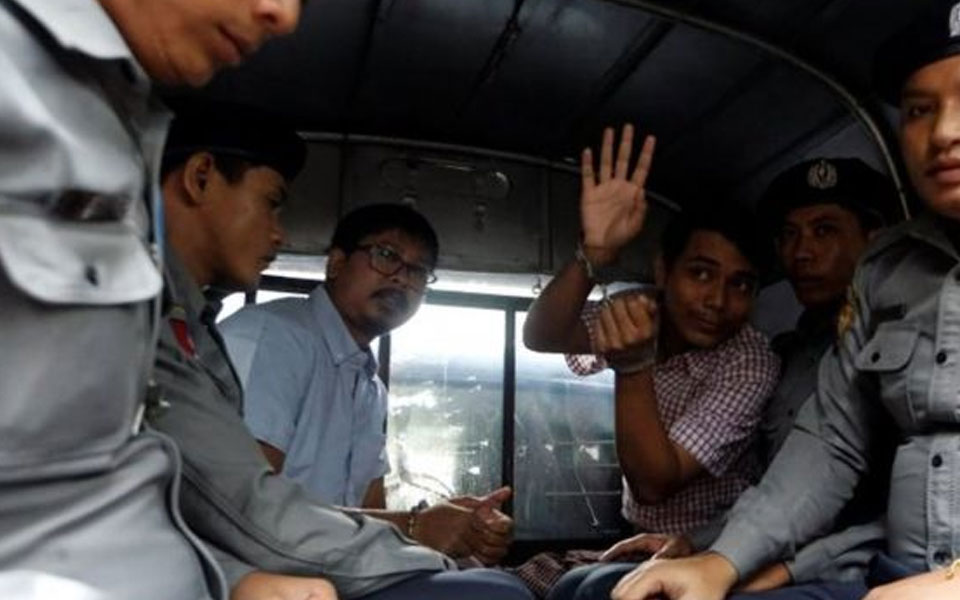
Yangon, July 9 : A Myanmar court on Monday charged two Reuters reporters with breaching a colonial-era law and illegally obtaining state secrets, according to the news agency.
The court approved the plea of the prosecutors to press charges against journalists Wa Lone, 32, and Kyaw Soe Oo, 28, who pleaded not guilty, reports Efe news.
Speaking outside the court in Yangon to members of the media, Wa Lone said: "We just (do) investigative reporting about violation of human rights and corruption in Rakhine state, according to our journalism ethic. We will continue this and face the court. We write from the all different angles. If the police perpetrated injustice, we have to investigated and write."
Dozens of people were outside the court including foreign embassy representatives and the wives of the two journalists.
The court had dismissed the reporters' pleas and the pair could be sentenced to up to 14 years in jail under the Official Secrets Act.
The decision comes after a witness testified during a preliminary hearing that the two journalists were trapped by security forces, who promised the journalists access to confidential documents about a controversial army offensive in the Rakhine state.
The two reporters were working on an investigative article on the killing of 10 Rohingya Muslim men and boys in a village in Rakhine.
The killings were part of a military operation Myanmar launched last year against the Rohingya, a persecuted Muslim minority in Myanmar, following a series of attacks by Rohingya rebels on government posts in the region.
The offensive has led to the exodus of 700,000 Rohingya to neighbouring Bangladesh, where they have been living in overcrowded camps.
According to Doctors Without Borders, at least 6,700 Rohingyas were killed during the offensive.
Let the Truth be known. If you read VB and like VB, please be a VB Supporter and Help us deliver the Truth to one and all.
Fire at mass marriage event attended by Dy CM Shivakumar, nobody affected
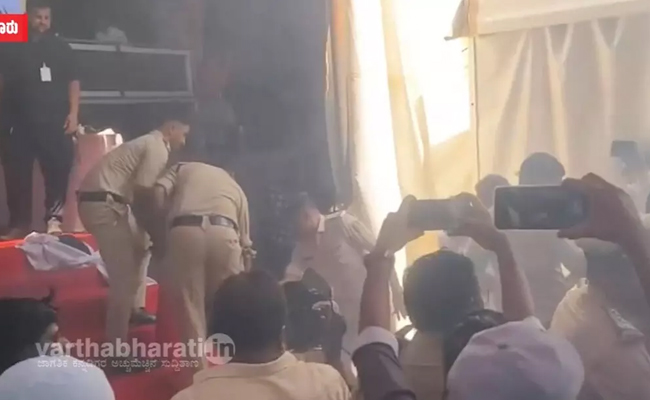
Raichur (Karnataka) (PTI): Fire broke out near the stage of the mass marriage event that was attended by Deputy Chief Minister D K Shivakumar here, police said on Sunday.
Nobody was affected, and the fire was immediately put out, they said.
The fire was noticed shortly after Shivakumar and other dignitaries left the stage, and Forest Minister Eshwaran Khandre was speaking to the media at the venue in Sindhanur, officials said.
According to officials, wires, speakers, and cloth materials near the stage caught fire, allegedly due to a short circuit.
Police personnel present at the spot quickly swung into action and extinguished the fire.
The programme was halted for some time and resumed later, they said.
Several ministers, legislators and political leaders from the region, and actor Sudeep had attended the event.