Myanmar military top brass must face justice: Rights body
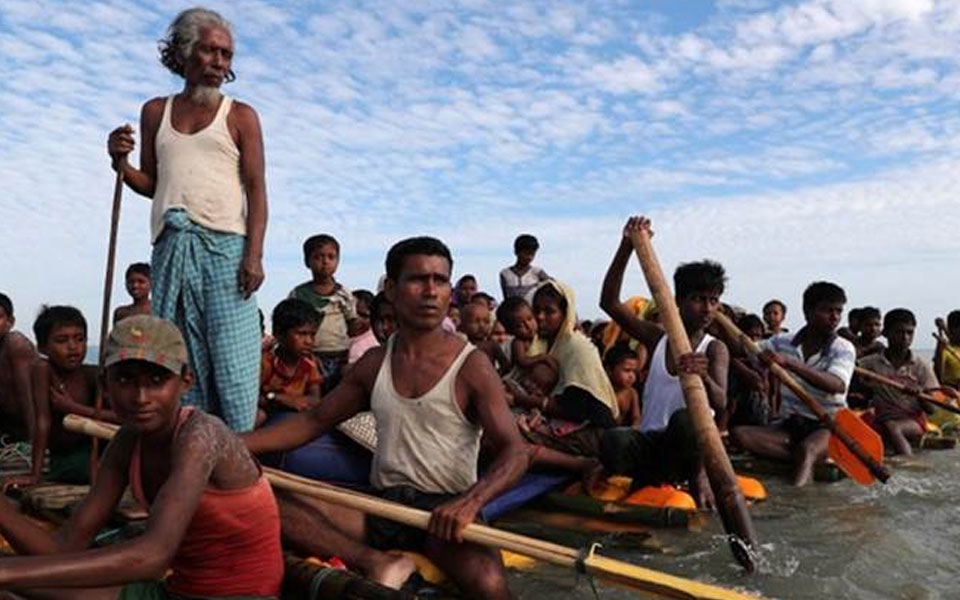
London, June 27 : A human rights body on Wednesday called for Myanmar military and security forces officials to face justice for their alleged crimes against humanity and ethnic cleansing of the Rohingya population.
The Amnesty International said there is "a mountain of evidence" demonstrating that the campaign was "orchestrated" by the military against the Rohingya population, Efe news reported.
Amnesty demanded that top Myanmar military officials be prosecuted by the International Criminal Court.
"Those with blood on their hands -- right up the chain of command to Senior General Min Aung Hlaing -- must be held to account for their role," Amnesty's Senior Crisis Advisor Matthew Wells said in a statement.
The military operations, supported by the Border Guard Police, began at the end of August 2017 after a group of Rohingya insurgents launched an attack on about 30 security posts.
The crackdown forced more than 700,000 people of the Muslim-majority ethnic group that had resided in western Myanmar for centuries to flee to Bangladesh.
In the report "Myanmar:'We Will Destroy Everything': Military Responsibility for Crimes Against Humanity in Rakhine State" published on Wednesday, Amnesty provided new details arrests, enforced disappearances, torture and "systematic attack" on the Rohingya population.
It named individuals for their roles in the "ethnic cleansing campaign".
International organisations and the UN have also denounced other crimes committed by the Myanmar armed forces, such as murder, rape, targeted large-scale burning of villages, among others.
Amnesty urged the international community to "finally put an end to the years of impunity" for the Myanmar military and called on the UN to "impose a comprehensive arms embargo".
Earlier this week the European Union imposed a series of sanctions -- asset freezes and travel bans -- against seven Myanmar security officials.
However, the head of the Myanmar Armed Forces was not on the list.
Considering the Rohingya illegal immigrants from Bangladesh, Myanmar does not recognise their citizenship and subjects them to discrimination, including restrictions on freedom of movement.
Let the Truth be known. If you read VB and like VB, please be a VB Supporter and Help us deliver the Truth to one and all.
Two injuries, one DNF, a DQ as India end messy World Relays campaign
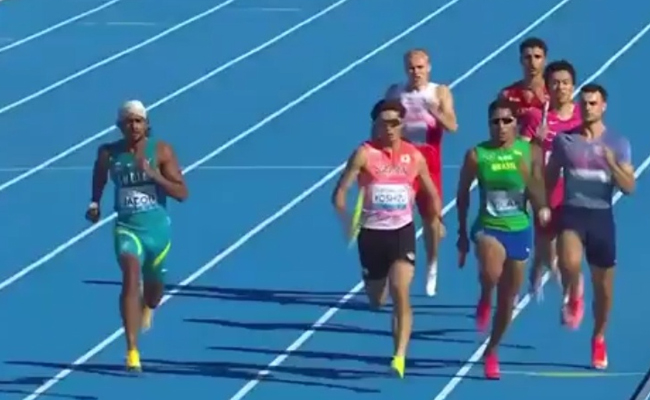
Gaborone (Botswana) (PTI): Amoj Jacob and Ragul Kumar got injured during the men's 4x400m and 4x100 races respectively as India ended their World Athletics Relays campaign in disappointment on the second day of competitions here on Sunday.
The Indian camp had high hopes of making the 2027 World Championships in the men's 4x400m relay but the team did not finish (DNF) the race as Jacob suffered cramps and pulled out of the race after taking the baton from the first leg runner Dharamveer Choudhary. Rajesh Ramesh and Vishal TK were to run in the third and fourth legs.
Those teams which could not qualify for the 2027 Beijing World Championships by reaching the final round of each of the six relay events on Saturday were given another chance in the second qualification round on Sunday.
The top two teams in each of the two heats (in all six relay events) booked the Beijing ticket on Sunday.
India will now have to try and qualify for the World Championships through the Top Lists of the World Athletics, which is a long and tedious process.
In the men's 4x100m race, third leg runner Ragul Kumar fell down the track after failing to hand over the baton inside the exchange zone to fourth leg runner Gurindervir Singh, which clearly showed the lack of coordination among the runners.
Harsh Santosh Raut and Animesh Kujur ran the first two legs.
The Indian quartet was disqualified and Kumar was seen being taken away from the Field of Play with the help of the volunteers.
It was a comedy of errors in the case of the women's 4x100m race, which saw the baton being dropped during an exchange between first leg runner Tamanna and second runner Nithya Gandhe, though the Indians finished the race in 53.09 seconds.
Gandhe started running quite a distance, but after realising that the baton was not in her hand, she turned and ran back to pick it up.
The only silver-lining for the Indian contingent was the national record time in the mixed 4x100m relay race, though the quartet of Ragul Kumar, Nithya Gandhe, Animesh Kujur and Sneha SS finished sixth in heat number two with a time of 41.35 seconds, bettering the previous national mark of 42.30 seconds set in March in Chandigarh.
The mixed 4x400m relay quartet of Theerthesh P Shetty, Kumari Saloni, Nihal William and Rashdeep Kaur ended at fifth in heat number one with a time of 3 minutes and 19.40 seconds.
On Saturday, all the five Indian relay teams had failed to make it to the respective final rounds and thus missed out on the 2027 World Championships berths.