Myanmar's earthquake death toll jumps to 1,644 as more bodies recovered from rubble
Bangkok (AP): Myanmar's ruling military said Saturday on state television that the confirmed death toll from a devastating 7.7 magnitude earthquake rose to 1,644, as more bodies were pulled from the rubble of the scores of buildings that collapsed when it struck near the country's second-largest city.
The new total is a sharp rise compared to the 1,002 total announced just hours earlier, underlining the difficulty of confirming casualties over a widespread region and the likelihood that the numbers will continue to grow from Friday's quake.
The number of injured increased to 3,408, while the missing figure rose to 139.
Rescue efforts are underway especially in the major stricken cities of Mandalay, the country's No. 2 city, and Naypyitaw, the capital. But even though teams and equipment have been flown in from other nations, they are hindered by the airports in those cities being damaged and apparently unfit to land planes.
Myanmar, also known as Burma, is in the throes of a prolonged civil war, which is already responsible for a humanitarian crisis. It makes movement around the country both difficult and dangerous, complicating relief efforts and raising fears that the death toll could still rise precipitously.
The earthquake struck midday Friday with an epicentre not far from Mandalay, followed by several aftershocks, including one measuring 6.4. It sent buildings in many areas toppling to the ground, buckled roads, caused bridges to collapse and burst a dam.
In Naypyidaw, crews worked Saturday to repair damaged roads, while electricity, phone and internet services remained down for most of the city. The earthquake brought down many buildings, including multiple units that housed government civil servants, but that section of the city was blocked off by authorities on Saturday.
More damage in Thailand
In neighbouring Thailand, the quake rocked the greater Bangkok area, home to around 17 million people, and other parts of the country.
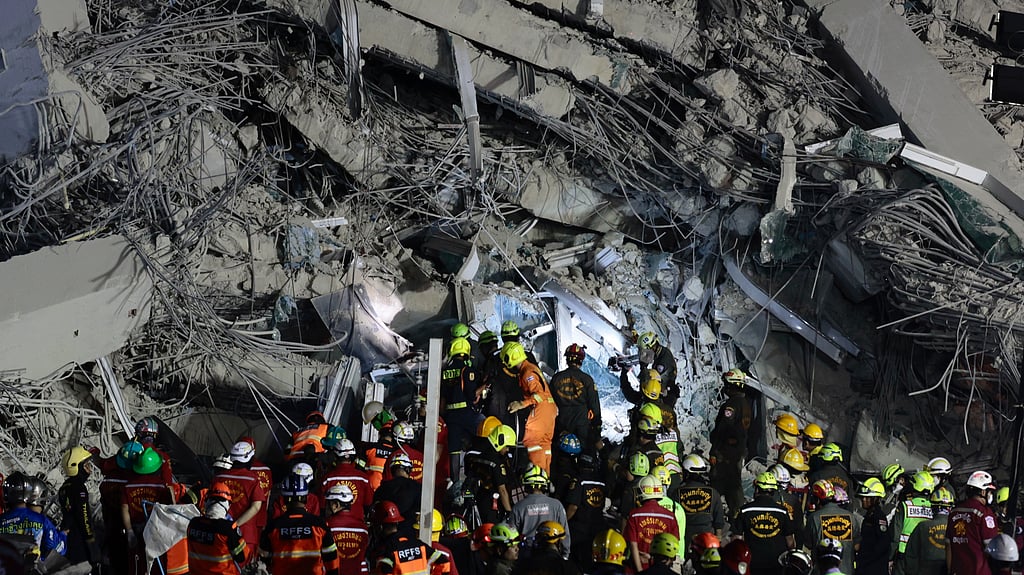
Bangkok city authorities said the number of confirmed dead was now 10, nine at the site of the collapsed high-rise under construction near the capital's popular Chatuchak market, while 78 people were still unaccounted for. Rescue efforts were continuing in the hope of finding additional survivors.
On Saturday, more heavy equipment was brought in to move the tons of rubble, but hope was fading among friends and family members of the missing that they would be found alive.
“I was praying that that they had survived but when I got here and saw the ruin — where could they be? In which corner? Are they still alive? I am still praying that all six are alive,” said 45-year-old Naruemol Thonglek, sobbing as she awaited news about her partner, who is from Myanmar, and five friends who worked at the site.
Waenphet Panta said she hadn't heard from her daughter Kanlayanee since a phone call about an hour before the quake. A friend told her Kanlayanee had been working high on the building on Friday.
“I am praying my daughter is safe, that she has survived and that she's at the hospital,” she said, Kanlayanee's father sitting beside her.
Thai authorities said that the quake and aftershocks were felt in most of the country's provinces. Many places in the north reported damage to residential buildings, hospitals and temples, including in Chiang Mai, but the only casualties were reported in Bangkok
Myanmar sits on a major fault line
Earthquakes are rare in Bangkok, but relatively common in Myanmar. The country sits on the Sagaing Fault, a major north-south fault that separates the India plate and the Sunda plate.
Brian Baptie, a seismologist with the British Geological Survey, said that the quake caused intense ground shaking in an area where most of the population lives in buildings constructed of timber and unreinforced brick masonry.
“When you have a large earthquake in an area where there are over a million people, many of them living in vulnerable buildings, the consequences can often be disastrous," he said in a statement.
A natural disaster on top of a civil war
Myanmar's government said that blood was in high demand in the hardest-hit areas. In a country where prior governments sometimes have been slow to accept foreign aid, Min Aung Hlaing said that Myanmar was ready to accept outside assistance.
Myanmar's military seized power from the elected government of Aung San Suu Kyi in February 2021, and is now involved in a civil war with long-established militias and newly formed pro-democracy ones.
Military forces continued their attacks even after the quake, with three airstrikes in northern Kayin state, also called Karenni state, and southern Shan — both of which border Mandalay state, said Dave Eubank, a former US Army Special Forces soldier who founded the Free Burma Rangers, a humanitarian aid organization that has provided assistance to both combatants and civilians in Myanmar since the 1990s.
Eubank told The Associated Press that in the area he was operating in, most villages have already been destroyed by the military so the earthquake had little impact.
“People are in the jungle and I was out in the jungle when the earthquake hit — it was powerful, but the trees just moved, that was it for us, so we haven't had a direct impact other than that the Burma army keeps attacking, even after the quake,” he said.
In northern Shan, an airstrike on a rebel-controlled village just minutes after the earthquake killed seven militia members and damaged five buildings, including a school, Mai Rukow, editor of a Shan-based online media Shwe Phee Myay News Agency, told the AP.
Government forces have lost control of much of Myanmar, and many places are incredibly dangerous or simply impossible for aid groups to reach. More than 3 million people have been displaced by the fighting and nearly 20 million are in need, according to the United Nations.
“Although a full picture of the damage is still emerging, most of us have never seen such destruction," said Haider Yaqub, Myanmar country director for the NGO Plan International, from Yangon.
Control tower at Myanmar airport collapsed
Satellite photos from Planet Labs PBC analysed by the AP show the earthquake toppled the air traffic control tower at Naypyitaw International Airport as if sheered from its base.
Debris lay scattered from the top of the tower, which controlled all air traffic in the capital of Myanmar, the photos showed on Saturday.
It wasn't immediately clear if there had been any injuries in the collapse, though the tower would have had staff inside of it at the time of the earthquake Friday.
Rescue groups head to Myanmar
China and Russia are the largest suppliers of weapons to Myanmar's military, and were among the first to step in with humanitarian aid.
China said it has sent more than 135 rescue personnel and experts along with supplies like medical kits and generators, and pledged around USD 13.8 million in emergency aid. Hong Kong sent a 51-member team to Myanmar.
Russia's Emergencies Ministry said it had flown in 120 rescuers and supplies, and the country's Health Ministry said Moscow had sent a medical team to Myanmar.
Other countries like India and South Korea are sending help, and the UN allocated USD 5 million to start relief efforts.
US President Donald Trump said Friday that Washington was going to help with the response, but some experts were concerned about this effort given his administration's deep cuts in foreign assistance.
Let the Truth be known. If you read VB and like VB, please be a VB Supporter and Help us deliver the Truth to one and all.
Maharashtra sets up state vaccination task force to strengthen immunisation programme

Mumbai (PTI): The Maharashtra government has set up a State Vaccination Task Force to strengthen the regular immunisation programme and review the progress of related campaigns, a health department official said on Monday.
The State Vaccination Task Force will comprise at least 29 members and will be headed by the administrative head of the health department, he informed.
The government has also constituted separate district-level and municipal vaccination task forces to improve implementation and address challenges at the grassroots level, he said.
Municipal task forces, chaired by respective civic commissioners, have been constituted in view of the vast urban population in Maharashtra and the role of civic bodies in implementing different health programmes.
The district-level task forces will function under the chairmanship of collectors.
"Complete immunisation of children at the appropriate age is an extremely simple, cost-effective and highly effective measure to reduce child mortality and the prevalence of diseases among kids. Immunisation is a powerful tool for reducing illness in children," maintained the official.
To ensure full vaccination of all children, the state government implements various campaigns from time to time as per the central government guidelines, he pointed out.
"Active participation and cooperation of other relevant government departments are essential (in making these campaigns successful)," according to the official.
The state-level body will review the regular immunisation programme, associated campaigns and vaccine-preventable diseases in detail. It will also conduct focused assessments of high-risk districts and municipal corporations, including vacancies at district, municipal and sub-district levels, availability of cold chain equipment, resource gaps and training requirements, he noted.
The state task force will review allocation and utilisation of funds for immunisation and ensure timely action by officers concerned based on reports from district and municipal task forces and state-level monitoring mechanisms, the official said.
It will also ensure active coordination and participation of other government departments in immunisation drives, while district and municipal task forces will carry out similar functions at their respective levels, the official added.