NASA says cooperation with ISRO remains intact
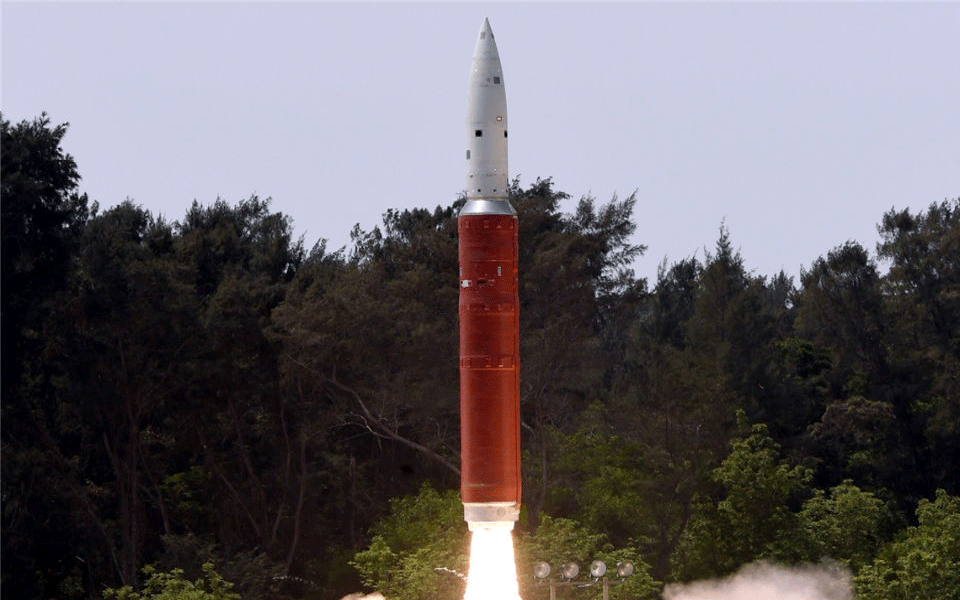
Washington: Apparently under prodding from the White House, NASA has said it will continue to cooperate with the ISRO, days after the US space agency's chief criticised India and termed its anti-satellite weapon test a "terrible thing" for creating about 400 pieces of orbital debris.
In a letter to ISRO Chairman K Sivan, NASA Administrator James Bridenstine said: "based on the guidance received from the White House", he looks forward to continuing to work with ISRO on a host of issues including human space flights.
"As part of our partnership with you, we will continue to work on issues using the NASA-ISRO Human Space Flight Working Group, Planetary Science Working Group, US India Earth Science Working Group and the Heliophysics Working Group," Bridenstine said.
In his letter, Bridenstine says he recently wrote to ISRO about the suspension of cooperation on human space flight.
"Recently, we sent you a letter indicating a suspension of activities under the NASA-ISRO Human Space Flight Working Group," he wrote.
From the April 4 letter, it appears that after the White House weighing in, the cooperation remains intact.
The letter comes days after NASA chief Bridenstine in a town hall meeting criticised India's anti-satellite missile (ASAT) test because of the debris it generated in the space and its potential threat to the International Space Station.
"The anti-satellite weapons test by India last week has resulted in about 400 pieces of orbital debris," he said on April 1, adding "that is a terrible, terrible thing to create an event that sends debris and an apogee that goes above the International Space Station".
"As we made clear, space debris is a serious issue for the United States. As it is a growing threat, it is the responsibility of all nations who operate in space," Bridenstine said in his letter, a copy of which has been seen by PTI.
"We will continue to monitor the remaining debris from your test as it relates to the safety of our human spaceflight activities especially at the International Space Station," wrote the NASA Administration, according to the letter.
Prime Minister Narendra Modi announced on March 27 that India had achieved a "historic feat" by shooting down its own low-orbit satellite with a ground-to-space missile, making the country a "space power".
Only three other countries - the US, Russia and China - have anti-satellite missile (ASAT) capabilities.
Let the Truth be known. If you read VB and like VB, please be a VB Supporter and Help us deliver the Truth to one and all.
Mamata visits Bhabanipur EVM strong room, warns against counting irregularities

Kolkata (PTI): West Bengal Chief Minister and TMC supremo Mamata Banerjee early Friday warned against any attempt to tamper with the counting process, hours after she visited an EVM strong room in Bhabanipur, alleging possible malpractice.
Banerjee, who emerged around 12:07 am after spending nearly four hours at the counting centre for her Bhabanipur constituency housed in Sakhawat Memorial School in south Kolkata, said only one person would be allowed inside the designated counting area.
"Either the candidate or one agent can stay upstairs. I have also suggested installation of a CCTV camera for the media," she told reporters.
Stressing the need for transparency, she said, "It is essential to maintain transparency. People’s votes must be protected. I rushed here after receiving complaints. The central forces initially did not allow me to enter."
Sounding a stern note ahead of the May 4 counting, she added, "If there is any plan to tamper with the counting process, it will not be tolerated."
On Thursday evening, Banerjee had reached the Bhabanipur Assembly segment counting centre, which houses the strong room for EVMs used in the April 29 polling, citing suspicion of tampering with the machines.
She entered the premises along with her election agent and remained inside for hours, even as Kolkata Mayor and TMC candidate from the Kolkata Port segment Firhad Hakim reached the spot but could not meet her.
"I reached here upon learning that the chief minister has arrived. But I couldn’t meet her since she was already inside the premises, exercising her right as a candidate to visit strong rooms. I wasn’t allowed there. I will not be able to confirm what exactly is transpiring inside," Hakim said.
The development coincided with protests by TMC candidates Kunal Ghosh and Shashi Panja outside the Khudiram Anushilan Kendra in north Kolkata, where they staged a sit-in alleging irregularities and possible tampering of EVMs stored in strong rooms, leading to face-offs between TMC and BJP supporters.
Earlier in a video message, Banerjee had urged party leaders, workers and polling agents to maintain a 24-hour vigil on EVM strong rooms, alleging that the BJP could attempt to tamper with the machines before counting begins.
Her remarks come amid heightened political tension in the state following a fiercely contested Assembly election, with parties closely monitoring arrangements and raising concerns over transparency.