Nations gather in Nairobi to hammer out treaty on plastic pollution
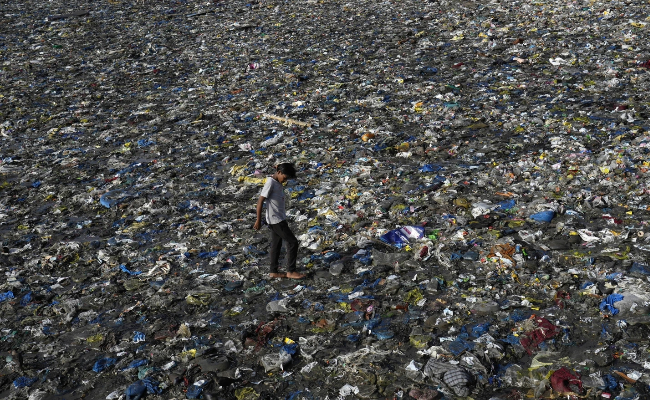
Nairobi (AP): Efforts to create a landmark treaty to end global plastic pollution advance Monday in Nairobi as most of the world's nations, plus petrochemical companies, environmentalists and others affected by the pollution gather to discuss draft language for the first time.
It's the third gathering in a compressed five-meeting schedule intended to complete negotiations by the end of next year.
Power dynamics and positions became clear in the first two rounds of talks in Paris and Punta del Este, Uruguay and echo some of the same positions as in international climate talks, and with good reason - many of the players are the same. Plastic is largely made from crude oil and natural gas, giving oil-producing countries and companies a large stake in any treaty.
Global negotiators last met in Paris in June and agreed to produce initial treaty text before reconvening in Nairobi. The draft was published in early September. The UN Intergovernmental Negotiating Committee on Plastic Pollution is charged with developing the first international, legally binding treaty on plastic pollution on land and at sea.
Nairobi is a significant location to host this third session, as the East African country is a global leader in fighting plastic pollution. In a groundbreaking move in 2017, Kenya banned the manufacture, sale and use of single-use plastic bags, which were hugely popular for carrying things but were also strewn across the landscape. In what is one of the strictest bans on the products, lawbreakers face fines and up to four years in jail.
Two years later, Kenya banned single-use plastic like cutlery, straws and PET bottles from parks, forests, beaches and other protected areas. Kenya is also an important player in environmental matters as home to United National Environment Programme headquarters. Kenya generates more than 70% of its electricity from renewable sources.
Church leaders throughout Africa issued an open letter this month through the charity Tearfund saying that Africa faces "mountains of plastic pollution, dumped or burnt," and called on their delegates to continue to speak out boldly "for a treaty which delivers change for our most vulnerable brothers and sisters".
THE PLAYERS
In Nairobi, Norway and Rwanda are leading a "high ambition coalition" of governments that want to end plastic pollution by 2040 by cutting production and limiting some chemicals used in making plastics.
They issued a ministerial joint statement this month calling for an ambitious and effective treaty to protect human health and the environment from plastic pollution by addressing the full life cycle of plastics. They expressed "deep concern" about significant increases in plastic production, plastic litter and greenhouse gas emissions. Plastic production is forecast to triple by 2060, according to UNEP.
Saudi Arabia, on the other hand, is leading a group of countries that have large petroleum industries and prefer to focus on recycling and waste management. This coalition wants nations to set their own action plans instead of across-the-board limits.
The United States' delegation is in-between, suggesting the treaty include some meaningful universal obligations as the high ambition coalition wants, while also recognising some national discretion, both because of the differences between countries and because some won't agree to it otherwise.
The draft represents the range of viewpoints shared at the first two meetings. Bj rn Beeler, international coordinator for the International Pollutants Elimination Network, compared it to a large menu people haven't ordered from yet. Nonetheless, he said, it is evident that negotiations have moved beyond plastic waste and into addressing plastic production and toxic chemicals used to make plastic.
Beeler, who is attending the negotiations, expects the draft to grow more before it shrinks and becomes final, as delegates add in ideas in Nairobi and countries develop their positions. IPEN wants a treaty that addresses the environmental and health issues posed by chemicals in plastics as the products are used, recycled, discarded or burned as waste.
Leaders of the global plastics industry are advocating for a process called chemical or advanced recycling and said they were very disappointed the draft doesn't have a strong focus on that. They view this as essential to solving the plastic waste crisis.
Environmental groups call it a marketing tactic to distract from real solutions like producing and using less plastic. Beyond Plastics and IPEN issued a report in October that says the process threatens the environment, the climate, human health and environmental justice.
Chemical recycling typically uses heat or chemical solvents to break down plastics into liquid and gas to produce an oil-like mixture or basic chemicals. Industry leaders say that mixture can be made back into plastic pellets to make new products.
Chris Jahn, a spokesperson for the International Council of Chemical Associations, said the draft was a missed opportunity to focus on circularity, rather than on caps and bans that don't address the issue of plastic becoming litter and pollution. He said they're working to get chemical recycling added.
"The focus is on ending plastic pollution, not plastic production," he said.
Karen McKee, president of ExxonMobil Product Solutions Company and also an ICCA leader, said they want to address the valid concern about plastic pollution, while also ensuring that society, including the developing world, benefits from plastic. Like Jahn, she said the treaty should focus on increasing circularity and redirecting plastic waste to recycling.
ExxonMobil does chemical recycling at its massive complex in Baytown, Texas, and plans to add the capability to many of its other manufacturing sites globally. Baytown includes plastic manufacturing, oil refining, and lubricant and chemical production.
Negotiators spent a significant amount of time at the last meeting in Paris debating the rules that would govern the discussions and voting, raising questions about whether the timeline could be met.
A US State Department official involved in the negotiations said many countries are working hard to stay on track, and the fact that negotiations on the text are now beginning is a good sign.
Let the Truth be known. If you read VB and like VB, please be a VB Supporter and Help us deliver the Truth to one and all.
EAM Jaishankar meets Jamaican PM, gifts over 10 BHISHM Cubes
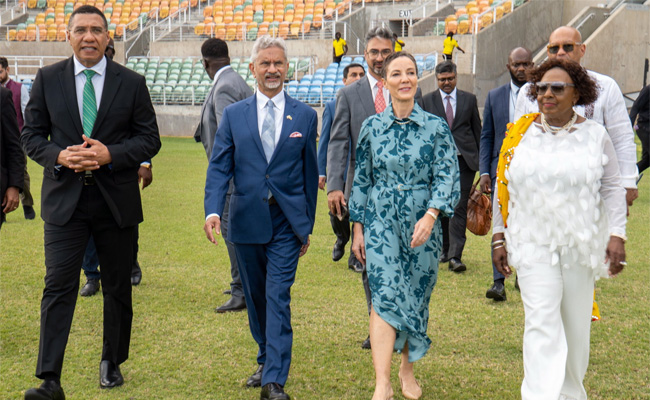
Kingston (PTI): External Affairs Minister S Jaishankar on Monday met Jamaican Prime Minister Andrew Holness and discussed ways to further deepen "political, economic and people-to-people cooperation."
Jaishankar also conveyed greetings from Prime Minister Narendra Modi to Holness.
"Pleased to call on Prime Minister @AndrewHolnessJM in Kingston. Conveyed the greetings of PM @narendramodi," Jaishankar posted on X.
"Discussed deepening our political, economic and people-to-people cooperation. Value his commitment towards further strengthening India-Jamaica relations," the post further read.
Also, the external affairs minister handed over 10 BHISHM (Bharat Health Initiative for Sahyog Hita & Maitri) Cubes as a gift to Jamaica.
"Formally handed over 10 BHISHM Cubes as a gift from India to Jamaica, in the presence of PM @AndrewHolnessJM, Health Minister @christufton and FM @kaminajsmith," Jaishankar posted on X.
"The BHISHM Cube mobile hospital system, designed for rapid deployment, will help Jamaica during disasters and emergencies. The gift of these cubes is a statement of friendship, a commitment to disaster preparedness, and an outcome of innovation," the post said.
Jaishankar arrived in Kingston on Saturday evening, marking the first leg of his nine-day tour of Jamaica, Suriname, and Trinidad and Tobago, aimed at further strengthening India's strategic and cultural ties with the Caribbean nations.
Earlier in the day, he interacted with the Indian diaspora and discussed India's ongoing transformation in infrastructure, human development and technology-driven governance and entrepreneurship with them.
He also highlighted the cricket bond between both countries as India gifted a scoreboard to Jamaica.
A scoreboard was dedicated at Sabina Park in Kingston. It is the home of the Jamaica cricket team and is the only Test cricket ground in the Caribbean island nation.
The minister expressed hope that the new scoreboard would witness many memorable innings, including those symbolising the enduring friendship between the two countries.
Cricket has long been a strong cultural bridge between India and Jamaica, which is part of the West Indies cricket team.
Jamaican players, including Chris Gayle, Courtney Walsh and Michael Holding, have played a major role in shaping the legacy of West Indies cricket in the international arena, contributing to its dominance in earlier decades and its continued global appeal.