NATO leaders declare China a global security challenge
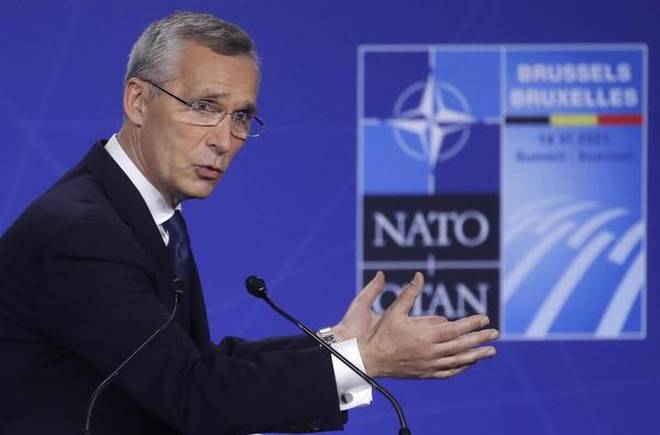
Brussels, Jun 14: NATO leaders on Monday declared China a constant security challenge and said the Chinese are working to undermine global order, a message in sync with President Joe Biden's efforts to get allies to speak out with a more unified voice against China's trade, military and human rights practices.
In a summit statement, the leaders said that China's goals and assertive behavior present systemic challenges to the rules-based international order and to areas relevant to alliance security. The warning to China comes as Biden has stepped up his effort to rally allies to speak in a more unified voice about China's human rights record, its trade practices and its military's increasingly assertive behaviour that has unnerved U.S. allies in the Pacific.
While the 30 heads of state and government avoided calling China a rival, they expressed concern about what they said were its coercive policies, the opaque ways it is modernizing its armed forces and its use of disinformation.
They called on Beijing to uphold its international commitments and to act responsibly in the international system.
Biden, who arrived at the summit after three days of consulting with Group of Seven allies in England, pushed for the G-7 communique there that called out what it said were forced labor practices and other human rights violations impacting Uyghur Muslims and other ethnic minorities in the western Xinjiang province. The president said he was satisfied with the communique, although differences remain among the allies about how forcefully to criticize Beijing.
Biden has also used his eight-day trip to Europe to urge allies to work more closely in pressing Russian President Vladimir Putin over his government's treatment of political dissidents and to do more to stem cyber attacks originating from Russia that have targeted private companies and governments around the globe.
The North Atlantic Treaty Organization is an alliance of European and North American countries formed after World War II as a bulwark against Russian aggression.
The new Brussels communique states plainly that the NATO nations will engage China with a view to defending the security interests of the alliance."
But as Biden faced with the G-7 communique, some allies bristled at the NATO effort to speak out on China.
German Chancellor Angela Merkel said NATO's decision to name China as a threat shouldn't be overstated because Beijing, like Russia, is also a partner in some areas. China is Germany's top trading partner and is heavily dependent on Russia in fulfilling the country's energy needs.
Merkel noted that when you look at the cyber threats, the hybrid threats, when you look at the cooperation between Russia and China, you can't just ignore China.
But she added that it was important to find the right balance as China is also a partner on many issues.
I think it's very important, just like we do in Russia, to always make the offer of political discussions, political discourse, in order to come up with solutions, Merkel said. But where there are threats, and I said they're in the hybrid field too, then as NATO you have to be prepared.
France's President Emmanuel Macron urged the alliance not to let China distract it from what he saw as more pressing issues facing NATO, including the fight against terrorism and security issues related to Russia.
I think it is very important not to scatter our efforts and not to have biases in our relation to China," Macron said.
The Chinese Embassy to the United Kingdom on Monday issued a statement saying the G-7 communique deliberately slandered China and arbitrarily interfered in China's internal affairs, and exposed the sinister intentions of a few countries, such as the United States. There was no immediate reaction from the Chinese government to the new NATO statement.
Biden arrived at his first NATO summit as president as leading members declared it a pivotal moment for an alliance beleaguered during the presidency of Donald Trump, who questioned the relevance of the multilateral organization.
Shortly after arriving at the alliance's headquarters for the first NATO summit of his presidency, Biden sat down with NATO Secretary General Jens Stoltenberg and underscored the U.S. commitment to Article 5 of the alliance charter, which spells out that an attack on one member is an attack on all and is to be met with a collective response.
Article 5 we take as a sacred obligation, Biden said. I want NATO to know America is there.
It was a sharp shift in tone from the past four years, when Trump called the alliance obsolete" and complained that it allowed for global freeloading countries to spend less on military defense at the expense of the U.S.
Biden was greeted by fellow leaders with warmth and even a bit of relief.
Belgium Prime Minister Alexander de Croo said Biden's presence emphasizes the renewal of the transatlantic partnership." De Croo said NATO allies were looking to get beyond four stormy years under the Trump administration and infighting among member countries.
I think now we are ready to turn the page," de Croo said.
Trump routinely berated other NATO countries for not spending enough on defense and even threatened to pull the U.S. out of the world's biggest security organization and even questioned the mutual defense provision of the NATO charter, a central tenet of the alliance.
The alliance also updated Article 5 to offer greater clarity on how the alliance should react to major cyber attacks a matter of growing concern amid hacks targeting the U.S. government and businesses around the globe by Russia-based hackers.
Beyond extending the potential use of the Article 5 mutual defense clause to space, the leaders also broadened the definition of what might constitute such an attack in cyberspace, in a warning to any adversary that might use constant low-level attacks as a tactic.
The organization declared in 2014 that a cyber attack could be met by a collective response by all 30 member countries, but on Monday they said that the impact of significant malicious cumulative cyber activities might, in certain circumstances, be considered as amounting to an armed attack.
The president started his day meeting with leaders of the Baltic states on NATO's eastern flank as well as separate meetings with leaders of Poland and Romania to discuss the threat posed by Russia and the recent air piracy in Belarus, according to the White House.
Biden's itinerary in Europe has been shaped so that he would first gather with G-7 leaders and then with NATO allies in Brussels before his much-anticipated meeting with Putin in Geneva on Wednesday.
Biden was meeting on Monday evening with Turkey's president, Erdogan, on the summit sidelines.
Biden has known Erdogan for years but their relationship has frequently been contentious. Biden, during his campaign, drew ire from Turkish officials after he described Erdogan as an autocrat." In April, Biden infuriated Ankara by declaring that the Ottoman-era mass killing and deportations of Armenians was genocide" a term that U.S. presidents have avoided using.
Let the Truth be known. If you read VB and like VB, please be a VB Supporter and Help us deliver the Truth to one and all.
Two injuries, one DNF, a DQ as India end messy World Relays campaign
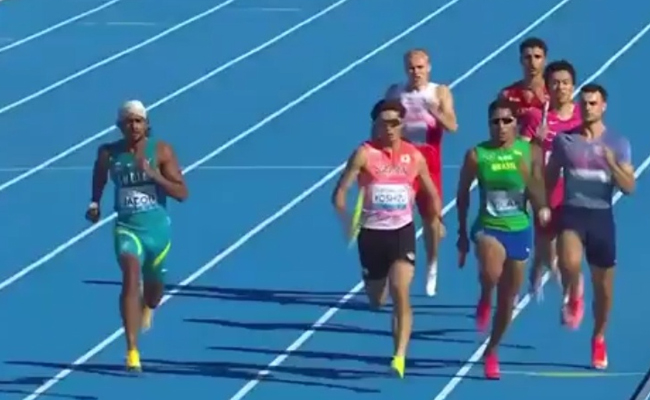
Gaborone (Botswana) (PTI): Amoj Jacob and Ragul Kumar got injured during the men's 4x400m and 4x100 races respectively as India ended their World Athletics Relays campaign in disappointment on the second day of competitions here on Sunday.
The Indian camp had high hopes of making the 2027 World Championships in the men's 4x400m relay but the team did not finish (DNF) the race as Jacob suffered cramps and pulled out of the race after taking the baton from the first leg runner Dharamveer Choudhary. Rajesh Ramesh and Vishal TK were to run in the third and fourth legs.
Those teams which could not qualify for the 2027 Beijing World Championships by reaching the final round of each of the six relay events on Saturday were given another chance in the second qualification round on Sunday.
The top two teams in each of the two heats (in all six relay events) booked the Beijing ticket on Sunday.
India will now have to try and qualify for the World Championships through the Top Lists of the World Athletics, which is a long and tedious process.
In the men's 4x100m race, third leg runner Ragul Kumar fell down the track after failing to hand over the baton inside the exchange zone to fourth leg runner Gurindervir Singh, which clearly showed the lack of coordination among the runners.
Harsh Santosh Raut and Animesh Kujur ran the first two legs.
The Indian quartet was disqualified and Kumar was seen being taken away from the Field of Play with the help of the volunteers.
It was a comedy of errors in the case of the women's 4x100m race, which saw the baton being dropped during an exchange between first leg runner Tamanna and second runner Nithya Gandhe, though the Indians finished the race in 53.09 seconds.
Gandhe started running quite a distance, but after realising that the baton was not in her hand, she turned and ran back to pick it up.
The only silver-lining for the Indian contingent was the national record time in the mixed 4x100m relay race, though the quartet of Ragul Kumar, Nithya Gandhe, Animesh Kujur and Sneha SS finished sixth in heat number two with a time of 41.35 seconds, bettering the previous national mark of 42.30 seconds set in March in Chandigarh.
The mixed 4x400m relay quartet of Theerthesh P Shetty, Kumari Saloni, Nihal William and Rashdeep Kaur ended at fifth in heat number one with a time of 3 minutes and 19.40 seconds.
On Saturday, all the five Indian relay teams had failed to make it to the respective final rounds and thus missed out on the 2027 World Championships berths.