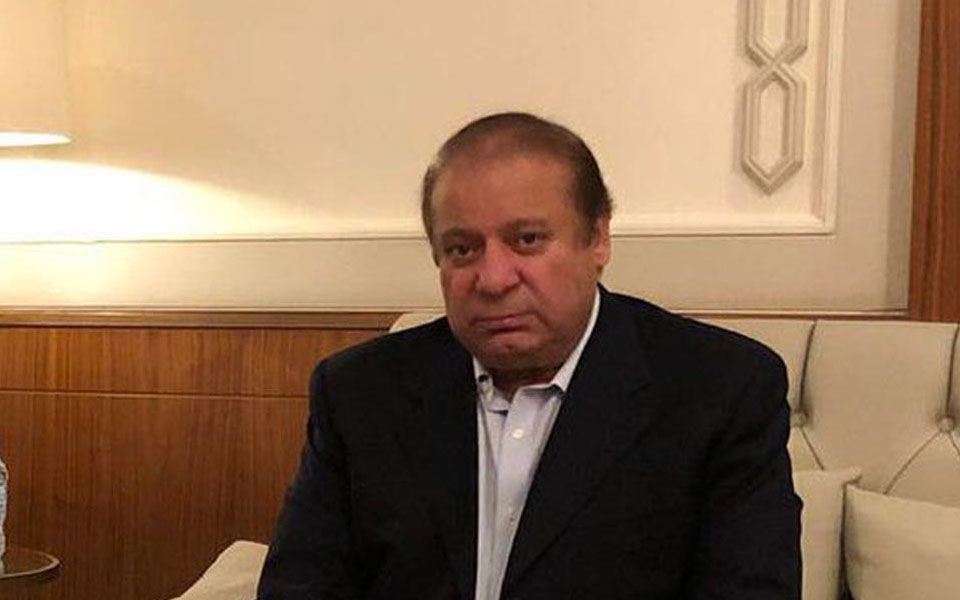
Islamabad, July 16 : Pakistan's former Prime Minister Nawaz Sharif, who was given a 10-year jail term this month in a corruption case, challenged his conviction and sought suspension of the guilty verdict, media reports said on Monday.

An anti-graft court had also handed down seven years in prison to Sharif's daughter Maryam Nawaz on the charges related to four luxury flats in London, reports Xinhua news agency.

They returned to Pakistan from London on Friday. Both are currently in Adiyala prison in Rawalpindi city near the capital Islamabad where they will face trial in other two corruption cases.

Sharif was accused of having wealth beyond his income. However, the charges were denied by the three-time Prime Minister as politically-motivated.

He was also sentenced one-year in prison for "not cooperating" with the National Accountability Bureau (NAB), Pakistan's anti-graft body.

His son-in-law was also convicted for one year in jail for abetment. Sharif's lawyers filed the petition in the Islamabad High Court, which sought acquittal of Nawaz Sharif and dropping all charges framed against him.

The court had imposed 8 million pounds penalty on Nawaz Sharif and 2 million pounds fine on Maryam Nawaz. A team of four senior lawyers filed the petition which prayed to set aside the judgement, conviction and sentence on July 6, 2018.

The Islamabad High Court has not yet accepted the petition. A date for hearing will be announced after the appeal is accepted.

Let the Truth be known. If you read VB and like VB, please be a VB Supporter and Help us deliver the Truth to one and all.


New Delhi (PTI): India has proposed a preferential trade agreement (PTA) with Mexico to help domestic exporters deal with the steep tariffs announced by the South American country, a top government official said on Monday.

Mexico has decided to impose steep import tariffs - ranging from about 5 per cent to as high as 50 per cent on a wide range of goods (about 1,463 tariff lines) from countries that do not have free trade agreements with Mexico, including India, China, South Korea, Thailand and Indonesia.

Commerce Secretary Rajesh Agrawal said that India has engaged with the country on the issue.

"Technical level talks are on...The only fast way forward is to try to get a preferential trade agreement (PTA) because an FTA (free trade agreement) will take a lot of time. So we are trying to see what can be a good way forward," he told reporters here.

While in an FTA two trading partners either significantly reduce or eliminate import duties on maximum number of goods traded between them, in a PTA, duties are cut or removed on a limited number of products.

Trading partners of Mexico cannot file a compliant against the decision on imposing high tariffs as they are WTO (World Trade Organisation) compatible.

The duties are within their bound rates, he said, adding that their primary target was not India.

"We have proposed a PTA because its a WTO-compatible way forward... we can do a PTA and try to get concessions that are required for Indian supply chains and similarly offer them concessions where they have export interests in India," Agrawal said.

ALSO READ: Mexico's Congress approves higher tariffs on goods from India, China and non-FTA nations

Citing support for local production and correction of trade imbalances, Mexico has approved an increase in MFN (most favoured nation) import tariffs (5-50 per cent) with effect from January 1, 2026 on 1,455 tariff lines (or product categories) within the WTO framework, targeting non-FTA partners.

Preliminary estimates suggest that this affects India's around USD 2 billion exports to Mexico particularly -- automobile, two-wheelers, auto parts, textiles, iron and steel, plastics, leather and footwear.

The measure is also aimed at curbing Chinese imports.

India-Mexico merchandise trade totalled USD 8.74 billion in 2024, with exports USD 5.73 billion, imports USD 3.01 billion, and a trade surplus of USD 2.72 billion.

The government has been continuously and comprehensively assessing Mexico's tariff revisions since the issue emerged, engaging stakeholders, safeguarding the interests of Indian exporters, and pursuing constructive dialogue to ensure a stable trade environment benefiting businesses and consumers in both countries.

ALSO READ: Search operation ends in Anjaw truck accident, 20 bodies recovered

Federation of Indian Export Organisations (FIEO) Director General Ajay Sahai has said that Mexico's decision is a matter of concern, particularly for sectors like automobiles and auto components, machinery, electrical and electronics, organic chemicals, pharmaceuticals, textiles, and plastics.

"Such steep duties will erode our competitiveness and risk, disrupting supply chains that have taken years to develop," Sahai said, adding that this development also underlines the little urgency for India and Mexico to fast-track a comprehensive trade agreement.

Domestic auto component manufacturers will face enhanced cost pressures with Mexico hiking duties on Indian imports, according to industry body ACMA.