Nearly half of global workforce at risk of losing livelihoods due to COVID: ILO
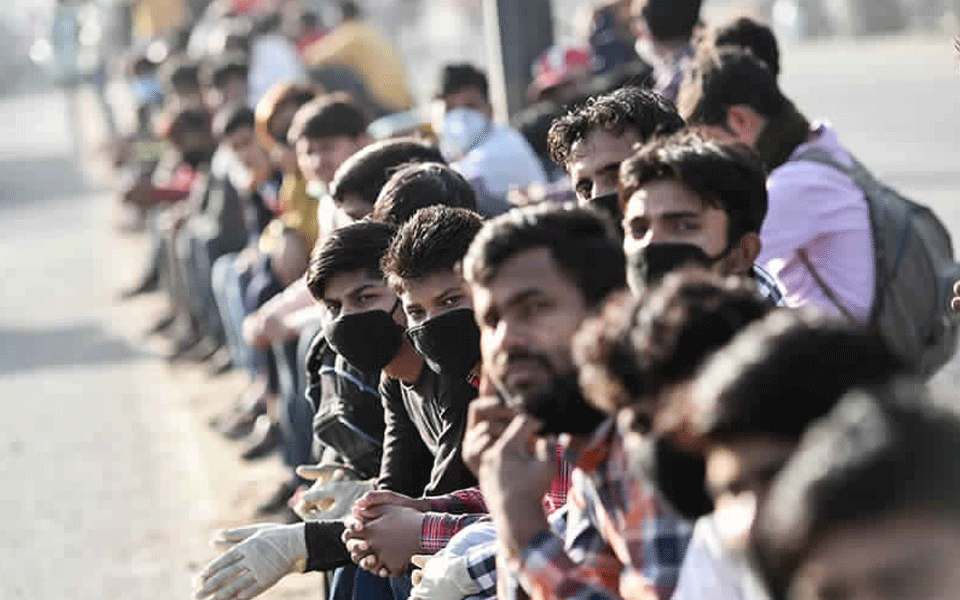
United Nations: Almost 1.6 billion workers in the informal economy, nearly half of the global workforce, face an immediate danger of losing their livelihoods due to the continued sharp decline in working hours because of the COVID-19 outbreak, the International Labour Organization has said.
More than 430 million enterprises in hard-hit sectors such as retail and manufacturing risk "serious disruption", the UN agency added. The findings appear in the ILO Monitor third edition: COVID-19 and the world of work, released Wednesday.
Globally, there are some 3.3 billion workers. Two billion have jobs in the informal economy, the most vulnerable workers in the labour market.
The agency said 1.6 billion in the informal economy "have suffered massive damage to their capacity to earn a living" as a result of the economic meltdown triggered by the COVID-19 pandemic.
Due to lockdowns or because they work in hard-hit sectors, these workers globally have seen a 60 per cent drop in income during the first month of the crisis, according to ILO estimates.
This translates into a more than 80 per cent decline in Africa and the Americas, 70 per cent in Europe and Central Asia, and 21.6 per cent in Asia and the Pacific, the ILO said.
ILO Director General Guy Ryder said as the pandemic and the jobs crisis evolve, the need to protect the world's most vulnerable workers becomes even more urgent.
"For millions of workers, no income means no food, no security and no future. Millions of businesses around the world are barely breathing. They have no savings or access to credit," he said.
"These are the real faces of the world of work. If we don't help them now, they will simply perish."
The UN agency estimated that compared to the pre-crisis levels, there will be a 10.5 per cent deterioration in working hours during the second quarter (Q2) of the year, equivalent to 305 million full-time jobs. Previous projections had put the figure at 6.7 per cent, or 195 million full-time workers.
The situation has worsened for all major regions, again compared to pre-crisis levels. Q2 estimates suggest a 12.4 per cent loss of working hours in the Americas, and 11.8 per cent for Europe and Central Asia. All other regions are above 9.5 per cent.
The ILO added that the proportion of workers living in countries where workplace closures have been recommended, or required, has decreased from 81 per cent to 68 per cent over the past two weeks.
While this is largely due to changes in China, measures have been stepped up elsewhere.
At the same time, 436 million enterprises operating in wholesale and retail, manufacturing, accommodation, and other economic sectors that have been hardest hit, face "high risks of serious disruption".
The ILO called for "urgent, targeted and flexible measures" to support both workers and business, particularly smaller enterprises and those in the informal economy.
"Measures for economic reactivation should follow a job-rich approach, backed by stronger employment policies and institutions, better-resourced and comprehensive social protection systems. International coordination on stimulus packages and debt relief measures will also be critical to making recovery effective and sustainable. International labour standards, which already enjoy tripartite consensus, can provide a framework," it said.
The ILO also stressed that international coordination on stimulus packages and debt relief measures will be critical to making recovery effective and sustainable.
Let the Truth be known. If you read VB and like VB, please be a VB Supporter and Help us deliver the Truth to one and all.
Man arrested with Rs 2.54-crore heroin in Mumbai

Mumbai (PTI): Police have arrested a man and seized over 500 grams of heroin worth Rs 2.54 crore in the illicit market from him in Mumbai, officials said on Friday.
The police's Anti-Narcotics Cell (ANC) made the drug seizure in Santacruz in the western suburbs. The operation was conducted by the Kandivali unit of the ANC on Thursday as part of a special crackdown against drug trafficking in the area, they said.
Acting on specific inputs, an ANC team conducted a raid in Santacruz (East) and intercepted a man. During a search, the team recovered 508 grams of high-grade heroin from his possession, an official said.
The seized contraband, a highly addictive, opioid drug derived from morphine, is estimated to be worth Rs 2.54 crore in the international market, he informed.
Following the seizure, a case was registered against the man under relevant sections of the Narcotic Drugs and Psychotropic Substances (NDPS) Act, 1985, and he was formally placed under arrest in the early hours of Friday.
The police are currently investigating the source of the drug and trying to identify the intended recipients of the consignment, he said.