Nepal president dissolves Parliament; announces mid-term polls in November
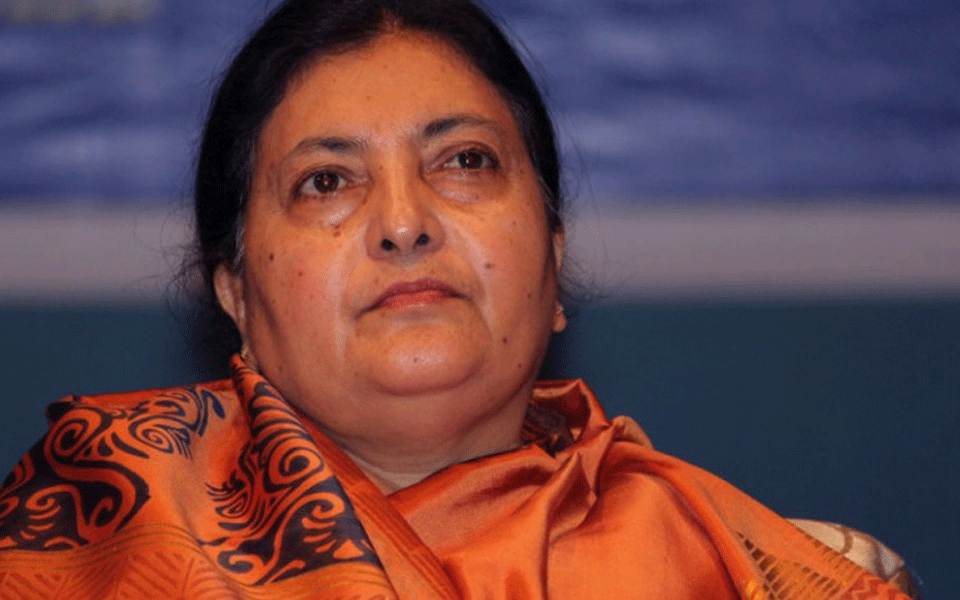
Kathmandu: Nepal President Bidya Devi Bhandari on Saturday dissolved the House of Representatives and announced mid-term polls on November 12 and 19 after she determined that both embattled Prime Minister K P Sharma Oli and the Opposition alliance were not in a position to form a government.
Bhandari's announcement came after Prime Minister Oli recommended the dissolution of the 275-member House following an emergency midnight Cabinet meeting.
A press statement issued by the Office of President said the Parliament was dissolved and dates of mid-term polls were announced in line with Article 76 (7) of the Constitution of Nepal.
The council of ministers has recommended conducting the first phase of the poll on November 12 and the second phase on November 19.
The move followed a notice from the Office of the President which said that it could appoint neither KP Sharma Oli, the incumbent prime minister, nor Sher Bahadur Deuba, Nepali Congress president, as claims made by both to form a new government were insufficient.
With four lawmakers in the 275-member House of Representatives dismissed by their party after they chose to be part of another party, a prime ministerial candidate requires the support of at least 136 lawmakers in Parliament to form a new government.
Interestingly, both Oli and Deuba had claimed the support of some lawmakers, whose names were included in the list of both of them, according to Nepalese media reports.
This is the second time President Bhandari has dissolved Parliament on the recommendation of Prime Minister Oli following a political crisis.
Last year on December 20, President Bhandari had dissolved Parliament but later it was reinstated by the Supreme Court in February.
Nepal's political crisis had taken a dramatic turn on Friday as Prime Minister Oli and the Opposition parties staked separate claims for the formation of a new government by submitting letters of support from lawmakers to the President.
Prime Minister Oli had reached the President's Office Shital Niwas and presented his list, a couple of minutes ahead of the Opposition leaders.
Oli was the first to declare that he had the support of 153 lawmakers of the House of Representatives, a day after recommending to the president to initiate the process for the formation of a new government in accordance to Article 76(5) of the Constitution, citing that he does not have adequate support to go through another floor test.
The letter he submitted had his signature along with the signatures of Janata Samajbadi Party-Nepal chair Mahanta Thakur and the party's parliamentary party leader Rajendra Mahato.
Likewise, Nepali Congress President Sher Bahadur Deuba along with other leaders of the Opposition alliance reached Shital Niwas with signatures of 149 lawmakers including 27 lawmakers from the Khanal-Nepal faction of the CPN-UML.
The president apparently told the Opposition leaders that she would take a call after consulting constitutional experts, The Himalayan Times reported.
However, a dispute emerged after a few lawmakers from the Madhav Nepal faction put out statements claiming that their signatures were misused and that they did not sign any paper to install Opposition leader Deuba as the prime minister against their own party chief, the report said.
Soon after the mid-term elections were announced, major political parties slammed Prime Minister Oli and President Bhandari for their unconstitutional moves.
Bishwa Prakash Sharma, Nepali Congress spokesperson, said, People are fighting the pandemic, and this is the gift to the people?.....the PM is riding on his imaginary highway of dictatorship. A collective raping of the Constitution will prove costly.
Barsha Man Pun, Maoist Center leader, said: This is a midnight robbery. Gyanendra Shah used to choose Fridays and midnights for similar moves. K P Oli is a stooge for those who did not like our Constitution, and this is an attack on democracy and our Constitution.
Shekhar Koirala, senior Nepali Congress leader, termed the late development as unconstitutional.
The move has pushed the country into a scary conflict. This move by the president cannot be pardoned," he said.
Ramesh Lekhak, another Nepali Congress leader, tweeted that the president forgot her duty and trashed the Constitution; she cannot protect and preserve democracy.
The fresh rounds of political chaos, at a time when the coronavirus is raging across the country, can invite more confrontation and political uncertainty, the Republica reported.
There is fear that the new political developments will push the country toward a prolonged crisis, the paper said.
Nepal plunged into a political crisis on December 20 last year after President Bhandari dissolved the House and announced fresh elections on April 30 and May 10 at the recommendation of Prime Minister Oli, amidst a tussle for power within the ruling Nepal Communist Party (NCP).
Oli's move to dissolve the House sparked protests from a large section of the NCP led by his rival Pushpa Kamal Dahal 'Prachanda'. In February, the apex court reinstated the dissolved House, in a setback to Oli who was preparing for snap polls.
Let the Truth be known. If you read VB and like VB, please be a VB Supporter and Help us deliver the Truth to one and all.
Fire at mass marriage event attended by Dy CM Shivakumar, nobody affected
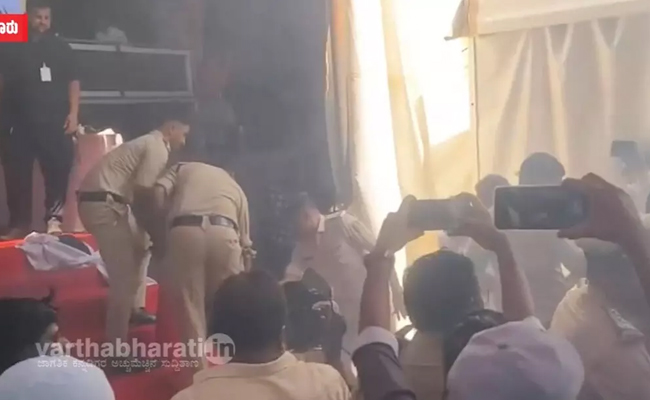
Raichur (Karnataka) (PTI): Fire broke out near the stage of the mass marriage event that was attended by Deputy Chief Minister D K Shivakumar here, police said on Sunday.
Nobody was affected, and the fire was immediately put out, they said.
The fire was noticed shortly after Shivakumar and other dignitaries left the stage, and Forest Minister Eshwaran Khandre was speaking to the media at the venue in Sindhanur, officials said.
According to officials, wires, speakers, and cloth materials near the stage caught fire, allegedly due to a short circuit.
Police personnel present at the spot quickly swung into action and extinguished the fire.
The programme was halted for some time and resumed later, they said.
Several ministers, legislators and political leaders from the region, and actor Sudeep had attended the event.