Nepal's President appeals for peace, says making efforts to find solution to current crisis
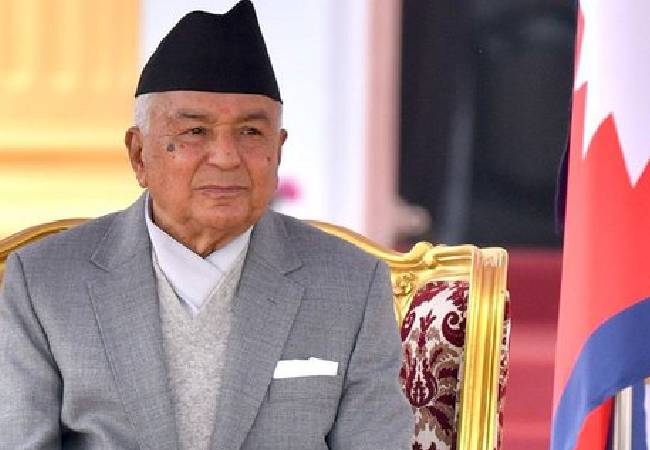
Kathmandu (PTI): Nepal's President Ramchandra Paudel Thursday appealed to all sides to cooperate in maintaining peace and said he was making efforts to find a solution to the current political situation within the constitutional framework.
It is the first time the president spoke about the current turmoil. He was not seen in public after the Gen Z agitating groups burnt the president's office and his private residence on Tuesday.
Paudel, who is currently under military protection, also urged people and all stakeholders to show patience and help maintain law and order in this critical situation.
"I am making every effort to protect democracy and to find a way out from the present political impasse within the constitutional framework while at the same time maintaining law and order,” said President Paudel.
He called all the sides to show trust in his efforts to find a solution to the problem at the earliest.
"I appeal to all parties to be confident that a solution to the problem is being sought as soon as possible to address the demands of the agitating citizens and to cooperate in maintaining peace and order in the country with restraint," he added.
Many people were expecting that the president would publicly appear and address the nation after the incident.
Earlier, President Paudel and Army Chief Ashok Raj Sigdel met with the
representatives of the protesting 'Gen Z' group at the army headquarters in Bhadrakali to pick a leader to run an interim government, sources said.
Former chief justice Sushila Karki, Kathmandu Mayor Balendra Shah and two others were among those being considered by the protesting Gen Z group to lead the interim government, they added.
The interim leader will replace Prime Minister K P Sharma Oli, who resigned on Tuesday following a violent student-led agitation.
An Army spokesperson confirmed that discussions are ongoing with various stakeholders. He, however, did not provide any names.
“We are holding rounds of talks with different stakeholders. The talks are mainly focused on finding a way out from the current stalemate and at the same time maintaining law and order situation in the country,” an Army spokesperson said.
A similar meeting was held on Wednesday, but it yielded no results.
“The new executive head will be the one who will conduct fresh elections within a specified time frame,” the sources added.
Apart from Karki and Shah, the other two names under consideration are the former CEO of Nepal Electricity Authority Kulman Ghising and Mayor of Dharan Harka Sampang.
Nepal plunged into a political crisis as Oli resigned on Tuesday in the face of massive protests, prompting the Nepal Army to take over the law and order situation.
Let the Truth be known. If you read VB and like VB, please be a VB Supporter and Help us deliver the Truth to one and all.
NCW chief condemns rape-murder of 4-year-old girl in Pune, calls for swift action
New Delhi (PTI): National Commission for Women (NCW) Chairperson Vijaya Rahatkar has condemned the alleged rape and murder of a four-year-old girl in Maharashtra's Pune, calling it "deeply distressing" and a "blot on humanity".
The girl was allegedly raped and killed by a 65-year-old labourer, who has a criminal record, in Bhor tehsil of Pune on Friday. The accused allegedly lured the child to a cattle enclosure on the pretext of giving her food. After raping her, he killed her by hitting her with a stone, according to police.
The accused has been arrested.
In a post on X on Saturday, Rahatkar said the incident in the Nasrapur area in Pune was heartbreaking and has shaken society.
"The brutal torture and murder of a four-year-old innocent girl in Nasrapur (Bhor, Pune) is deeply painful, heartbreaking, and shocking. It is a blot on humanity," she said.
She said Pune Rural police has arrested the accused and noted that Maharashtra Chief Minister Devendra Fadnavis and Deputy Chief Minister Sunetra Pawar have assured strict action in the case.
Rahatkar said the NCW has taken cognisance of the matter and written to the National Commission for Protection of Child Rights (NCPCR), requesting the body to ensure necessary and prompt action.
It has also been recommended that the case be pursued under stringent provisions of the Protection of Children from Sexual Offences (POCSO) Act and be closely monitored from the filing of the chargesheet to proceedings in a fast-track special court to ensure time-bound justice, she added.
Ensuring justice for the victim and stringent punishment for the accused is a collective responsibility, the NCW chairperson underlined.
In a post on X, the NCW said it has taken suo motu cognisance of the extremely "heinous" incident.
"This heinous crime causes profound pain and outrage, and it highlights serious concerns regarding the safety of young girls," it said.
Strongly condemning this grave "inhuman act", the NCW said such crimes constitute a serious violation of children's rights and raise questions about society's security system.