Nepal's Supreme Court orders appointment of Sher Bahadur Deuba as Prime Minister
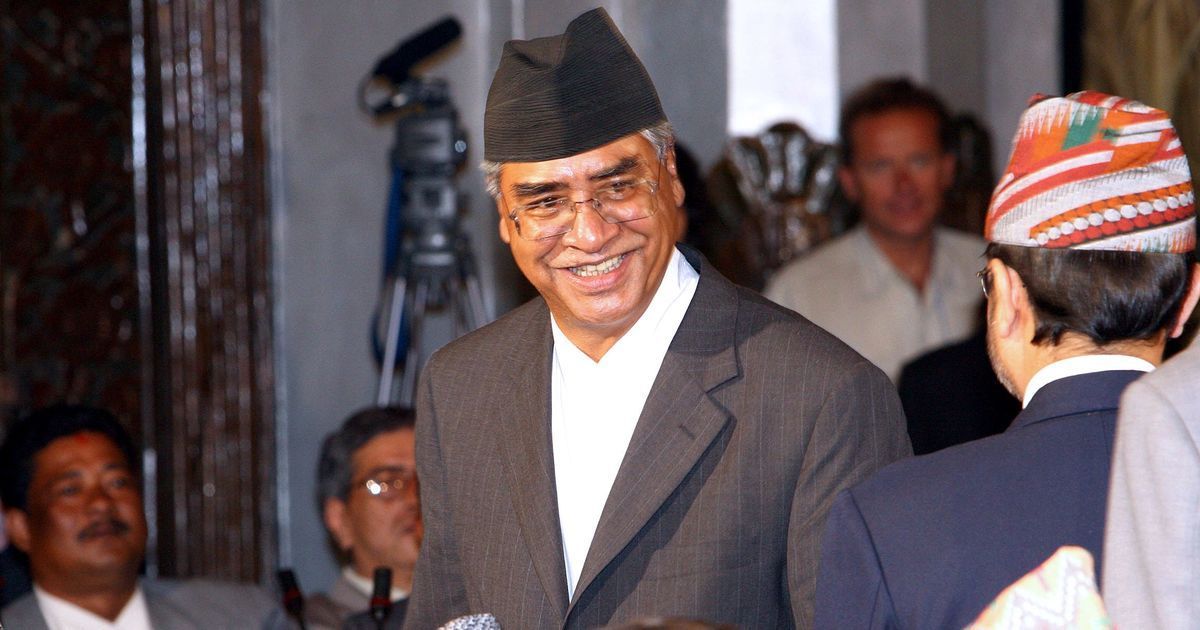
Kathmandu, Jul 12: In a landmark verdict, Nepal's Supreme Court on Monday directed President Bidya Devi Bhandari to appoint Nepali Congress chief Sher Bahadur Deuba as prime minister by Tuesday and reinstated the House of Representatives for a second time in five months.
A five-member Constitutional Bench of the Supreme Court led by Chief Justice Cholendra Shumsher Rana issued the verdict stating that President Bhandari's decision to dissolve the lower house upon a recommendation of Prime Minister K P Sharma Oli was an unconstitutional act, delivering a major blow to the veteran Communist leader who was preparing for snap polls.
The bench issued a mandamus to appoint Deuba as the Prime Minister by Tuesday.
Deuba, 74, has served as the prime minister on four occasions; first from 1995 to 1997, then from 2001 to 2002, again from 2004 to 2005, and from 2017 to 2018. Currently, he is the Leader of the Opposition in the House.
The court also ordered summoning a new session of the House of Representatives at 5 PM on July 18.
Chief Justice Rana also said that the bench has concluded that party whip does not apply when lawmakers take part in the voting to elect new Prime Minister as per Article 76(5) of the Constitution.
The bench comprising four other senior most justices -- Dipak Kumar Karki, Mira Khadka, Ishwar Prasad Khatiwada and Dr Ananda Mohan Bhattarai -- had concluded hearings in the case last week.
President Bhandari had dissolved the 275-member lower house for the second time in five months on May 22 at the recommendation of Prime Minister Oli and announced snap elections on November 12 and November 19.
Last week, the Election Commission had announced the schedule for mid-term elections despite the uncertainty over polls.
Welcoming the apex court verdict, senior leader of the Nepal Communist Party-UML Madhav Kumar Nepal said that the judgement was commendable.
"The Supreme Court has done a commendable job. This has saved the political system that is in place. Since the court has directly asked to appoint Deuba as new prime minister, we have no role to play now," he said.
Under Madhav Nepal's leadership, 23 lawmakers of UML had put their signature in favour of Deuba's claim to the prime ministership.
Madhav Nepal also said that Parliament will now take all the decisions. "Parliament has been reinstated. We will now go to Parliament. All the decisions will be taken from Parliament now," he said. "The court's verdict has also raised moral questions on Oli's actions."
Meanwhile, Prime Minister Oli's supporters, including youths and students affiliated to the ruling CPN-UML, took to streets here to protest against the apex court's verdict against the 69-year-old Communist leader.
Cadres of the National Youth Force affiliated to CPN -UML gathered in Maitighar Mandal near the court premises chanting slogans against the verdict.
"We are not bound to accept all the orders passed by the Supreme Court, beware!" read a banner carried by the demonstrators.
Oli's confidant and former minister Mahesh Basnet was also present at the protests, according to media reports.
As many as 30 petitions were filed against the dissolution of the House by the President. One of the petitions was filed by the Opposition parties' alliance with the signature of 146 lawmakers demanding reinstatement of the lower house of Parliament and appointment of Deuba as the prime minister.
Nepal plunged into a political crisis on December 20 last year after President Bhandari dissolved the House and announced fresh elections on April 30 and May 10 at the recommendation of Prime Minister Oli, amidst a tussle for power within the ruling Nepal Communist Party (NCP).
On February 23, the apex court reinstated the dissolved House of Representatives, in a setback to embattled Prime Minister Oli who was preparing for snap polls.
Oli, who is currently heading a minority government after losing a trust vote in the House, has repeatedly defended his move to dissolve the House of Representatives, saying some leaders of his party were attempting to form a "parallel government".
Let the Truth be known. If you read VB and like VB, please be a VB Supporter and Help us deliver the Truth to one and all.
Two injuries, one DNF, a DQ as India end messy World Relays campaign
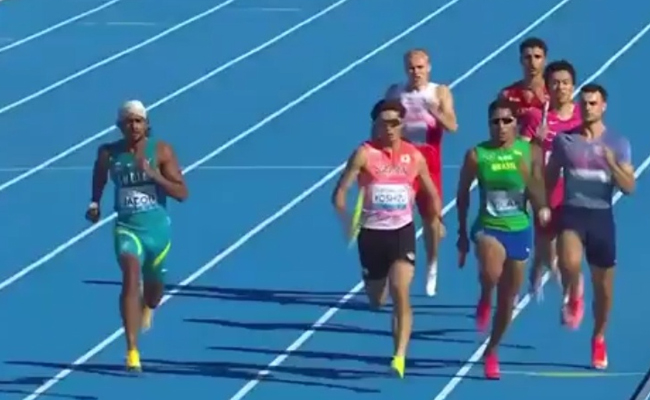
Gaborone (Botswana) (PTI): Amoj Jacob and Ragul Kumar got injured during the men's 4x400m and 4x100 races respectively as India ended their World Athletics Relays campaign in disappointment on the second day of competitions here on Sunday.
The Indian camp had high hopes of making the 2027 World Championships in the men's 4x400m relay but the team did not finish (DNF) the race as Jacob suffered cramps and pulled out of the race after taking the baton from the first leg runner Dharamveer Choudhary. Rajesh Ramesh and Vishal TK were to run in the third and fourth legs.
Those teams which could not qualify for the 2027 Beijing World Championships by reaching the final round of each of the six relay events on Saturday were given another chance in the second qualification round on Sunday.
The top two teams in each of the two heats (in all six relay events) booked the Beijing ticket on Sunday.
India will now have to try and qualify for the World Championships through the Top Lists of the World Athletics, which is a long and tedious process.
In the men's 4x100m race, third leg runner Ragul Kumar fell down the track after failing to hand over the baton inside the exchange zone to fourth leg runner Gurindervir Singh, which clearly showed the lack of coordination among the runners.
Harsh Santosh Raut and Animesh Kujur ran the first two legs.
The Indian quartet was disqualified and Kumar was seen being taken away from the Field of Play with the help of the volunteers.
It was a comedy of errors in the case of the women's 4x100m race, which saw the baton being dropped during an exchange between first leg runner Tamanna and second runner Nithya Gandhe, though the Indians finished the race in 53.09 seconds.
Gandhe started running quite a distance, but after realising that the baton was not in her hand, she turned and ran back to pick it up.
The only silver-lining for the Indian contingent was the national record time in the mixed 4x100m relay race, though the quartet of Ragul Kumar, Nithya Gandhe, Animesh Kujur and Sneha SS finished sixth in heat number two with a time of 41.35 seconds, bettering the previous national mark of 42.30 seconds set in March in Chandigarh.
The mixed 4x400m relay quartet of Theerthesh P Shetty, Kumari Saloni, Nihal William and Rashdeep Kaur ended at fifth in heat number one with a time of 3 minutes and 19.40 seconds.
On Saturday, all the five Indian relay teams had failed to make it to the respective final rounds and thus missed out on the 2027 World Championships berths.