Netanyahu defends expanded Gaza offfensive; Israeli strike kills five Al Jazeera journalists
_vb_03.jpeg)
Tel Aviv: Israeli Prime Minister Benjamin Netanyahu on Sunday defended a fresh military offensive in the Gaza Strip, calling it “more sweeping than previously announced” and asserting that Israel “has no choice but to finish the job and complete the defeat of Hamas.”
Speaking amid mounting condemnation at home and abroad over the 22-month conflict, Netanyahu said the security cabinet had directed the dismantling of Hamas strongholds not only in Gaza City but also in the “central camps” and Muwasi. These areas, according to UN estimates, shelter more than half a million displaced people and had not been mentioned in Israel’s earlier announcement on Friday.
A source familiar with the operation, speaking on condition of anonymity, confirmed Israel’s plans to extend military action to both areas. Netanyahu maintained that “safe zones” would be established, though such areas have been bombed in previous strikes.
The announcement came as heavy bombardment was reported in Gaza City late Sunday. Shortly before midnight, Al Jazeera confirmed the killing of its correspondent Anas al-Sharif in a targeted Israeli strike. The attack hit a tent for Al Jazeera journalists outside the main gate of al-Shifa Hospital, an area known for hosting medical personnel.
Shifa Hospital’s administrative director, Rami Mohanna, said the strike killed five Al Jazeera journalists, including Sharif, whom Israel accused of leading a Hamas cell responsible for orchestrating rocket attacks. Sharif was killed moments after posting a video showing intense bombardment in Gaza City.
Let the Truth be known. If you read VB and like VB, please be a VB Supporter and Help us deliver the Truth to one and all.
Indian startup's 'Drishti' satellite launched aboard SpaceX rocket
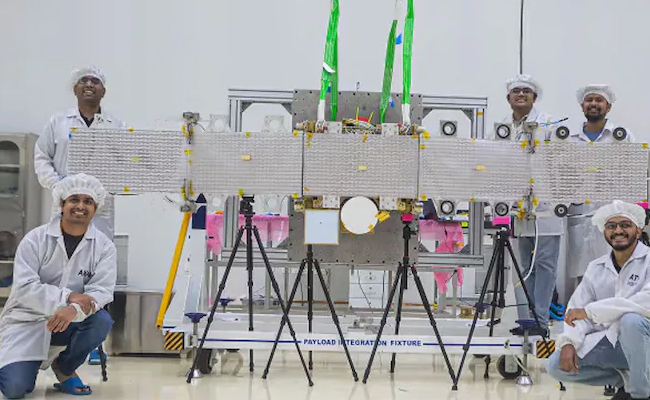
New Delhi (PTI): Bengaluru-based space start-up GalaxEye's Mission Drishti satellite was launched on Sunday aboard SpaceX's Falcon 9 rocket from California.
Mission Drishti is the world's first OptoSAR satellite, integrating electro-optical (EO) and synthetic aperture radar (SAR) sensors into a single operational platform, according to the company.
While EO sensors capture high-resolution images during sunlight and clear skies, SAR sensors provide all-weather and all-time images, using radar pulses.
In a statement, Suyash Singh, founder and CEO of GalaxEye, said, "With the satellite (Mission Drishti) now successfully in orbit, our immediate focus is on completing its commissioning. As we move through this phase, we are already witnessing strong global interest in the differentiated datasets enabled by our OptoSAR payload."
The satellite will help address long-standing limitations of conventional systems and enable more reliable and consistent data acquisition across diverse environmental conditions, the company said.
As a dual-use Earth observation satellite, the mission will support use cases across defence, agriculture, disaster management, maritime monitoring, and infrastructure planning.
The satellite is also expected to complement India's broader initiatives, including the 29 active Earth Observation satellites outlined in ISRO's recent annual report.
The launch came after five years of indigenous research and development, and extensive environmental testing and performance validation of the Mission Drishti.
In a statement, Lt Gen AK Bhatt (Retd), director general of Indian Space Association (ISpA), said, "GalaxEye has achieved what only a few global players have, which is seamlessly combining optical and SAR capabilities on a single platform to enable persistent, all-weather intelligence."
What stands out is not just the technology, but its broader impact on how downstream applications will increasingly define value in the space economy, particularly in Earth observation, where timely, decision-grade insights are critical," he added.
ISpA is the premier industry association of space and satellite companies in the country.
Union Minister Jitendra Singh also took note of the Mission Drishti launch, saying the development marked a significant milestone in India's space journey.
In a post on X, the minister said, "The successful launch of the world's first OptoSAR satellite, and the largest privately-built satellite in the country, reflects the immense potential of our young innovators driving nation-building."
GalaxEye aims to scale up Mission Drishti to a constellation of 10 satellites by 2030, developing a robust and sovereign Earth observation infrastructure for India.