Netanyahu to seek approval for expanded Gaza military operations as 29 Palestinians are killed
Tel Aviv, Aug 7 (AP): The Israeli security cabinet is set to meet Thursday evening to discuss a possible expansion of Israel's military operations in Gaza, a move that — if happens — would come despite fierce opposition from many in Israel, including the families of hostages who remain in Hamas captivity.
The meeting comes on a day when at least 29 Palestinians were killed in airstrikes and shootings across southern Gaza, according to local hospitals.
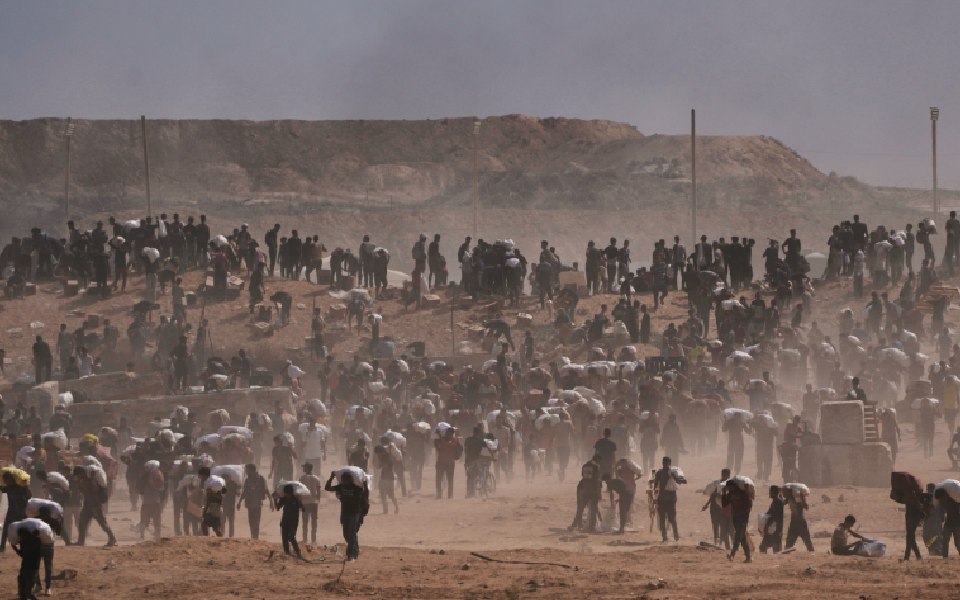
Nasser Hospital in the southern city of Khan Younis said 12 of the fatalities were from people attempting to access aid near a distribution site run by a US and Israeli-backed private contractor.
At least 50 people were wounded, many from gunshots, the hospital said. Neither the Gaza Humanitarian Foundation nor the Israeli military, which helps secure the group's sites, immediately commented on the strikes or shootings. The Israeli military has accused Hamas of operating in densely populated civilian areas.
Prime Minister Benjamin Netanyahu has been meeting this week with top advisers and security officials to discuss what his office said are ways to “further achieve Israel's goals in Gaza” after the breakdown of ceasefire talks last month.
An Israeli official familiar with the matter said the Security Cabinet is expected to hold a lengthy debate and approve an expanded military plan to conquer all or parts of Gaza not yet under Israeli control.
The official, speaking on condition of anonymity pending a formal decision, said that whatever is approved would be implemented gradually and in stages with the idea of increasing pressure on Hamas.
Such a step would trigger new international condemnation of Israel at a time when Gaza is plunging toward famine. It also has drawn opposition across Israel, with hostage families saying it could threaten their loved ones.
Israel's army chief, Lt. Gen. Eyal Zamir, has warned that the plan would endanger the hostages and further strain Israel's army, which has been stretched thin during a nearly two-year war, according to Israeli media. The comments appear to have exposed a rift between Netanyahu and his army.
Opposition to expansion of the war
Demonstrations were planned across Israel on Thursday evening to protest the expected Cabinet decision.
On Thursday morning, almost two dozen relatives of hostages being held in Gaza set sail from southern Israel towards the maritime border with Gaza, where they broadcast messages from loudspeakers on boats to their relatives in Gaza.
The families denounced Netanyahu's plan to expand military operations. Yehuda Cohen, the father of Nimrod Cohen, an Israeli soldier held hostage in Gaza, said from the boat that Netanyahu is prolonging the war to satisfy extremists in his government and to prevent it from collapsing.
“Netanyahu is working only for himself,” he said, pleading with the international community to put pressure on Netanyahu to stop the war and save his son.
Israel returns body of Palestinian activist for burial
Israeli authorities returned the body of a Palestinian activist allegedly killed by an Israeli settler last week, after female Bedouin relatives launched a hunger strike to protest the authority's decision to hold his body in custody. The hunger strike was a rare public call from Bedouin women who traditionally mourn in private.
Witnesses said Awdah Al Hathaleen was shot and killed by a radical Israeli settler during a confrontation caught on video last month. Israeli authorities said they would only return the body if the family agrees to certain conditions that would “prevent public disorder.”
Despite dropping some of their demands, family members said Israel set up checkpoints and prevented many mourners from outside the village from attending.
The plight of Palestinians in this area of the West Bank, known as Masafer Yatta, was featured in “No Other Land,” an Oscar-winning documentary about settler violence and life under Israeli military rule.
Al Hathaleen, a political activist and an English teacher, was a contributor to the film and close friend of its Palestinian co-directors.
Aid organisations denounce Israeli policies
Two major international aid organisations published reports on Thursday denouncing Israeli policies in Gaza.
Human Rights Watch called on governments worldwide to suspend their arms transfers to Israel in the wake of deadly airstrikes on two Palestinian schools last year.
Human Rights Watch said an investigation did not find any evidence of a military target at either school. At least 49 people were killed in the airstrikes that hit the Khadija girls' school in Deir al-Balah on July 27, 2024, and the al-Zeitoun C school in Gaza City on Sept. 21, 2024.
Doctors without Borders, also known as Médecins Sans Frontières or MSF, accused the Gaza Humanitarian Foundation food distribution sites of causing “orchestrated killing” rather than handing out aid.
According to the United Nations, more than 850 people have died near GHF sites in the past two months. MSF runs two medical clinics very close to the GHF sites and said it had treated nearly 1,400 people wounded near the sites between June 7 and July 20, including 28 people who were dead upon arrival. MSF also treated 41 children who were shot near GHF sites.
The organization said it has also treated almost 200 patients with physical assault injuries from chaotic scrambles at GHF sites, including head injuries, suffocation, and multiple patients with severely aggravated eyes after being sprayed at close range with pepper spray.
GHF did not immediately answer a request for comment. But it has said that its contractors have not shot anyone at its sites.
Hamas-led group killed around 1,200 people, mostly civilians, and abducted 251 in the Oct. 7, 2023, attack that ignited the war. They still hold 50 hostages, around 20 of them believed to be alive, after most of the rest were released in ceasefires or other deals.
Israel's retaliatory military offensive has killed more than 61,000 Palestinians, according to Gaza's Health Ministry. The ministry doesn't distinguish between civilians and combatants in its count but says around half the dead have been women and children. The ministry is part of the Hamas government but is staffed by medical professionals. The UN and other independent experts view its figures as the most reliable casualty count.
Israel has disputed the figures but hasn't provided its own.
Let the Truth be known. If you read VB and like VB, please be a VB Supporter and Help us deliver the Truth to one and all.
Mangaluru: Man sentenced to 20 years rigorous imprisonment in POCSO case

Mangaluru: A court in Mangaluru has sentenced a 44-year-old man to 20 years of rigorous imprisonment in connection with a case under the Protection of Children from Sexual Offences (POCSO) Act.
According to Deccan Herald, the Additional District and Sessions Judge, FTSC-II (POCSO), Maanu K S, delivered the judgment.
The convict has been identified as Dayanand Moolya (44).
According to Special Public Prosecutor Sahana Devi Boloor, the incident occurred on November 16, 2025, when a seven-year-old girl was studying alone at home and the accused illegally entered the house and raped her. He threatened to kill her and throw her into a well if she revealed it to anyone.
The survivor later informed her mother, following which a complaint was registered at Mulki Police Station on November 22. Police Inspector Manjunath B S investigated the case and submitted the charge sheet to the court.
For the rape, under POCSO Section 6, along with Bharatiya Nyaya Sanhita (BNS) Act 65(2) and POCSO 4(2), the man has been sentenced to 20 years of rigorous imprisonment and a fine of Rs 30,000. For illegal entry into the house, under BNS Section 332(B), the convict has been sentenced to three years of simple imprisonment and a fine of Rs 5,000. For issuing death threats, under BNS Section 351(3), he has been sentenced to two years of simple imprisonment and a fine of Rs 5,000.
The court also directed payment of Rs 4 lakh as compensation to the survivor, including Rs 40,000 from the fine amount, and instructed the District Legal Services Authority to provide the remaining Rs 3.60 lakh.