New algorithm that may predict your intelligence

New York, June 30: Be careful if you lie about your IQ as researchers have developed a machine-learning algorithm that may tell how smart you are by looking at a scan of your brain.
The study showed that the new computing tool can predict a person's intelligence from functional magnetic resonance imaging (fMRI) scans of their resting state brain activity.
The fMRI develops a map of brain activity by detecting changes in blood flow to specific brain regions.
"We found if we just have people lie in the scanner and do nothing while we measure the pattern of activity in their brain, we can use the data to predict their intelligence," said co-author Ralph Adolphs from the California Institute of Technology (Caltech).
To train their algorithm on the complex patterns of activity in the human brain, the researchers downloaded the brain scans and intelligence scores from almost 900 individuals.
The researchers found that after processing the data, the algorithm was able to predict intelligence at statistically significant levels across the subjects.
"The information that we derive from the brain measurements can be used to account for about 20 per cent of the variance in intelligence we observed in our subjects," said Julien Dubois from the Cedars-Sinai Medical Centre.
In predicting intelligence from brain scans, the algorithm is doing something that humans cannot, because even an experienced neuroscientist cannot look at a brain scan and tell how intelligent a person is, the researchers said.
The researchers also conducted a parallel study, using the same test population and approach, that attempted to predict personality traits from fMRI brain scans.
The personality test they used divides personality into five scales -- openness to experience, conscientiousness, extraversion, agreeableness, neuroticism.
However, it has turned out to be much more difficult to predict personality using the method the team used for predicting intelligence.
The two studies are yet to be published in the separate journals Personality Neuroscience and Philosophical Transactions of the Royal Society.
Let the Truth be known. If you read VB and like VB, please be a VB Supporter and Help us deliver the Truth to one and all.
Two injuries, one DNF, a DQ as India end messy World Relays campaign
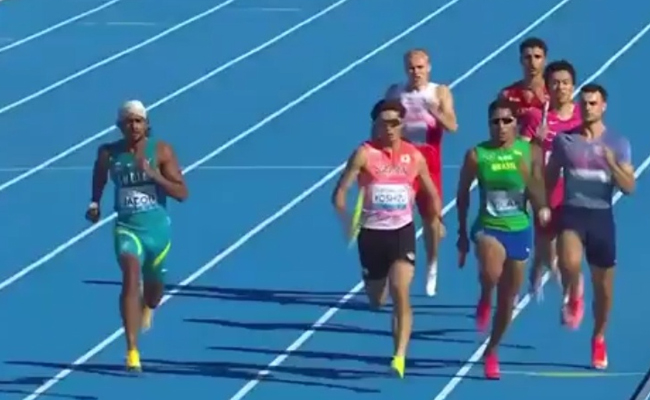
Gaborone (Botswana) (PTI): Amoj Jacob and Ragul Kumar got injured during the men's 4x400m and 4x100 races respectively as India ended their World Athletics Relays campaign in disappointment on the second day of competitions here on Sunday.
The Indian camp had high hopes of making the 2027 World Championships in the men's 4x400m relay but the team did not finish (DNF) the race as Jacob suffered cramps and pulled out of the race after taking the baton from the first leg runner Dharamveer Choudhary. Rajesh Ramesh and Vishal TK were to run in the third and fourth legs.
Those teams which could not qualify for the 2027 Beijing World Championships by reaching the final round of each of the six relay events on Saturday were given another chance in the second qualification round on Sunday.
The top two teams in each of the two heats (in all six relay events) booked the Beijing ticket on Sunday.
India will now have to try and qualify for the World Championships through the Top Lists of the World Athletics, which is a long and tedious process.
In the men's 4x100m race, third leg runner Ragul Kumar fell down the track after failing to hand over the baton inside the exchange zone to fourth leg runner Gurindervir Singh, which clearly showed the lack of coordination among the runners.
Harsh Santosh Raut and Animesh Kujur ran the first two legs.
The Indian quartet was disqualified and Kumar was seen being taken away from the Field of Play with the help of the volunteers.
It was a comedy of errors in the case of the women's 4x100m race, which saw the baton being dropped during an exchange between first leg runner Tamanna and second runner Nithya Gandhe, though the Indians finished the race in 53.09 seconds.
Gandhe started running quite a distance, but after realising that the baton was not in her hand, she turned and ran back to pick it up.
The only silver-lining for the Indian contingent was the national record time in the mixed 4x100m relay race, though the quartet of Ragul Kumar, Nithya Gandhe, Animesh Kujur and Sneha SS finished sixth in heat number two with a time of 41.35 seconds, bettering the previous national mark of 42.30 seconds set in March in Chandigarh.
The mixed 4x400m relay quartet of Theerthesh P Shetty, Kumari Saloni, Nihal William and Rashdeep Kaur ended at fifth in heat number one with a time of 3 minutes and 19.40 seconds.
On Saturday, all the five Indian relay teams had failed to make it to the respective final rounds and thus missed out on the 2027 World Championships berths.