New details highlight Lion Air jet's problems before crash

Jakarta, Nov 2 : New details about the crashed Lion Air's jet previous flight have cast more doubt on the Indonesian airline's claim to have fixed technical problems as hundreds of personnel searched the sea a fifth day Friday for victims and the plane's fuselage.
The brand new Boeing 737 MAX 8 plane plunged into the Java Sea early Monday, just minutes after taking off from the Indonesian capital Jakarta, killing all 189 people on board.
Herson, head of Bali-Nusa Tenggara Airport Authority, said the pilot on the plane's previous flight on Sunday from Bali requested to return to the airport not long after takeoff but then reported the problem had been resolved.
Several passengers have described the problem as a terrifying loss of altitude.
Lion Air has said the unspecified problem was fixed after Sunday's flight, but the fatal flight's pilots also made a "return to base" request not long after takeoff.
"Shortly after requesting RTB, the pilot then contacted the control tower again to inform that the plane had run normally and would not return" to Bali's Ngurah Rai airport, said Herson, who uses a single name.
"The captain said the problem was resolved and he decided to continue the trip to Jakarta."
Data from flight-tracking websites shows both flights had highly erratic speed and altitude after takeoff, though confirmation is required from data recorded by the aircraft's "black box" flight recorders.
Investigators displayed one of the jet's two flight recorders at a news conference Thursday evening, later confirmed to be the flight data recorder, and said they would immediately attempt to upload information and begin analysis.
"In principle, all data we have obtained, including flight data and air navigation, and also from other sources we find that there have indeed been problems" with the plane, said Haryo Satmiko, deputy chairman of the National Transport Safety Committee.
"We will prove more technical problems with data recorded in the black box."
The steel-encased memory unit of the recovered flight recorder had separated from its base plate, showing the plane hit the sea at tremendous speed, he said.
Investigators say that is also indicated by the search and rescue effort finding many body parts rather than intact victims.
Satmiko said investigators had already contacted the pilot of the plane's Sunday flight.
The problems with it were "just as it circulates on media and social media," he said, referring to accounts of passengers.
One of them, Diah Mardani, told a current affairs television program earlier this week that after takeoff "the plane suddenly fell, then rose, then fell again harder and shook."
"All the passengers started shouting God is Great," she said. "The atmosphere was very tense."
She said she was travelling with a group of more than 50 colleagues and many were crying with relief after landing in Jakarta.
A team from the US National Transportation Safety Board including Boeing experts has joined the Indonesian investigation. The Lion Air crash is the worst airline disaster in Indonesia since 1997, when 234 people died on a Garuda flight near Medan.
In December 2014, an AirAsia flight from Surabaya to Singapore plunged into the sea, killing all 162 on board.
Indonesian airlines were barred in 2007 from flying to Europe because of safety concerns, though several were allowed to resume services in the following decade. The ban was completely lifted in June. The US lifted a decade long ban in 2016.
Lion Air, a discount carrier, is one of Indonesia's youngest and biggest airlines, flying to dozens of domestic and international destinations.
It has been expanding aggressively in Southeast Asia, a fast-growing region of more than 600 million people.
Let the Truth be known. If you read VB and like VB, please be a VB Supporter and Help us deliver the Truth to one and all.
Mumbai-Pune Expressway connecting link now fully operational
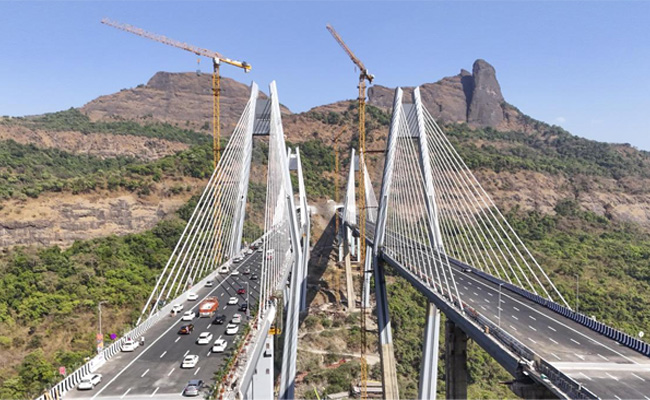
Mumbai (PTI): The Mumbai-bound carriageway of the Mumbai-Pune Expressway connecting link was opened to vehicular traffic on Saturday noon after a delay caused by the dismantling of inauguration infrastructure and cleaning work, a day after the Pune section became operational.
The 13.3 km-long "missing link", which bypasses a section of the Bhor Ghat stretch of the expressway and cuts travel time between Mumbai and Pune by 25 to 30 minutes, was inaugurated a day earlier by Chief Minister Devendra Fadnavis in the presence of Deputy CMs Eknath Shinde and Sunetra Pawar.
The Pune-bound carriageway of the corridor was opened to traffic immediately; however, the Mumbai-bound section remained closed to traffic for several hours after the inauguration.
An official of the Maharashtra State Road Development Corporation told PTI on Saturday that the opening of the Mumbai-bound carriageway was delayed mainly due to the dismantling of the inauguration infrastructure and cleaning work.
The removal of the stage and other decorations was completed in the morning. The work to load and transport the material slightly delayed the opening of the carriageway.
Vehicular movement on the carriageway began after all the remaining material was cleared and road cleaning was completed, the official added.
The expressway control room said that despite significant vehicular movement, the access-controlled highway has not witnessed any major traffic snarls since Friday evening, after the Pune-bound carriageway of the missing link was opened to traffic.
The Missing Link project connects Khopoli (in Raigad) on the Mumbai side to Kusgaon near Lonavala in Pune district and is expected to make the expressway fully access-controlled, easing congestion in the ghat section.
Developed by the MSRDC and dubbed an "engineering marvel", the project includes two tunnels, two viaducts and a cable-stayed bridge over Tiger Valley. It bypasses the steep, accident-prone ghat section, where frequent traffic snarls are reported during weekends and on public holidays.