New government in Maldives reviewing more than 100 agreements with India: Official
Male (PTI): There were 77 Indian military personnel in the Maldives and the new government here was reviewing more than 100 agreements signed with New Delhi, a senior Maldivian official said on Sunday, a day after President Mohamed Muizzu formally requested India to withdraw its troops from the island nation.
Addressing a press conference here, the Undersecretary for Public Policy of the Presidential Office, Mohamed Firuzul Abdul Khaleel said the new administration has established that there are 77 Indian military personnel in the Maldives.
There were 24 Indian military personnel to manage the first helicopter, 25 Indians to manage the Dornier aircraft, 26 personnel to manage the second helicopter, and two more for maintenance and engineering, Firuzul was quoted as saying by the Maldivian media.
He said that President Muizzu, who won the presidential election in September, has initiated efforts to expel all 77 from the Maldives.
The Maldives is one of India's key maritime neighbours in the strategic Indian Ocean Region and the overall bilateral ties including in areas of defence and security have been on an upward trajectory under the government of Ibrahim Mohamed Solih.
The Maldives is also one of the biggest beneficiaries of India's Neighbourhood First policy.
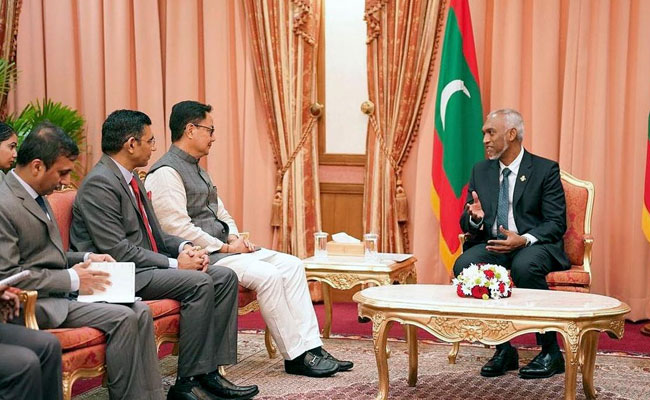
During a meeting with Union Minister of Earth Sciences Kiren Rijiju here on Saturday, Muizzu officially requested the Indian government to have their military personnel removed from the Maldives.
Rijiju called on Muizzu, widely seen as a pro-China leader, at his office, a day after attending the Maldivian leader's inauguration ceremony.
Muizzu had built his presidential campaign against Solih on the promise of expelling Indian military personnel from the Maldives. He also said he would review the agreements between Maldives and India, and disclose its contents where possible.
Firuzul said the former administration of ex-President Solih signed over 100 agreements with India, and that the new administration is reviewing them, Sun.mv.com reported.
The agreements in question include the Uthuru Thila Falhu (UTF) agreement and other defence agreements, the report said.
The previous administration had refused to disclose the exact number of Indian military personnel stationed in Maldives, citing that it posed a threat to national security, it said.
Soon after the oath-taking on Friday, President Muizzu asserted that he was firmly committed to ensuring that his country remains "free" of any "foreign military presence" to preserve its independence and sovereignty.
During his meeting with Rijiju on Saturday, President Muizzu formally requested the Government of India to withdraw its military personnel from the Maldives.
"The President noted that at the Presidential Election held in September, the Maldivian people had given him a strong mandate to make the request to India and expressed the hope that India will honour the democratic will of the people of the Maldives," the statement from the President's Office said.
While discussing the matter with Rijiju, Muizzu also acknowledged the significant role of the two helicopters in providing numerous emergency medical evacuations in the Maldives.
In May, Defence Minister Rajnath Singh visited the Maldives during which he handed over a fast patrol vessel and a landing craft to the island nation.
Maldives is India's key maritime neighbour in the Indian Ocean Region (IOR) and occupies a special place in the Prime Minister's vision of SAGAR' (Security and Growth for All in the Region) and the Neighbourhood First Policy.'
Let the Truth be known. If you read VB and like VB, please be a VB Supporter and Help us deliver the Truth to one and all.
Bengaluru airport introduces AI-based system to enhance safety at vehicle-aircraft intersections
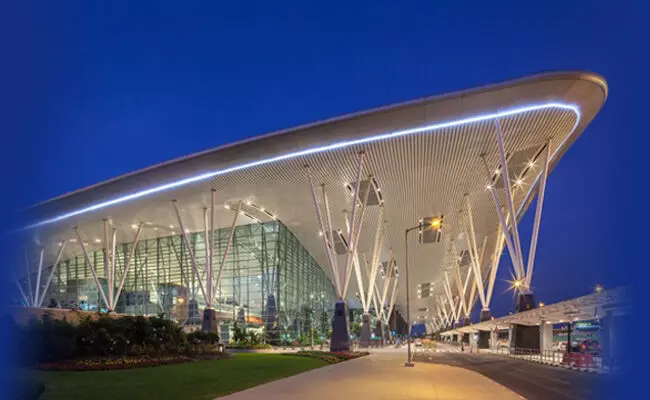
Bengaluru: Bangalore International Airport Limited (BIAL) has introduced an integrated smart airside safety system at Kempegowda International Airport to improve operational safety at key intersection zones.
According to The Hindu, the system has been designed to enhance safety at Cross Service Roads (CSRs), where aircraft and ground vehicle movements intersect.
According to BIAL, the system integrates AI-based computer vision, automation, and centralised monitoring to manage right-of-way movements and reduce the risk of human error.
“CRSs are among the most sensitive areas within airport operations, requiring precise and seamless coordination between aircraft and ground vehicles. Traditionally, right of way protection at these intersections relied on manual or semi-manual inset light activation, creating dependencies on human intervention, increasing the risk of delays and limiting operational visibility,” TH quoted BIAL as saying.
The new system uses real-time detection of vehicle movement, risk assessment, and automated signalling. AI-enabled cameras identify potential conflicts and trigger automated inset light signals to ensure aircraft priority. Normal operations resume once the area is confirmed clear.
“Based on these detections, the system triggers automated inset light activation to protect aircraft right‑of‑way and restores normal signalling once the intersection is confirmed clear. A centralised monitoring and analytics platform digitally logs all events, strengthening governance, compliance, and operational control,” BIAL said.
By embedding technology into operations, the system creates a data-driven separation layer between aircraft and ground vehicles, significantly reducing human error, especially during night and low-visibility conditions.
“Precision-led signal activation improves traffic flow, minimises unnecessary stoppage and enhances turnaround efficiency. It also establishes a scalable foundation for predictive safety analytics, enabling trend analysis, peak-hour optimisation, compliance mapping and risk forecasting to support continuous improvement and stronger airside governance,” BIAL said.