New island emerges after undersea volcano erupts off Japan, but experts say it may not last long
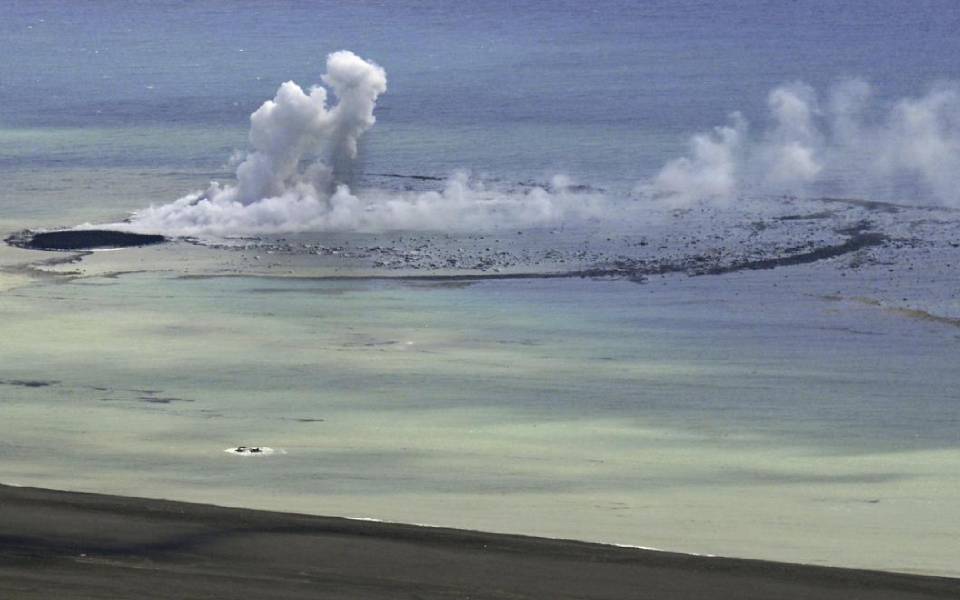
TOKYO (AP): An undersea volcano erupted off Japan three weeks ago, providing a rare view of the birth of a tiny new island, but experts say it may not last very long.
The unnamed undersea volcano, located about 1 kilometer (half a mile) off the southern coast of Iwo Jima, which Japan calls Ioto, started its latest series of eruptions on Oct. 21.
Within 10 days, volcanic ash and rocks piled up on the shallow seabed, its tip rising above the sea surface. By early November, it became a new island about 100 meters (328 feet) in diameter and as high as 20 meters (66 feet) above the sea, according to Yuji Usui, an analyst in the Japan Meteorological Agency's volcanic division.
Volcanic activity has increased near Iwo Jima and similar undersea eruptions have occurred in recent years, but the formation of a new island is a significant development, Usui said.
Volcanic activity at the site has since subsided, and the newly formed island has somewhat shrunk because its “crumbly” formation is easily washed away by waves, Usui said.
He said experts are still analyzing the development, including details of the deposits. The new island could survive longer if it is made of lava or something more durable than volcanic rocks such as pumice.
“We just have to see the development,” he said. “But the island may not last very long.”
Undersea volcanos and seismic activities have formed new islands in the past.
In 2013, an eruption at Nishinoshima in the Pacific Ocean south of Tokyo led to the formation of a new island, which kept growing during a decade-long eruption of the volcano.
Also in 2013, a small island surfaced from the seabed after a massive 7.7-magnitude earthquake in Pakistan. In 2015, a new island was formed as a result of a month-long eruption of a submarine volcano off the coast of Tonga.
Of about 1,500 active volcanos in the world, 111 are in Japan, which sits on the so-called Pacific “ring of fire,” according to the Japan Meteorological Agency.
Iwo Jima was the site of some of the fiercest fighting of World War II, and the photograph taken by AP photographer Joe Rosenthal of the flag-raising atop the island's Mount Suribachi on Feb. 23, 1945, came to symbolize the Pacific War and the valor of the United States Marines.
Let the Truth be known. If you read VB and like VB, please be a VB Supporter and Help us deliver the Truth to one and all.
Maharashtra sets up state vaccination task force to strengthen immunisation programme

Mumbai (PTI): The Maharashtra government has set up a State Vaccination Task Force to strengthen the regular immunisation programme and review the progress of related campaigns, a health department official said on Monday.
The State Vaccination Task Force will comprise at least 29 members and will be headed by the administrative head of the health department, he informed.
The government has also constituted separate district-level and municipal vaccination task forces to improve implementation and address challenges at the grassroots level, he said.
Municipal task forces, chaired by respective civic commissioners, have been constituted in view of the vast urban population in Maharashtra and the role of civic bodies in implementing different health programmes.
The district-level task forces will function under the chairmanship of collectors.
"Complete immunisation of children at the appropriate age is an extremely simple, cost-effective and highly effective measure to reduce child mortality and the prevalence of diseases among kids. Immunisation is a powerful tool for reducing illness in children," maintained the official.
To ensure full vaccination of all children, the state government implements various campaigns from time to time as per the central government guidelines, he pointed out.
"Active participation and cooperation of other relevant government departments are essential (in making these campaigns successful)," according to the official.
The state-level body will review the regular immunisation programme, associated campaigns and vaccine-preventable diseases in detail. It will also conduct focused assessments of high-risk districts and municipal corporations, including vacancies at district, municipal and sub-district levels, availability of cold chain equipment, resource gaps and training requirements, he noted.
The state task force will review allocation and utilisation of funds for immunisation and ensure timely action by officers concerned based on reports from district and municipal task forces and state-level monitoring mechanisms, the official said.
It will also ensure active coordination and participation of other government departments in immunisation drives, while district and municipal task forces will carry out similar functions at their respective levels, the official added.