New satellite image shows China constructing bridge on its side of Pangong lake in Ladakh: Sources
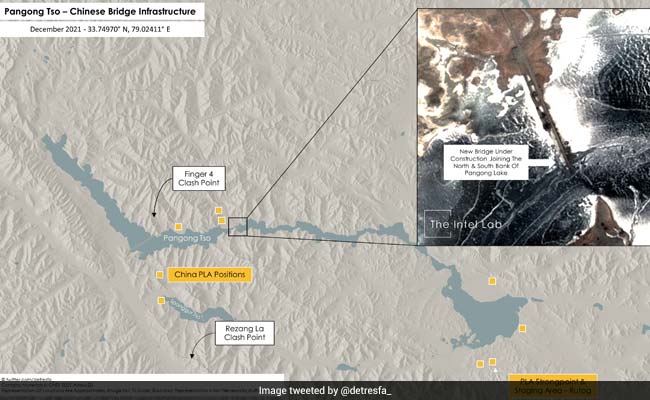
New Delhi: A new satellite image showing China building a bridge on its side of the Pangong lake in eastern Ladakh emerged on Monday amid the prolonged Sino-India military standoff in the border area.
People familiar with the development said the satellite imagery is of an area on the Chinese side of the Line of Actual Control(LAC) near the Galwan valley region.
The armies of India and China had created a buffer zone in Galwan valley following their deadly clashes on June 15, 2020.
On January 1, Indian and Chinese troops exchanged sweets and greetings at 10 border posts along the LAC including in eastern Ladakh to mark the New Year.
The sources said the bridge is at a distance of around 40 km from the alignment of the LAC in the region and that India has also been developing infrastructure in the region at a rapid pace.
Geo-intelligence expert Damien Symon posted a satellite image on Twitter suggesting that the new bridge was being constructed by China to link the North and South banks of Pangong lake.
Military experts said the aim of constructing the bridge in the Khurnak area could be to ensure that the Chinese People's Liberation Army(PLA) is able to quickly mobilise its troops in the region.
The Indian military sources said India has been developing infrastructure in all key areas along the LAC and that India is aware of Chinese activities in the region.
Last week, Defence Minister Rajnath Singh inaugurated the Chisumle-Demchok road at Umling La Pass at over 19,000 feet in Ladakh that is considered as a key stretch for military purpose.
China has been focusing on strengthening its military infrastructure after Indian troops took control of several strategic peaks on the southern bank of Pangong lake in August 2020 after the Chinese PLA attempted to intimidate them in the area.
The eastern Ladakh border standoff between the armies of India and China erupted on May 5, 2020, following a violent clash in the Pangong lake area.
Both sides gradually enhanced their deployment by rushing in tens of thousands of soldiers as well as heavy weaponry.
As a result of a series of military and diplomatic talks, the two sides completed the disengagement process last year in the north and south banks of the Pangong lake and in the Gogra area.
Each side currently has around 50,000 to 60,000 troops along the LAC in the sensitive sector.
The 13th round of Corps Commander-level military talks in October ended in a stalemate with the Indian Army saying that the ''constructive suggestions'' made by it were not agreeable to the Chinese side.
The defence ministry last Friday said it held several rounds of military talks with the Chinese side to deescalate the situation in eastern Ladakh without compromising on its stand of ''complete disengagement and immediate restoration of status quo ante''.
India has been insisting on returning to the status quo that existed before the face-off erupted.
Let the Truth be known. If you read VB and like VB, please be a VB Supporter and Help us deliver the Truth to one and all.
Vartha Bharati–Sankalp predictions align closely with Karnataka bypoll results

Bengaluru: The Vartha Bharati–Sankalp election analysis has shown a high level of accuracy in predicting the outcome of the recent Karnataka Assembly by-elections held in May 2026, correctly calling winners in both constituencies and closely estimating vote share trends.
The by-elections were held in Bagalkot and Davanagere South, drawing significant political attention as both seats were seen as key tests for the ruling Congress and opposition BJP.
According to the analysis, Vartha Bharati–Sankalp had made three major projections ahead of the results the winning party, vote share percentages, and margin of victory.
In both constituencies, the platform accurately predicted that the Congress would emerge victorious. The outcome matched the projections, with Congress candidates winning in Bagalkot and Davanagere South.
In terms of vote share, the predictions were largely in line with the final results. In Bagalkot, the BJP’s vote share was forecast in the range of 40 to 46 per cent, while the actual figure stood at 42.9 per cent. The Congress vote share, however, exceeded expectations, with the party securing 55.4 per cent against a projected range of 43 to 48 per cent.
The margin of victory in Bagalkot turned out to be significantly higher than anticipated. While the projection had placed the margin between 2,000 and 3,500 votes, the final margin was around 22,332 votes.
In Davanagere South, the predictions also remained largely accurate. The Congress vote share was projected between 43 and 51 per cent, and the final figure stood at 43.9 per cent. The BJP was expected to secure between 42 and 50 per cent but ended with 40.3 per cent.
The analysis had also identified the role of SDPI as a potential spoiler in the constituency. While its vote share was estimated around 6 per cent, the party eventually secured around 12 per cent of the vote.
The margin of victory in Davanagere South was predicted to be between 1,500 and 2,600 votes. The actual margin was higher at around 5,708 votes, though the contest remained relatively close as anticipated.
Overall, the performance of Vartha Bharati–Sankalp stood out for correctly identifying the winning parties in both seats and maintaining close accuracy in vote share estimates, with only limited deviations in specific cases.