New swine flu virus strain with "pandemic potential" identified in China: Study

Beijing: A new flu virus strain, identified among pigs in China, is becoming prevalent among workers in the swine industry, according to a study which says the pathogen has "all the essential hallmarks of a candidate pandemic virus."
The study, published in the journal PNAS, is based on a surveillance of pigs in China from 2011 to 2018, and found that the influenza virus strain, with genetic material termed as G4 genotype, has become predominant in swine populations since 2016.
According to the scientists, including those from the Chinese Center for Disease Control and Prevention, these G4 viruses bind to receptor molecules in human cells, and can replicate in the outer layer of the respiratory system.
They demonstrated that the newly identified virus can efficiently infect ferrets via aerosol transmission, causing severe clinical symptoms in them like sneezing, wheezing, coughing, and a mean maximum weight loss ranging from 7.3 to 9.8 per cent of the mammals' body mass.
The study also noted that humans are not protected from the G4 virus by the immunity offered by other human influenza vaccine strains, indicating that there is no preexisting population immunity to the virus.
Blood sample analysis of workers in the swine industry indicated that nearly 10.4 per cent (35/338) of them were positive for the G4 flu virus.
Participants between 18 and 35 years of age had about 20 per cent positive rates of the virus in their blood, according to the study, indicating that the predominant G4 strain has acquired increased human infectivity.
"Such infectivity greatly enhances the opportunity for virus adaptation in humans and raises concerns for the possible generation of pandemic viruses," the scientists wrote in the study.
They said the newly identified virus is a growing problem in pig farms, adding that the widespread circulation of G4 viruses in pigs "inevitably increases their exposure to humans."
The scientists said two recent cases of G4 virus infection, reported in 2016 and 2019, were of a 46- and a nine-year-old, respectively.
According to the study, the two patients had neighbours who reared pigs, suggesting that G4 virus "could transmit from swine to human, and lead to severe infection and even death."
"Thus, it is necessary to strengthen the surveillance effort of G4 EA viruses among swine and human populations," the researchers wrote in the study.
Let the Truth be known. If you read VB and like VB, please be a VB Supporter and Help us deliver the Truth to one and all.
MP cruise boat tragedy: Search ops expanded to trace four missing passengers
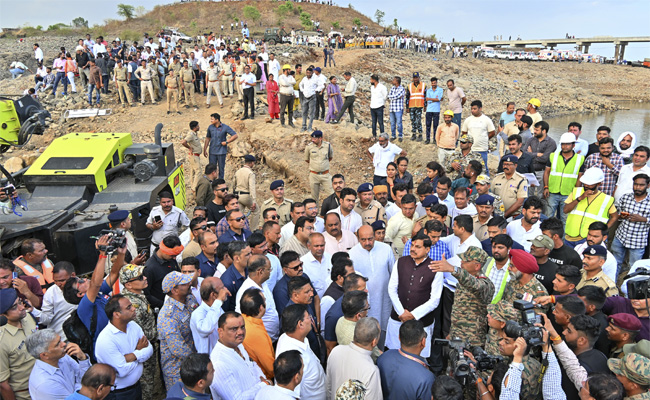
Jabalpur (PTI): Army divers and disaster response teams on Saturday expanded their search at Bargi Dam in Madhya Pradesh to locate a man and three children still missing after the cruise boat tragedy that claimed nine lives two days ago, officials said.
With 28 of the 41 identified passengers onboard the ill-fated cruise boat rescued safely, police are preparing to register an FIR in connection with the accident that occurred at the reservoir in Jabalpur district on Thursday evening, they said.
The search radius has been expanded to 5 km in the backwaters of the Bargi Dam, located downstream of the Narmada River, area sub-divisional officer of police (SDOP) Anjul Ayank Mishra told PTI.
Nine people drowned in the incident, while 28 were rescued, and efforts are ongoing to trace the missing persons, he said.
ALSO READ: Alleging unauthorised sorting of postal ballot covers, TMC files complaint with EC
According to the police, more than 200 rescuers, including around 20 Army divers airlifted from Agra, began the search operation at 5 am on Saturday to trace Kamraj, an employee of the Ordnance Factory in Khamaria, his son Tamil (5), Vijay Soni (6) and Mayuram (5).
Mishra said that an inquest case has been registered and the post-mortem of nine deceased persons has been completed.
"Our priority is to search for the missing persons. We will soon register an FIR," he said.
Investigators have said that CCTV footage near the boarding point showed 43 people heading towards the ill-fated boat, and the names of 41 persons, who boarded the vessel, have been ascertained so far.
Collector Raghvendra Singh confirmed that a search is underway for four missing persons.
The rescue operation, being carried out by the National Disaster Response Force (NDRF), State Disaster Response Force (SDRF) and local divers, was briefly affected around 9 am due to strong winds.
The state government on Friday ordered a probe into the incident and dismissed three crew members after survivors alleged negligence and safety lapses, including failure to provide life jackets.
The government also banned the operation of similar vessels in the state.
The boat, operated by the state tourism department, sank during a sudden storm around 6 pm on Thursday, and the wreckage was retrieved from the dam water on Friday, after the rescuers confirmed that there were no more bodies inside.
Eyewitnesses have said that strong winds made the water choppy, prompting passengers to raise an alarm and ask the crew to steer the vessel towards the riverbank.
A survivor alleged negligence by the crew and described a last-minute scramble for life jackets.