New Zealand's Jacinda Ardern wins 2nd term in election landslide
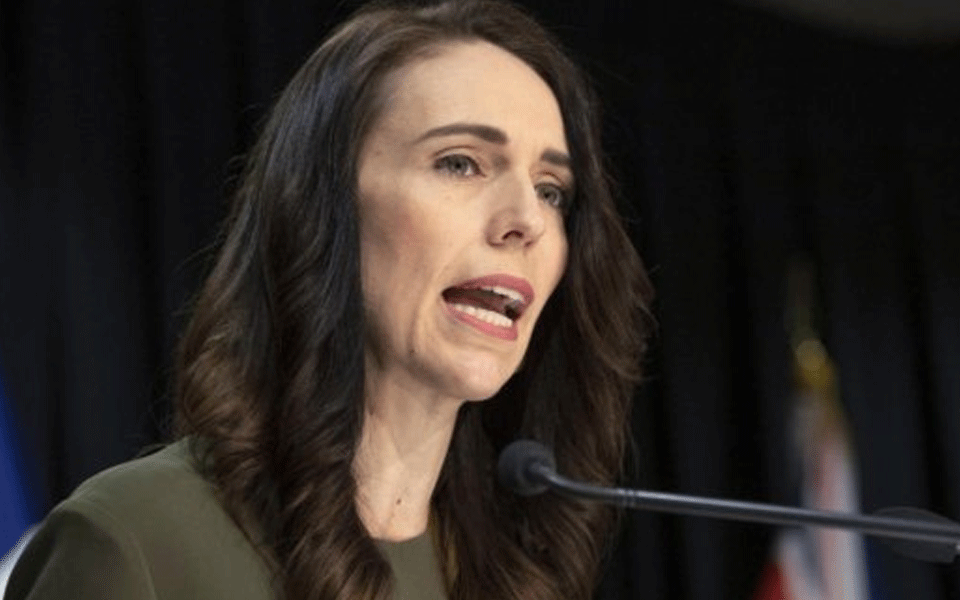
Auckland: New Zealand Prime Minister Jacinda Ardern won a second term in office on Saturday in an election landslide of historic proportions.
With most votes counted, Ardern's liberal Labour Party was winning 49% of the vote compared to 27% for its main challenger, the conservative National Party.
Labour was on target to win an outright majority of the seats in Parliament, something that hasn't happened since New Zealand implemented a proportional voting system 24 years ago. Typically, parties must form alliances to govern, but this time Ardern and Labour can go it alone.
In a victory speech in front of hundreds of cheering supporters in Auckland, Ardern said her party had gotten more support from New Zealanders that at any time in at least 50 years.
This has not been an ordinary election, and it's not an ordinary time, she said. It's been full of uncertainty and anxiety, and we set out to be an antidote to that." Ardern promised not to take her new supporters for granted and to govern for all New Zealanders.
We are living in an increasingly polarized world, a place where, more and more, people have lost the ability to see one another's point of view, she said. I think in this election, New Zealanders have shown that this is not who we are. A record number of voters cast early ballots in the two weeks leading up to the election.
On the campaign trail, Ardern was greeted like a rock star by people who crammed into malls and spilled onto streets to cheer her on and get selfies with her.
Her popularity soared earlier this year after she led a successful effort to stamp out the coronavirus. There is currently no community spread of the virus in the nation of 5 million and people are no longer required to wear masks or social distance.
Ardern, 40, won the top job after the 2017 election when Labour formed an alliance with two other parties. The following year, she became only the second world leader to give birth while in office.
She became a role model for working mothers around the world, many of whom saw her as a counterpoint to President Donald Trump. And she was praised for her handling of last year's attack on two Christchurch mosques, when a white supremacist gunned down 51 Muslim worshippers.
She moved quickly to pass new laws banning the deadliest types of semi-automatic weapons.
In late March this year, when only about 100 people had tested positive for COVID-19, Ardern and her health officials put New Zealand into a strict lockdown with a motto of Go hard and go early. She shut the borders and outlined an ambitious goal of eliminating the virus entirely rather than just trying to control its spread.
With New Zealand having the advantage of being an isolated island nation, the strategy worked. The country eliminated community transmission for 102 days before a new cluster was discovered in August in Auckland.
Ardern swiftly imposed a second lockdown in Auckland and the new outbreak faded away. The only new cases found recently have been among returning travelers, who are in quarantine.
The Auckland outbreak also prompted Ardern to postpone the election by a month and helped increase the early voter turnout.
The National Party's leader, Judith Collins, is a former lawyer. She served as a minister when National was in power and prides herself on a blunt, no-nonsense approach, a contrast to Ardern's empathetic style.
Collins, 61, was promising sweeping tax cuts in response to the economic downturn caused by the virus.
In a speech to her supporters in Auckland, Collins said she'd called Ardern to congratulate her.
It is an outstanding result for the Labour Party, Collins said. It has been a tough campaign." Collins promised that the party would be back to fight another day.
The election also saw Deputy Prime Minister Winston Peters and his small New Zealand First party voted out. The libertarian ACT Party increased its support to 8% and the Green Party won 7.5% of the votes.
Labour Minister David Parker said it was a landslide win for his party. It's a tremendous accolade first and foremost to the prime minister, but also to the wider Labour team and the Labour movement, he said.
In the election, voters also had a say on two contentious social issues whether to legalize marijuana and euthanasia. Polls taken before the election indicated the euthanasia referendum was likely to pass while the outcome of the marijuana vote remained uncertain. The results of both referendums will be announced October 30.
Let the Truth be known. If you read VB and like VB, please be a VB Supporter and Help us deliver the Truth to one and all.
4 workers die after being buried under coal slurry in Jharkhand's Dhanbad

Dhanbad (Jharkhand) (PTI): At least four workers died after being buried under coal slurry in Jharkhand's Dhanbad district on Saturday, a police official said.
The incident took place at Moonidih coal washery in the command area of Bharat Coking Coal Limited (BCCL).
"Bodies of all four workers were dug out of debris during a rescue operation," Putki police station in-charge Waqar Hussain told PTI.
The incident took place when coal slurry was being loaded into trucks by workers, during which a large chunk of slurry fell and trapped several workers underneath, officials said.
The deceased have been identified as Manik Bauri, Dinesh Bauri, Deepak Bauri, and Hemlal Gope.
Meanwhile, the family members of the deceased and local villagers placed the bodies in front of the washery gate and began a protest.
They demanded compensation, jobs for dependents and action against those responsible for the incident.
Police and administration officials are trying to pacify the protesters, an official said.