No money to buy petrol, says Lankan govt as it urges citizens not to queue up for fuel
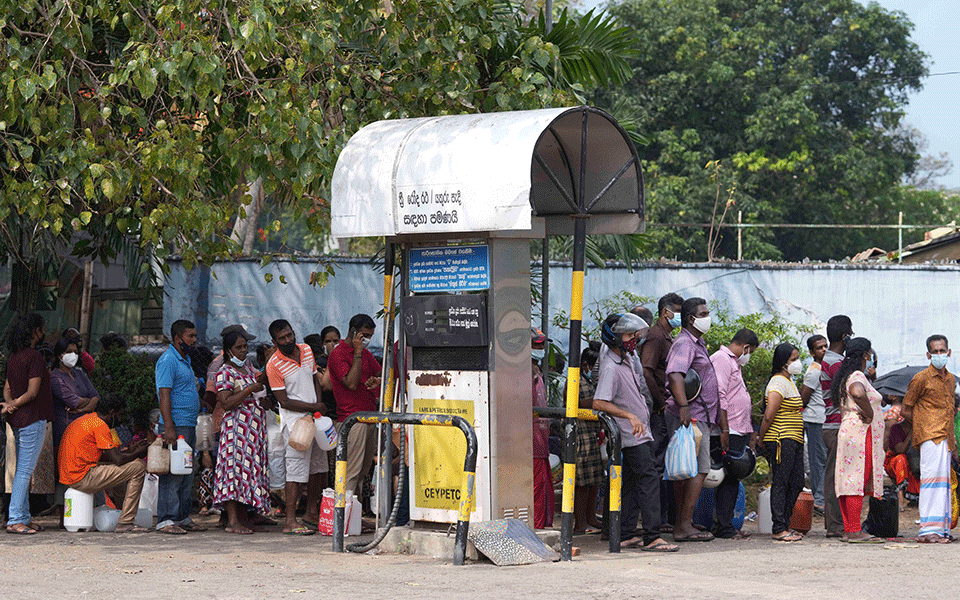
Colombo (PTI): Crisis-hit Sri Lanka on Wednesday revealed that it does not have foreign exchange to pay for a vessel of petrol anchored in its waters for nearly two months as it appealed to citizens "not to wait in line" for fuel.
However, the country has received sufficient stocks of diesel, the government said.
Since March 28, a vessel with petrol has been anchored in Sri Lankan waters, power and energy minister Kanchana Wijesekera told Parliament, confirming that the country is facing an issue of petrol availability, online portal newsfirst.lk reported.
We do not have US dollars to make the payment for the vessel with petrol," he said, adding that another USD 53 million is due for the same vessel for a previous shipment in January 2022.
The minister said the shipping company concerned has refused to release the vessel until both the payments are settled.
Wijesekera said following an assurance from the Central Bank of Sri Lanka to make the previous payment, the company had agreed to release the current vessel after the due payment is made.
However, we are yet to source the fund for this purpose, he said, adding that the ministry is working towards releasing the vessel either on Wednesday or Thursday.
This is why we requested the people not to wait in line for fuel. There is no issue with diesel. But, please do not stay in line for petrol. We have limited stocks of petrol and are trying to distribute it accordingly for essential services, especially ambulances, the minister said.
We apologise for this. We understand that three-wheelers can only operate with the daily fuel purchases. We appeal to the public not to remain in line for fuel on Wednesday and Thursday," he said.
The minister also appealed to the people to stop stockpiling fuel, as there is no way of delivering petrol for the next two days.
Wijesekera said it would take another three days from Friday to complete the distribution of petrol to all filling stations.
Of the 67 proposals made to the ministry on fuel purchases, 39 were identified as practically applicable in Sri Lanka, he said, adding that no matter what proposal is made, the country cannot import petrol without opening the letter of credit.
A letter of credit, also known as a documentary credit or bankers commercial credit, or letter of undertaking, is a payment mechanism used in international trade to provide an economic guarantee from a creditworthy bank to an exporter of goods.
Wijesekera said Sri Lanka has received sufficient stocks of diesel.
On Tuesday, we distributed super diesel and auto diesel to all the filling stations in the country. We hope to ensure the continuous supply of diesel from today (Wednesday) to all the 1,190 active filling stations in the country, although there are 1,300 filling stations, he told the House.
For June 2022, Sri Lanka needs USD 530 million for fuel imports, the minister said, noting that even if the country receives the benefit of an Indian Credit Line, it needs over USD 500 million for fuel purchases per month, compared to the USD 150 million from two years ago.
The high demand for fuel and currency depreciation can be cited as the main reasons for this, he said, revealing that Sri Lanka is to make a payment of over USD 700 million for previous shipments of fuel.
Earlier this month, India extended its current credit line by a further USD 200 million to replenish Sri Lanka's rapidly depleting fuel stocks. India has committed over USD 3 billion to the debt-ridden island nation in loans, credit lines and credit swaps since January this year.
Earlier on Wednesday, Prime Minister Ranil Wickremesinghe told Parliament that USD 160 million has been received from the World Bank and a grant from the ADB (Asian Development Bank) is also expected. However, the money received from the World Bank cannot be used to buy fuel.
We are trying to see if we can use some of it for fuel purchases," he said.
Sri Lanka is going through the worst economic crisis since independence in 1948. A crippling shortage of foreign reserves has led to long queues for fuel, cooking gas and other essentials while power cuts and soaring food prices heaped misery on the people.
The economic crisis also triggered a political crisis in Sri Lanka and a demand for the resignation of the powerful Rajapaksas.
President Gotabaya Rajapaksa sacked his Cabinet and appointed a younger Cabinet as a response to the demand for his resignation. A continuous protest opposite his secretariat has now gone on for well over a month.
On May 9, Gotabaya Rajapaksa's elder brother Mahinda Rajapaksa resigned as the prime minister to make way for the president to appoint an interim all political party government. Wickremesinghe was appointed the country's new prime minister on Thursday.
Let the Truth be known. If you read VB and like VB, please be a VB Supporter and Help us deliver the Truth to one and all.
Vijay''s TVK wins an impressive 108 seats in TN polls
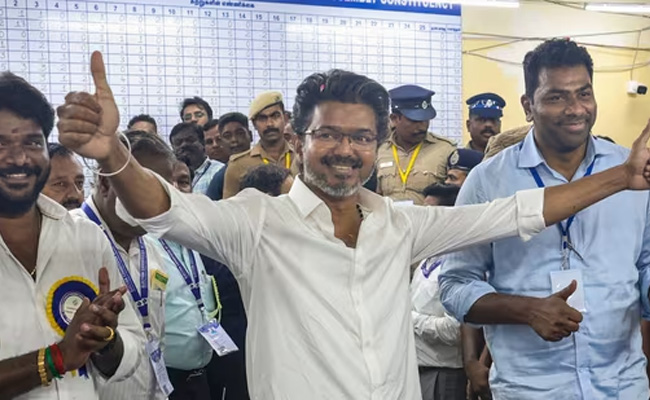
Chennai (PTI): Vijay-led TVK secured an impressive 108 seats trouncing the incumbent DMK led by M K Stalin which finished with only 59 seats in the Tamil Nadu Assembly elections held on April 23, as per the final tally of the ECI on Tuesday.
The opposition AIADMK won 47 seats while its allies the PMK obtained 4 and the BJP and AMMK clinched one seat each respectively in the election, according to the data available on the Election commission of India's website.
The DMK's allies - the Congress managed to win 5 seats, the IUML, CPI, CPI (M), and VCK: 2 each and DMDK secured one seat, among a total of 234 Assembly constituencies in the state.
The votes were taken up for counting on May 4 and the final tally was announced on Tuesday.
Actor-politician Vijay's Tamilaga Vettri Kazhagam on Monday created a record of sorts in the electoral history of Tamil Nadu and emerged as the single largest party by delivering a shock defeat to DMK and its president Stalin in his Kolathur constituency, while the AIADMK was pushed to a distant third spot.
Vijay won from both Perambur and Tiruchirappalli East constituencies.
The TVK has clocked nearly 35 per cent (34.92) vote share in its debut polls.
This will be the first time in Tamil Nadu that a party will assume power a little over two years after its founding in February 2024.