First African-American woman Nobel laureate Toni Morrison dies at 88
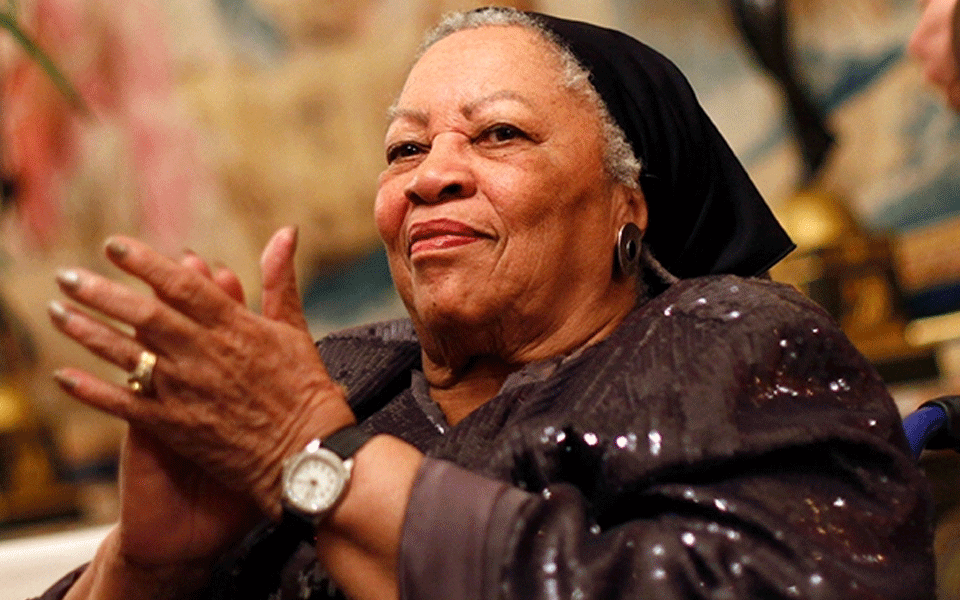
New York: Toni Morrison, the first African-American woman to win the Nobel Prize for Literature and one of America's best loved writers, has died following a brief illness, her family said in a statement Tuesday. She was 88.
"It is with profound sadness we share that, following a short illness, our adored mother and grandmother, Toni Morrison, passed away peacefully last night surrounded by family and friends," they said.
"Although her passing represents a tremendous loss, we are grateful she had a long, well lived life," the statement added, describing her as "the consummate writer who treasured the written word."
Morrison wrote 11 novels, many of them touching on life as a black American, in a glittering literary and award-laden career that lasted over six decades.
She also penned numerous essays, poems and speeches and was often referred to as America's "conscience" for her poignant takes on race and human rights, never afraid of commenting on the day's weightiest political issues.
She won the Pulitzer Prize and the American Book Award in 1988 for her 1987 novel "Beloved." Set after the American Civil War in the 1860s, the story centered on a slave who escaped Kentucky to the free state of Ohio.
The book was later turned into a film starring Danny Glover and Oprah Winfrey. Morrison received numerous other accolades including the Nobel Prize for Literature in 1993.
In 1996, she was honored with the National Book Foundation's Medal of Distinguished Contribution to American Letters.
In 2012, Barack Obama presented her with the Presidential Medal of Freedom and in 2016 she received the PEN/Saul Bellow Award for Achievement in American Fiction.
"She was a great woman and a great writer, and I don't know which I will miss more," Robert Gottlieb, Morrison's longtime editor at Knopf publishers, said in a statement sent to AFP.
Sonny Mehta, chairman of Knopf, said he could "think of few writers in American letters who wrote with more humanity or with more love for language than Toni."
"Her narratives and mesmerizing prose have made an indelible mark on our culture. Her novels command and demand our attention. They are canonical works, and more importantly, they are books that remain beloved by readers," he said.
Morrison was born in Ohio on February 18, 1931. "The Bluest Eye," her first novel, was published in 1970 when she was almost 40 years old.
She followed up with "Sula" in 1973, going on to publish another nine novels, including the acclaimed "Song of Solomon" in 1977 which won the National Book Critics Circle Award.
Her writings touched many, including Obama who recalled reading "Song of Solomon" as a child "and not just trying to figure out how to write, but also how to be and how to think." Morrison's life was also touched by tragedy. In 2010 her son Slade died of pancreatic cancer aged just 45.
She spent time as an editor at Random House and taught at Princeton University. Morrison died at the Montefiore Medical Center in New York on Monday.
Let the Truth be known. If you read VB and like VB, please be a VB Supporter and Help us deliver the Truth to one and all.
Hospital wall collapse: CM orders suspension of executive engineer; kin of victims get solatium

Bengaluru (PTI): Karnataka Chief Minister Siddaramaiah on Thursday ordered the immediate suspension of an executive engineer for the Bowring and Lady Curzon Hospital wall collapse that claimed the lives of seven people, during a high-level review meeting at Vidhana Soudha.
A compensation of Rs 5 lakh, as announced by the CM Siddaramaiah, was distributed to the families of seven victims who lost their lives in the tragedy on Wednesday evening, which occurred due to heavy downpour with gusty winds and hailstorm.
The meeting of municipal commissioners of the five corporations, chaired by the chief minister and attended by Deputy Chief Minister D K Shivakumar, focused on fixing accountability and examining lapses that led to the tragedy.
"Why was soil dumped in a way that damaged the wall? Why did you not monitor this?" Siddaramaiah asked, pulling up hospital authorities during the meeting.
A statement from the chief minister's office said that the CM ordered the immediate suspension of the executive engineer of the Karnataka Health Systems Development Project (KHSDP).
ALSO READ: Three arrested for running fake Aadhaar racket in UP's Badaun
He also questioned the hospital authorities, asking why they failed to monitor the dumping of soil that weakened the structure.
The chief minister directed that a notice be issued to the head of the Hospital.
During the meeting, Siddaramaiah said the rains had caused extensive damage in the city, with over 250 trees uprooted.
The Chief Minister instructed officials to take necessary measures before the onset of the monsoon to avoid untoward incidents.
Commissioners of all five municipal zones in Bengaluru have been asked to take precautionary steps, including trimming dry and dangerous tree branches, the CMO said.
Siddaramaiah also directed them to get the silt cleared from stormwater drains to prevent flooding, and that immediate action be taken to remove debris and fallen branches from roads.
Further, he instructed that barricades be placed at underpasses where water stagnates and restricts public movement.
The Greater Bengaluru Authority (GBA) Chief Commissioner M Maheshwar Rao said in a statement that Shivajinagar MLA Rizwan Arshad distributed compensation cheques of Rs 5 lakh each to the families of the deceased on Thursday.
Seven people, including a six-year-old girl, were killed and seven others injured when the compound wall collapsed amid heavy rain, strong winds and a hailstorm on Wednesday evening.
Police said the victims, comprising three from Bengaluru, two from Kerala on a study tour and one each from Uttar Pradesh and Assam, had taken shelter near the wall when it suddenly gave way, trapping them under the debris.
The chief minister questioned officials over the dumping of soil near the wall despite knowing it could weaken the structure, and directed that a notice be issued to the head of Bowring Hospital.
Siddaramaiah, who had visited the spot soon after the incident along with senior officials, reviewed the situation and ordered a detailed probe into the collapse.