North Korea begins to dismantle missile test site
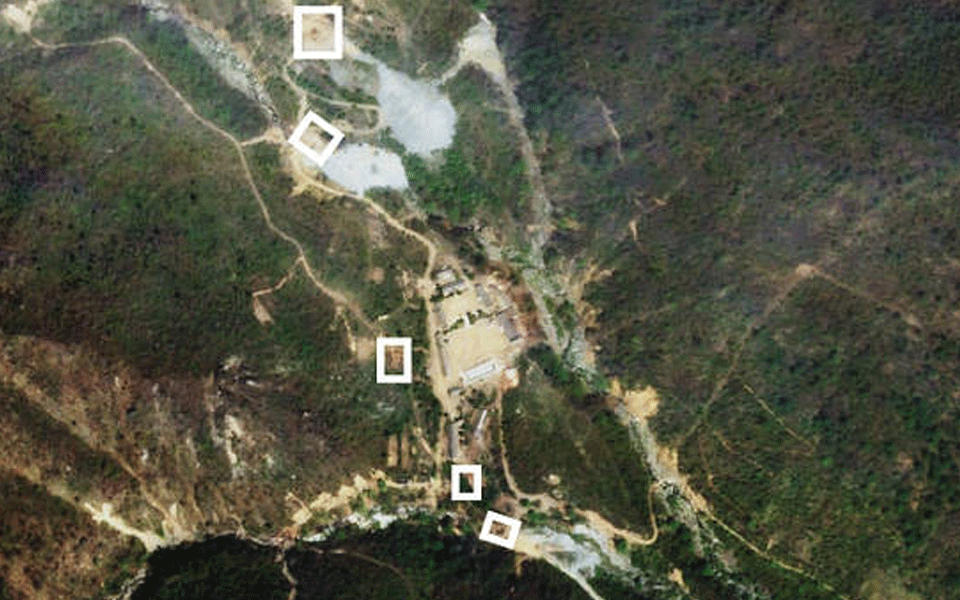
Seoul, July 24 : North Korea has begun to dismantle a missile engine testing site in line with a promise made by its leader Kim Jong-un at his historic summit with US President Donald Trump, according to a US-based monitoring group.
According to 38 North, the images taken from July 20-22 and published by the North Korea-focused website, showed key facilities being dismantled at the Sohae Satellite Launching Station, located in the north Pyongan province, near the country's northwestern border with China.
The facilities included a rail-mounted processing building, used to assemble space launch vehicles before they are moved to the launch pad. Completed around 2011, Sohae is considered the main base for North Korea's space programme and has been used for three important launches.
Also being dismantled was a rocket engine test stand that had been used to build liquid-fuel engines for ballistic missiles and space launch vehicles, Yonhap news agency reported.
"Since these facilities are believed to have played an important role in the development of technologies for the North's intercontinental ballistic missile programme, these efforts represent a significant confidence building measure on the part of North Korea," 38 North said, adding that the work probably began sometime within the past two weeks.
The dismantling of Sohae could help in expediting US-North Korea dialogue after the two sides agreed to improve ties and work for the denuclearization of the peninsula in exchange for Washington guaranteeing the North Korean regime's survival during the June 12 summit in Singapore between the leaders of the two countries.
During his summit with Trump, Kim agreed to dismantle the rocket engine testing facility. The declaration signed by the two sides, however, was criticized for not laying down protocols or concrete steps.
A recent visit by the US Secretary of State Mike Pompeo had also highlighted the different priorities of the two governments and the complexities of a process which could stretch over a long time.
Pyongyang had also urged Seoul and Washington to sign a treaty formally ending the Korean War. The US Department of State responded on Monday by saying that the agreement would be signed after North Korea's denuclearization.
Meanwhile, South Korea reacted positively to reports of the dismantling of the missile site.
Let the Truth be known. If you read VB and like VB, please be a VB Supporter and Help us deliver the Truth to one and all.
Indian startup's 'Drishti' satellite launched aboard SpaceX rocket
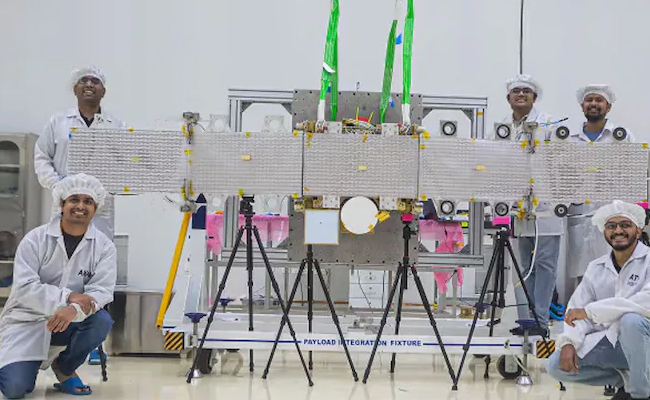
New Delhi (PTI): Bengaluru-based space start-up GalaxEye's Mission Drishti satellite was launched on Sunday aboard SpaceX's Falcon 9 rocket from California.
Mission Drishti is the world's first OptoSAR satellite, integrating electro-optical (EO) and synthetic aperture radar (SAR) sensors into a single operational platform, according to the company.
While EO sensors capture high-resolution images during sunlight and clear skies, SAR sensors provide all-weather and all-time images, using radar pulses.
In a statement, Suyash Singh, founder and CEO of GalaxEye, said, "With the satellite (Mission Drishti) now successfully in orbit, our immediate focus is on completing its commissioning. As we move through this phase, we are already witnessing strong global interest in the differentiated datasets enabled by our OptoSAR payload."
The satellite will help address long-standing limitations of conventional systems and enable more reliable and consistent data acquisition across diverse environmental conditions, the company said.
As a dual-use Earth observation satellite, the mission will support use cases across defence, agriculture, disaster management, maritime monitoring, and infrastructure planning.
The satellite is also expected to complement India's broader initiatives, including the 29 active Earth Observation satellites outlined in ISRO's recent annual report.
The launch came after five years of indigenous research and development, and extensive environmental testing and performance validation of the Mission Drishti.
In a statement, Lt Gen AK Bhatt (Retd), director general of Indian Space Association (ISpA), said, "GalaxEye has achieved what only a few global players have, which is seamlessly combining optical and SAR capabilities on a single platform to enable persistent, all-weather intelligence."
What stands out is not just the technology, but its broader impact on how downstream applications will increasingly define value in the space economy, particularly in Earth observation, where timely, decision-grade insights are critical," he added.
ISpA is the premier industry association of space and satellite companies in the country.
Union Minister Jitendra Singh also took note of the Mission Drishti launch, saying the development marked a significant milestone in India's space journey.
In a post on X, the minister said, "The successful launch of the world's first OptoSAR satellite, and the largest privately-built satellite in the country, reflects the immense potential of our young innovators driving nation-building."
GalaxEye aims to scale up Mission Drishti to a constellation of 10 satellites by 2030, developing a robust and sovereign Earth observation infrastructure for India.