North Korea's Kim gets a close look at Russian fighter jets as his tour narrows its focus to weapons
Seoul, (AP): North Korean leader Kim Jong Un inspected Russia's most advanced fighter jet as he toured an aircraft factory Friday on an extended trip that has raised concerns about banned weapons transfer deals between the increasingly isolated countries.
Since entering Russia aboard his armoured train on Tuesday, Kim has met President Vladimir Putin and visited weapons and technology sites, underscoring deepening ties between the two nations locked in separate confrontations with the West. Foreign governments and experts speculate Kim will likely supply ammunition to Russia for its war efforts in Ukraine in exchange for receiving advanced weapons or technology from Russia.
On Friday, Russia's state media published videos showing Kim's train pulling into a station in the far eastern city of Komsomolsk-on-Amur and Kim's convoy sweeping out of the station on the way to the city's aircraft factory.
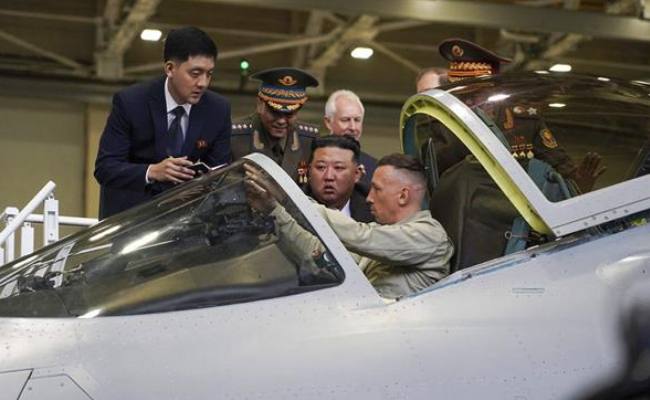
Russia's Cabinet later released video showing Kim, on an elevated platform, looking at the cockpit of the Su-57 - Russia's most sophisticated fighter jet - while listening to its pilot. Kim beamed and clapped his hands when a Su-35 fighter jet landed after a demonstration flight.
According to a Russian Cabinet statement, Kim visited a facility producing Sukhoi SJ-100 passenger planes as well, accompanied by Deputy Prime Minister Denis Manturov.
"We have shown one of our leading aircraft plants to the leader of (North Korea)," Manturov said in the statement. "We are seeing potential for cooperation in the aircraft-making and other industries, which is particularly acute for solving our countries' task of achieving technological sovereignty."
Kim travels next to Vladivostok to view Russia's Pacific fleet, a university and other facilities, Putin told Russian media after he met with Kim on Wednesday.
Putin on Friday briefed Belarusian President Alexander Lukashenko about his summit with Kim. During their meeting in the Black Sea resort of Sochi, Lukashenko suggested that Belarus could join Russia and North Korea in "three-way cooperation."
It was Kim's first foreign trip since April 2019, when he visited Vladivostok for his first meeting with Putin. The 2019 Russian visit came two months after Kim failed to win badly needed sanctions relief from the United States during a second summit with then U.S.-President Donald Trump in Vietnam.
Kim's earlier trip was likely primarily meant to seek Russian help to overcome the brunt of the U.S.-led sanctions. But this time, Putin appears to be desperate to receive North Korean conventional arms to replenish his exhausted inventory in the second year of Russia's war in Ukraine. Experts say Kim, in return, would seek Russian assistance to modernize his air force and navy, which are inferior to those of rival South Korea while Kim has devoted much of his own resources to his nuclear weapons program.
Asked whether Russia asked North Korea to send troops to fight alongside Russian soldiers in Ukraine, Putin flatly dismissed the idea, calling it "sheer nonsense," according to Russia's state media.
Putin reiterated that Russia would abide by U.N. sanctions, some of which ban North Korea from exporting or importing any weapons. Kremlin spokesperson Dmitry Peskov separately said that no agreements on bilateral military cooperation were signed after the Putin-Kim meeting Wednesday.
Experts say it's highly unlikely for North Korea to participate in the Russia-Ukraine war, though it has publicly supported Moscow's invasion. But they say North Korea and Russia aren't likely to publicize any deals on weapons supplies to avoid stronger international criticism.
The Kim-Putin summit took place at the Vostochny Cosmodrome, Russia's most important domestic launch center. The venue is probably linked to North Korean struggles to put into space an operational spy satellite to monitor U.S. and South Korean military movements.
Asked if Russia and North Korea could cooperate in space research, Putin said: "That's why we have come here. (Kim) shows keen interest in rocket technology. They're trying to develop space, too."
Since last year, the US has accused North Korea of providing ammunition, artillery shells and rockets to Russia, likely much of them copies of Soviet-era munitions. South Korean officials said North Korean weapons provided to Russia have already been used in Ukraine.
On Thursday evening, the national security advisers of the U.S., South Korea and Japan talked by phone and expressed "serious concerns" about prospective weapons deals between Russia and North Korea. They warned that Moscow and Pyongyang would "pay a clear price" if they go ahead with such deals, according to South Korea's presidential office.
After a meeting in Seoul discussing the allies' nuclear deterrence strategies, U.S. and South Korean officials on Friday stepped up their condemnation of the recent moves by Russia and North Korea.
Sasha Baker, the U.S. acting undersecretary of defense for policy, said Washington will continue to "try to identify and expose and counter Russian attempts to acquire military equipment, again, to prosecute their illegal war on Ukraine." South Korean Vice Foreign Minister Chang Ho-jin said Washington and Seoul, while tightening security cooperation, would ensure that Moscow faces consequences if it helps advance North Korea's weapons program.
The possibility that Russia may aid North Korea's nuclear program stoked anger in South Korea, where some argued that Seoul could provide lethal arms to Ukraine in retaliation. But South Korea's Defense Ministry said Thursday its policy of not supplying weapons to countries at war remains unchanged. Seoul has far limited its support of Ukraine to nonlethal military supplies and humanitarian items.
Some analysts question how much Russia would be willing to share its closely guarded high-tech weapons technologies with North Korea in return for its conventional arms. But others say Russia would do so because of its urgent need to refill its drained reserves.
Putin told reporters Wednesday that Russia and North Korea have "lots of interesting projects" in areas like transportation and agriculture and that Moscow is providing its neighbor with humanitarian aid.
The Kremlin said Thursday that Putin accepted Kim's invitation to Pyongyang, and that Russian Foreign Minister Sergey Lavrov is expected to visit in October.
At Wednesday's summit, Kim vowed "full and unconditional support" for Putin in what he described as a "just fight against hegemonic forces to defend its sovereign rights, security and interests," in an apparent reference to the war in Ukraine.
Information on Kim's trip to Russia is largely from the two nations' official media outlets. North Korean media did not give updates Friday on Kim. They typically report on his activities a day later, apparently to meet the need for North Korean propaganda to glorify Kim.
Let the Truth be known. If you read VB and like VB, please be a VB Supporter and Help us deliver the Truth to one and all.
AIITA welcomes Karnataka’s ban on obscene songs in school events
Bhatkal: The Karnataka unit of the All India Ideal Teachers Association (AIITA) has welcomed the Karnataka government’s decision to strictly ban school children from dancing to obscene songs during educational and cultural programmes in government, aided, and private schools across the state.
AIITA Karnataka State President M. R. Manvi congratulated the government for taking what he termed an important step to preserve the sanctity of education.
“Such decisions to safeguard the dignity of school children and uphold the values of education are the need of the hour. This rule should not be limited to government schools alone but must be strictly implemented in all private educational institutions as well,” he said.
He further urged the government to address other concerns within school programmes.
“The government should not only prohibit obscene dances in the name of school anniversaries, but also ensure that plays and dialogues that incite religious hatred are avoided. Schools should be centres of harmony, not platforms for spreading hatred,” he added.
According to a recent circular issued by the Department of School Education and Literacy, obscene dances are adversely affecting the mental health and moral values of students.
In this regard, schools have been advised to use songs that promote nationalism, positive thinking, the greatness of Kannada culture, and value-based traditions instead of inappropriate content during programmes.
The circular also emphasises that students should be dressed in decent attire.
AIITA also backed the department’s warning that disciplinary action would be taken against head teachers if such guidelines are violated. The association has further demanded that district Deputy Directors of Public Instruction strictly monitor the implementation of these rules.