Not normal to tolerate Pak’s continued use of terror as instrument of state policy: India
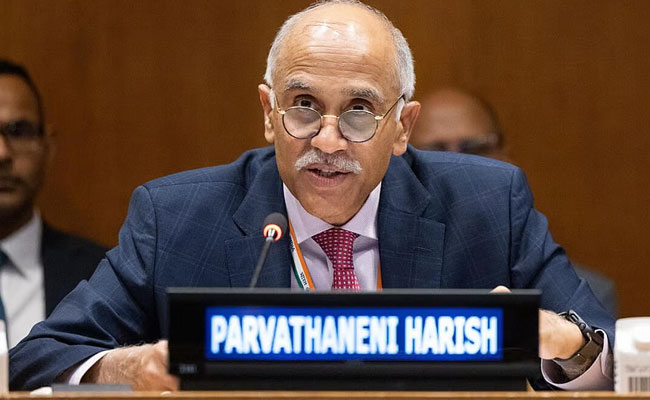
United Nations (PTI): In a strongly-worded retort in the UNSC, India said it is not normal to tolerate Pakistan’s continued use of terrorism as an instrument of state policy, as New Delhi hit back at Islamabad’s envoy for advancing a “false and self-serving” account of Operation Sindoor.
India’s Permanent Representative to the UN, Ambassador Parvathaneni Harish, delivered a sharp response to comments made by Pakistan’s Ambassador to the UN, Asim Iftikhar Ahmad.
Ahmad spoke about Operation Sindoor, Jammu and Kashmir and the Indus Waters Treaty in his remarks at the UN Security Council open debate on Monday on ‘Reaffirming International Rule of Law: Pathways to Reinvigorating Peace, Justice, and Multilateralism.’
Harish said Pakistan, an elected member of the Security Council, has a single-point agenda - to harm India and its people.
With Ahmad telling the Council that Pakistan’s response to Operation Sindoor “established that there can be no ‘new normal’ based on coercion or impunity", Delhi slammed Islamabad, with Harish asserting that terrorism can never be normalised as Pakistan wishes to do.
"We have heard talk from the Representative of Pakistan about the new normal. Let me reiterate again that terrorism can never be normalised as Pakistan wishes to do. It is not normal to tolerate Pakistan’s continued use of terrorism as an instrument of state policy," Harish said, adding that India will do whatever is required to protect and ensure the safety and security of its citizens.
"This hallowed chamber cannot become a forum for Pakistan to legitimise terrorism,” Harish said.
Harish said Pakistan’s envoy “advanced a false and self-serving account” of Operation Sindoor, launched by India in May last year, targeting terror infrastructure in Pakistan and Pakistan-occupied Kashmir in retaliation for the April 22 Pahalgam attack that killed 26 civilians.
“The facts on this matter are clear. Pakistan-sponsored terrorists killed 26 innocent civilians in a brutal attack in Pahalagam in April 2025. This august body itself called for holding the perpetrators, organisers, financiers and sponsors of this reprehensible act of terrorism accountable and brought to justice. That is exactly what we did,” Harish said.
Harish’s reference was to the press statement issued by the Security Council in April last year.
In the statement in which the 15-nation body had condemned in the strongest terms the terrorist attack in Pahalgam and had “underlined the need to hold perpetrators, organisers, financiers and sponsors of this reprehensible act of terrorism accountable and bring them to justice”, with the Council stressing that those responsible for these killings should be held accountable.
Harish underscored that India’s actions in Operation Sindoor were measured, non-escalatory, and responsible, and focused on dismantling the terrorist infrastructure and disabling terrorists.
“Till May 9, Pakistan was threatening more attacks on India. But on May 10, the Pakistani military called our military directly and pleaded for a cessation to the fighting,” he said, adding that the destruction caused to multiple Pakistani airbases by the Indian operation, including images of destroyed runways and burnt-out hangars, is in the public domain.
Hitting out strongly at Pakistan for raising the issue of Jammu and Kashmir, Harish said Pakistan has no locus standi to comment on matters that are internal to India.
“The Union Territory of Jammu and Kashmir has been, is, and will always remain an integral and inalienable part of India,” he said.
On the Indus Waters Treaty, Harish said India had entered into the agreement 65 years ago in good faith, in a spirit of goodwill and friendship.
“Throughout these six and a half decades, Pakistan has violated the spirit of the Treaty by inflicting three wars and thousands of terror attacks on India. Thousands of Indian lives have been lost in Pakistan-sponsored terror attacks,” he said.
In the wake of the Pahalgam terror attack, Harish said India was “compelled to finally announce that the Treaty will be held in abeyance until Pakistan, a global epicentre of terror, credibly and irrevocably ends its support for cross-border and all other forms of terrorism.”
Further, India asserted that Pakistan is well advised to introspect about the rule of law.
"It could start by asking itself how it has let its armed forces engineer a constitutional coup through the 27th amendment and giving life-time immunity to its Chief of Defence Forces,” a reference to the 27th Constitutional Amendment passed in November last year under Prime Minister Shehbaz Sharif that gives Pakistan’s Field Marshal Asim Munir lifelong immunity from any legal prosecution.
Let the Truth be known. If you read VB and like VB, please be a VB Supporter and Help us deliver the Truth to one and all.
Unruly scenes witnessed in Punjab Assembly
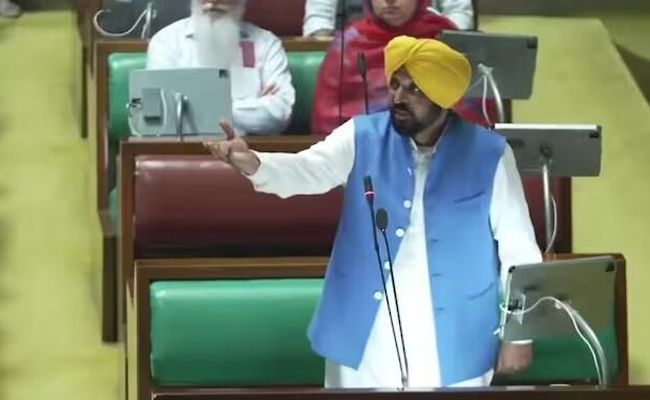
Chandigarh (PTI): The Punjab Assembly on Friday witnessed high drama on Friday after Congress MLA Sukhpal Singh Khaira made an allegedly objectionable remark against Chief Minister Bhagwant Mann during an intense argument over the alleged use of mobile phone in the house by the legislator.
During the one-day special session of the Punjab Vidhan Sabha here, Mann accused Khaira of using a mobile phone when Speaker Kultar Singh Sandhwan was reading out an official resolution on the revision of wages.
After rising from his seat, the chief minister pointed to the speaker, claiming that Khaira is busy on his mobile phone and urged him to ask the Congress MLA what Sandhwan had said about the resolution.
The speaker then asked Khaira to maintain order in the house and listen to the resolution carefully.
Mann then asked Khaira, "Why don't you go out and then use it (mobile phone)," which led to a strong verbal altercation during which the opposition MLA hurled an accusation against the chief minister. Meanwhile, the speaker appealed for order and insisted that the chair be addressed.
However, both Mann and Khaira continued arguing and could be seen pointing fingers at each other as the proceedings of the house were disrupted.
The AAP MLAs also rose from their seats with Finance Minister Harpal Singh Cheema condemning Khaira for his conduct and demanded action against him.
Cheema further alleged that Khaira "always tries to disturb the house" as he spoke about his conduct in the assembly.
The incident occurred as an official resolution on the revision of wages was presented at the special session by Labour Minister Tarunpreet Singh Sond who said it paid homage to labourers on the International Workers' Day.
"Workers are the axis of construction of the nation, the community, the state and society. Every construction project succeeds only through their blood and sweat," the resolution read.
As per the resolution, "The base rate of minimum wages for the working class in Punjab was last revised in the year 2012. Although the dearness allowance has continued to increase since 2012, there has been no increase in the base rate of minimum wages.
On this sacred occasion of May Day, in this special session of the legislative assembly, this house proposes to revise and increase the minimum wages of labourers and strongly recommends to the government to take a decision regarding the increase of minimum wages for workers, so that the contributions of the workers can be acknowledged." PRK