Obama slams Trump-era, warns of 'strongman politics'
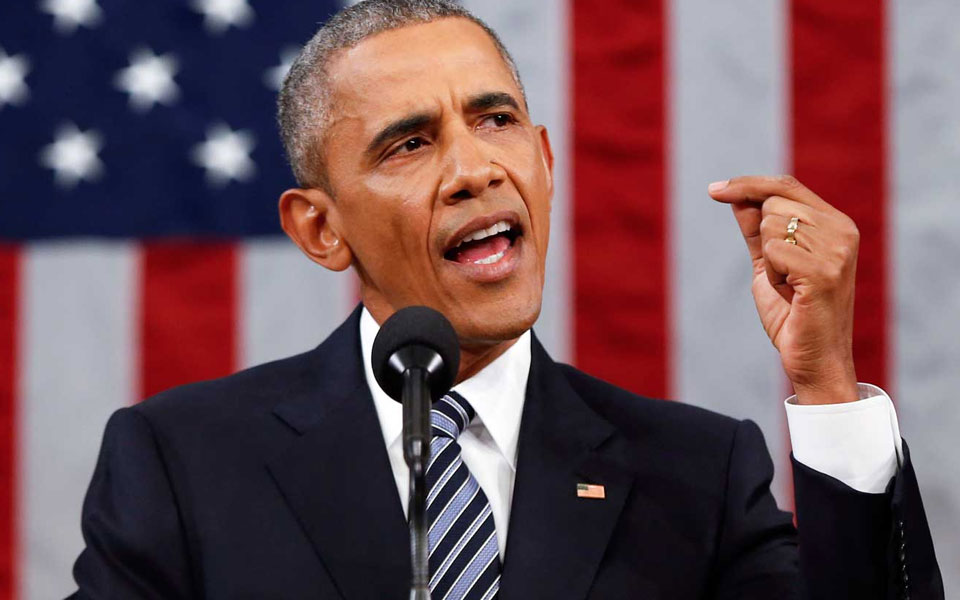
Johannesburg (South Africa), July 18 : Barack Obama has used his first high-profile speech since stepping down as US president to take swipes at "strongman politics" and politicians' disregard for facts.
Obama on Tuesday here mounted a passionate defence of democracy and warned against the politics of the day as his successor, Donald Trump, was heavily criticised for a humiliating news conference on Monday with his Russian counterpart Vladimir Putin, the BBC reported.
In his address in honour of the late Nelson Mandela ahead of the 100th anniversary of his birth, Obama slammed populist movements toward authoritarianism around the world and ridiculed the "utter loss of shame among political leaders" who lie.
Obama, who has made an art of criticising Trump's values without explicitly naming him, peppered his speech on Tuesday with warnings against some of his successor's key policies, including protectionism, climate change denial and closed borders.
"The politics of fear and resentment and retrenchment is on the move at a pace that would have seemed unimaginable just a few years ago," he told the crowd of around 15,000 people in Johannesburg.
"I am not being alarmist, I'm simply stating the facts. Strongman politics are ascendant, suddenly, whereby elections and some pretence of democracy are maintained,... those in powers seek to undermine every institution or norm that gives democracy meaning."
His remarks followed Trump's news conference in Helsinki, Finland, in which the US leader sided with Putin over his own country's intelligence agencies on whether Russia interfered in the 2016 US election, the CNN reported.
Dashing expectations of him confronting Putin over the issue after the US indicted 12 Russians, accused of hacking the Democrat's emails and computer networks to target Hillary Clinton's presidential campaign, Trump sort of toed the Russian line.
"You have to believe in facts. Without facts there's no basis for cooperation. If I say this is a podium and you say this is an elephant, it's going to be hard for us to cooperate," he said.
"I can't find common ground if somebody says that climate change just isn't happening, when almost all the world's scientists tell us it is. I don't know where to start talking to you about this. If you say it's an elaborate hoax, where do we start?"
He said politics today often reject the concept of objective truth. "People just make stuff up. We see it in the growth of state sponsored propaganda, internet fabrications, the blurring of lines between news and entertainment, the utter loss of shame among political leaders...," he said, to laughter in the crowd.
Obama had opened his speech reflecting on the recent chaos of the world that gave him the opportunity to seek perspective.
"But in the strange and uncertain times that we are in -- with each day's news cycles bringing more head-spinning and disturbing headlines -- I thought maybe it would be useful to step back for a moment and try to get some perspective," Obama added.
He warned that the press was under attack, that censorship and state control of media is on the rise and that social media was being used to promote hate, propaganda and conspiracy theories.
"So, on Madiba's 100 birthday, we now stand at a crossroads," he said, using a clan name of affection for Mandela. He said that there was a choice between two visions of humanity's future that the world must choose between.
"Let me tell you what I believe. I believe in Nelson Mandela's vision, I believe in a vision shared by (Mahatma) Gandhi and (Martin Luther) King (Jr), and Abraham Lincoln," he said.
He talked about equality and justice and freedom and multi-racial democracy built on the premise that all people were created equal and were endowed with certain inalienable rights.
Obama's speech at the 16th annual Nelson Mandela Lecture, is one of his highest-profile appearances and his first return to Africa since he left office in 2017.
Let the Truth be known. If you read VB and like VB, please be a VB Supporter and Help us deliver the Truth to one and all.
Double-decker electric bus gutted in fire at Kurla BEST depot
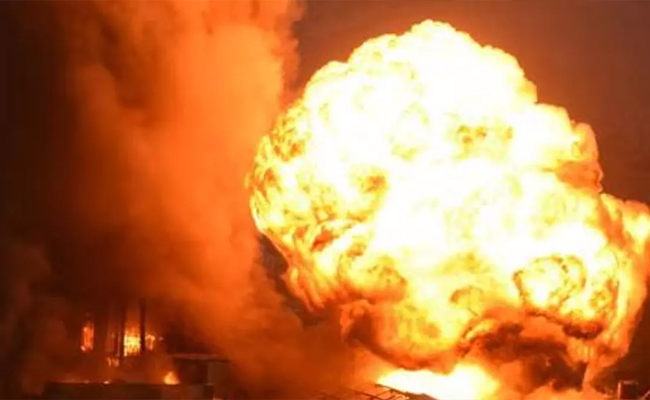
Mumbai (PTI): An empty double-decker electric bus was gutted in a fire during servicing at a BEST depot in Mumbai's Kurla area on Sunday, officials said, adding that nobody was injured.
The blaze broke out inside the Kurla BEST bus depot near Kanakia Building at 4.14 pm, according to preliminary information from the Mumbai Fire Brigade.
The parked bus was unoccupied at the time of the incident.
Fire brigade personnel rushed to the spot and brought the blaze under control. The exact cause of the fire was yet to be ascertained, they said.
No injuries were reported in the incident, officials added.
The Brihanmumbai Electricity Supply and Transport (BEST) Undertaking has hired 50 electric double-decker buses from Switch Mobility in its fleet of around 2,700 buses.