Only severe COVID-19 patients to be tested before discharge: Union health ministry
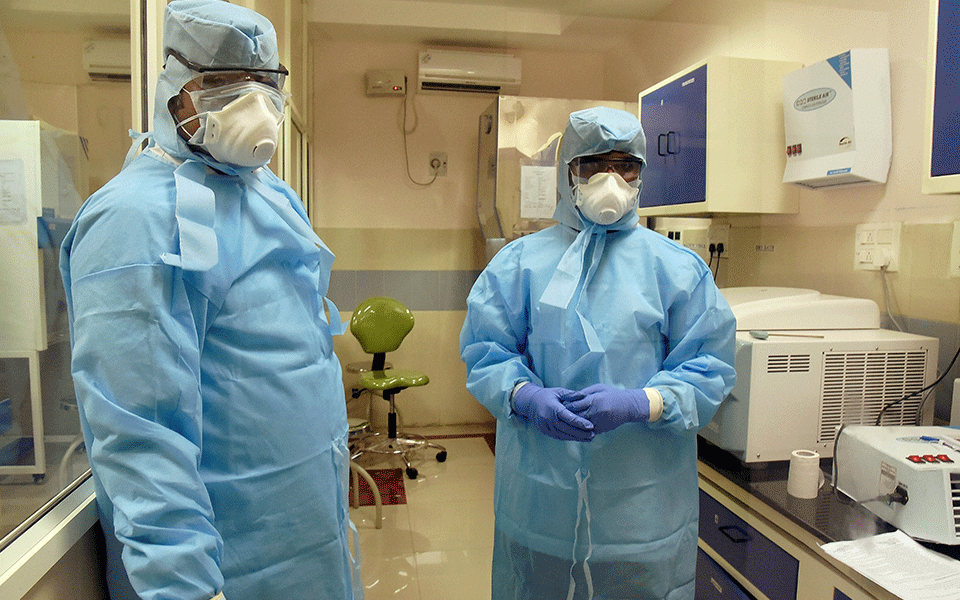
New Delhi: Coronavirus infected patients developing severe illness or having compromised immunity will have to test negative through RT-PCR test before being discharged by a hospital, the Union health ministry on Friday said in its revised discharge policy for COVID-19 cases.
Moderate cases of COVID-19 and pre-symptomatic, mild and very mild cases need not undergo tests before being discharged after resolution of symptoms.
According to the rules till now, a patient was considered fit to be discharged if he or she tested negative on day 14 and then again in a span of 24 hours.
"The revised discharge policy is aligned with the guidelines on the 3 tier COVID facilities and the categorisation of patients based on clinical severity," the ministry said.
The death toll due to COVID-19 rose to 1,981 and the number of cases climbed to 59,662 on Saturday, registering an increase of 95 deaths and 3,320 cases in the last 24 hours, according to the Union health ministry.
The discharge criteria for severe cases, including immunocompromised like HIV patients, transplant recipients, and those having malignancy will be based on clinical recovery and of patient tested negative once by RT-PCR (after resolution of symptoms), the revised policy stated.
Cases clinically classified as "moderate" will undergo monitoring of body temperature and oxygen saturation.
If fever resolves within three days and patient maintains saturation above 95 per cent for the next four days (without oxygen support), such a patient will be discharged after 10 days of symptom onset incase of absence of fever without antipyretics, resolution of breathlessness and no oxygen requirement
"There will be no need for testing prior to discharge," the ministry said. At the time of discharge, patient will be advised to follow home isolation for seven days as per the guidelines.
Patient on oxygenation also falling under moderate category, whose fever does not resolve within three days and demand of oxygen therapy continues, will be discharged only after resolution of clinical symptoms and when they are able to maintain oxygen saturation for three consecutive days.
Mild, very mild and pre-symptomatic cases admitted to a COVID care facility will undergo regular temperature and pulse oximetry monitoring.
"The patient can be discharged after 10 days of symptom onset and no fever for three days. There will be no need for testing prior to discharge," the revised discharge policy stated.
At the time of discharge, patient will be advised to follow home isolation for further seen days as per the prescribed guidelines.
At any point of time, prior to discharge from COVID Care Centre, if oxygen saturation dips below 95 per cent, patient will be moved to Dedicated COVID Health Centre.
After discharge from the facility, if he/she again develops symptoms of fever, cough or breathing difficulty he will contact the COVID Care Centre or state helpline or 1075.
His or her health will again be followed up through tele-conference on day 14, it said.
Let the Truth be known. If you read VB and like VB, please be a VB Supporter and Help us deliver the Truth to one and all.
Man arrested with Rs 2.54-crore heroin in Mumbai

Mumbai (PTI): Police have arrested a man and seized over 500 grams of heroin worth Rs 2.54 crore in the illicit market from him in Mumbai, officials said on Friday.
The police's Anti-Narcotics Cell (ANC) made the drug seizure in Santacruz in the western suburbs. The operation was conducted by the Kandivali unit of the ANC on Thursday as part of a special crackdown against drug trafficking in the area, they said.
Acting on specific inputs, an ANC team conducted a raid in Santacruz (East) and intercepted a man. During a search, the team recovered 508 grams of high-grade heroin from his possession, an official said.
The seized contraband, a highly addictive, opioid drug derived from morphine, is estimated to be worth Rs 2.54 crore in the international market, he informed.
Following the seizure, a case was registered against the man under relevant sections of the Narcotic Drugs and Psychotropic Substances (NDPS) Act, 1985, and he was formally placed under arrest in the early hours of Friday.
The police are currently investigating the source of the drug and trying to identify the intended recipients of the consignment, he said.