No one asked India to stop buying oil from Russia, Union Minister Puri says in US
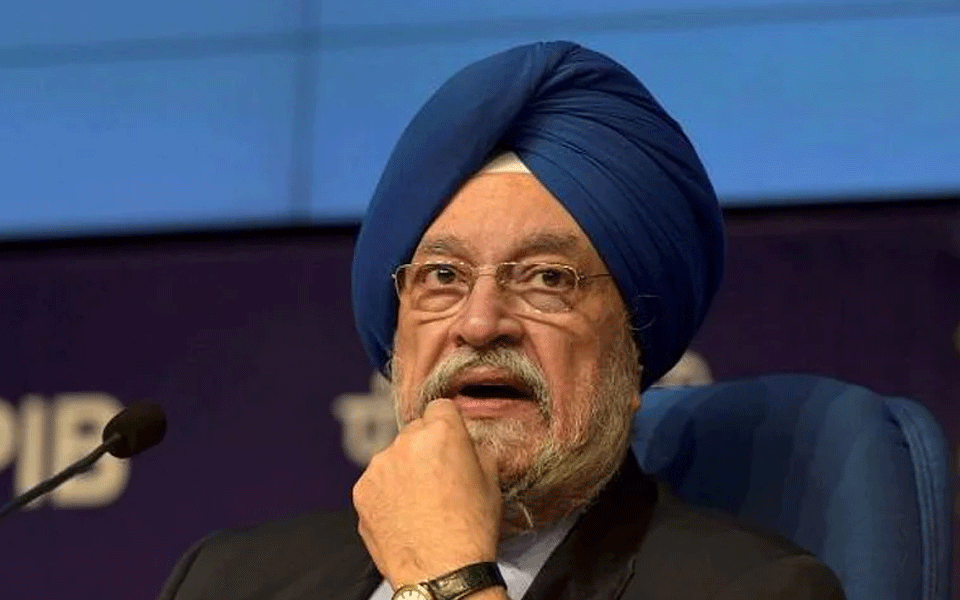
Washington (PTI): India, the world's third-biggest oil importer and consumer will continue to buy oil from any country that it has to, Oil Minister Hardeep Singh Puri said asserting that no country has told New Delhi to stop buying oil from Russia.
India, which has not publicly condemned Moscow for its 'special military action' in Ukraine, has become Russia's No.2 oil buyer after China as Western buyers stopped trading with that country and its oil prices fell.
Puri, who is here for talks with the US authorities on clean energy, said the government has a moral duty to provide energy at affordable rates to consumers.
"India will buy oil from wherever it has to for the simple reason that this kind of a discussion cannot be taken to the consuming population of India," he told a group of Indian reporters here. "Have I been told by anyone to stop buying Russian oil? The answer is a categorical 'no'."
He also expressed confidence that India would be able to mitigate a two million barrels per day cut in production by oil producers' cartel OPEC and its allies, known as OPEC+.
"If you are clear about your policy, which means you believe in energy security and energy affordability, you will buy from wherever you have to purchase energy from sources," Puri said after his bilateral meeting with the US Energy Secretary Jennifer Granholm.
With imports meeting 85 percent of its oil needs, India has been diversifying its sources of oil purchases. Its refiners snapped up discounted Russian oil that was shunned by some Western buyers over Moscow's Ukraine invasion in February.
From making up for just 0.2 percent of all the oil imported, Russia now is India's second-biggest oil supplier after Iraq, accounting for about 18 percent of all oil bought.
At one point Russian Urals crude was more than USD 30 a barrel cheaper than Brent crude (the global benchmark). By the end of September, it was around USD 20 a barrel cheaper.
The Indian government, which has been defending its purchases from Russia on grounds that it has to source oil from where it is cheapest, has so far not shown any inclination to join a plan by the G7 group of nations led by the US to cap the price of oil purchased from Russia as a means of limiting Moscow's revenue.
On the production cut by OPEC+ which has reversed the downward trend in international oil prices, Puri said it was the sovereign right of the producers to decide on the output.
"India is not a part of OPEC. India is at the receiving end of OPEC decisions," he said in response to a question.
"I have always traditionally taken the view (that) it is their sovereign right to decide what they wish to do, how much oil they want to produce, and how much they want to put into the market. But I always say that all of this is subject to the doctrine of consequences intended and unintended," he said.
India, as one of the major consumers of oil and gas, also has a major say in the global oil market, he said.
"That's why I'm deliberately exercising not just calm, but also restraint in commenting on what has happened, because I'm told that there were assurances given, don't ask me whom, etc., that in fact, they were not planning to do this," the minister said.
Puri said the oil producers had last year told India "that this (production adjustment) was a temporary adjustment and what you would see is that by February, the amount of crude which is released into the market would be sufficient to cater to the increasing demand."
"Obviously from March 2020, when the global economy was in a virtual lockdown state, there has been a calibrated opening. But now most of the economies are slowly firing on all cylinders, and therefore there's an increase in demand," he said.
"But the fact of the matter is that large parts of the world today are either in recession or are experiencing conditions (like) recession," he said.
Observing that OPEC's decisions have been widely commented upon, both here and in other parts of the world, he said, "how much of the proposed 2 million barrels which have been curtailed absorbs less production earlier and how many are going to be fresh cuts is something that will be very carefully studied."
"The market was already preparing to have a million barrels cut. So, the announcement of a two-million-barrel cut has taken large parts of the world by surprise and questions are being asked because it stands to reason that if there is a large shortfall in the amounts of energy that are released into the global market, then prices will escalate," the minister said.
And prices escalating would in turn exacerbate the movement towards recession which in turn will lead to a loss of demand. "So, it becomes a vicious cycle," he said.
"Whether that has been fully taken into account or not, it's not for me to comment on the decision that has been taken. But I believe that all decisions which are taken and which have global ramifications have both intended and unintended consequences. How these play out we will see."
During his meeting with US authorities, Puri broached the idea of the India-US Green Corridor, which he said elicited a positive response from his US counterpart.
"The turbulence in the energy markets, and I'm using the word turbulence support carefully, will not allow India's resolve to transition to green clean, and sustainable energy," he said.
The two countries would now look into the broader contours of this ambitious Green Energy Corridor.
India's import from the US is shooting up and currently buying USD 20 billion worth of energy from the United States. There are discussions on buying more from the United States, he said.
While work on green energy would continue, traditional exploration and production of oil and gas would continue as well, he noted.
The world is also in progress on green hydrogen. India and the US have an advantage which at present is not being realised, he added.
Let the Truth be known. If you read VB and like VB, please be a VB Supporter and Help us deliver the Truth to one and all.
Himachal: Three killed, two injured as speeding car dashes against parked truck
Mandi (HP) (PTI): Three people were killed and two others sustained grievous injuries after a speeding car dashed against a stationary truck at Dadour near Nerchowk in Mandi district on Monday late at night, police said on Tuesday.
There were five people in the car when the tragedy struck. Three were declared dead in the hospital while two have been referred to AIIMS Bilaspur.
The deceased were identified as Anil Kumar (28), Rohit Kumar (26) and Subash Kumar (23), all residents of Mandi district, while the injured are Harish and Pankaj.
A case has been registered under relevant sections and investigations are underway, said Superintendent of Police (SP) Mandi Vinod Kumar.
He added that the bodies have been handed over to the family members of the deceased.
In a statement, Chief Minister Sukhvinder Singh Sukhu expressed grief over the loss of three lives in a road accident. He directed the district administration to ensure best possible treatment for the injured and wished them a speedy recovery.