Over 1,000 artefacts missing from Sri Lanka's Presidential Palace, PM's official residence: Police
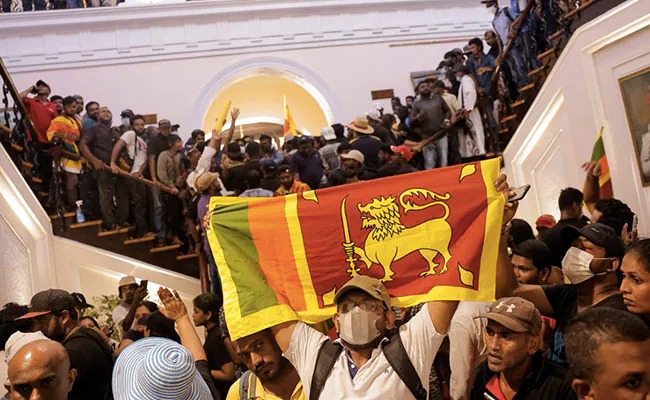
Colombo, Jul 23: More than 1,000 valuable artefacts, including items of vintage and antique value have reportedly gone missing from Sri Lanka's Presidential Palace and Prime Minister's official residence at Temple Trees here after irate anti-government protesters occupied these premises earlier this month, police said on Saturday.
On July 9, anti-government protesters occupied the residences of former President Gotabaya Rajapaksa and former Prime Minister Ranil Wickremesinghe after storming into their premises and setting fire to one of the buildings protesting the government's handling of the unprecedented economic crisis.
Based on initial investigations at least 1,000 items of value, including rare artefacts have gone missing from the Presidential Palace as well as the Prime Minister's official residence, web portal Colombo Page quoted police sources as saying.
Special investigation teams have been formed to begin an investigation, it said.
What is compounding the agony for the investigative officers is that the Sri Lankan Department of Archaeology does not have a detailed record of the antiques and different artefacts at the Presidential Palace, even though it has been gazetted as a place of archaeological importance, the report said.
A senior official of the Department of Archaeology told Sunday Lankadeepa newspaper that it would be difficult to get specific and clear information about the exact number of antiques that have gone missing, even though police estimate that it could be well over 1,000.
Newly-elected President Ranil Wickremesinghe said he respects the rights of the protesters to peacefully undertake their demonstrations, but he asserted that he will not allow another government building like the Presidential Palace or the Prime Minister's private residence to be occupied.
Wickremesinghe said he has authorised Sri Lanka's armed forces and the police to take whatever action is necessary to stop people from storming public facilities and obstructing Parliament.
"Don't obstruct the parliamentarians and the parliament from carrying out their duty," he said this week.
In a pre-dawn raid on Friday, Sri Lankan security forces attacked a site of anti-government protesters at Galle Face, where several government offices are located, injuring at least nine persons.
Let the Truth be known. If you read VB and like VB, please be a VB Supporter and Help us deliver the Truth to one and all.
Delhi: Teenager slashes boy for refusing money for drugs; held

New Delhi (PTI): A 16-year-old boy has been apprehended for allegedly attacking a teenager with a paper cutter near the Red Fort area last month after the victim refused to give him money for drugs, an official said on Tuesday.
The juvenile, who had been absconding after the incident, was also found to be involved in another attempt to murder case registered at Jama Masjid police station, they said.
The case came to light on April 5 when police received information from LNJP Hospital about a 17-year-old boy, a resident of Nangloi, who had been admitted with serious injuries.
The victim had sustained sharp wounds on his neck and abdomen and was unfit to give a statement, the police said.
Preliminary inquiry revealed that the victim quarrelled with an unidentified boy at Parade Ground near the Red Fort, following which he was attacked. A case under relevant sections of the BNS was registered.
A team was constituted to trace the accused, which analysed CCTV footage from the area and identified a suspect seen fleeing the spot. The boy was later identified with the help of local intelligence as a vagabond frequenting the Chandni Chowk area, police said.
Despite multiple raids in Delhi and adjoining areas, the accused remained untraceable. Subsequently, his mobile number was tracked, and technical surveillance led police to Haridwar in Uttarakhand.
On April 29, the police team conducted a raid in a village in Haridwar and apprehended the juvenile after sustained efforts, an officer said.
During questioning, the accused disclosed that he had been living in the Chandni Chowk area for the past two years and was addicted to drugs. On the night of April 4, he allegedly got into an argument with the victim after the latter refused to give him money and slapped him. Enraged, he attacked the boy with a paper cutter, inflicting multiple injuries.
The police said the accused later attacked another person near the Jama Masjid Metro Station on the same night before fleeing to Haridwar.
He also disposed of the weapon and clothes by throwing them from a moving train to evade arrest, they said.
Further investigation is underway, they added.