Over 300 killed in Ghazni city fighting: Afghan Defence Minister
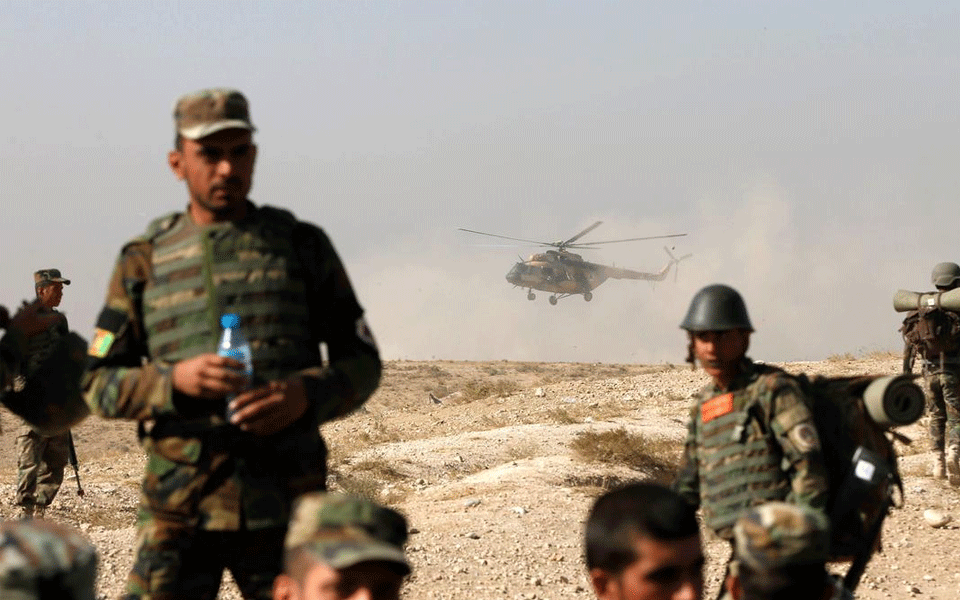
Kabul, Aug 13: Over 300 people, including 100 government troops and 30 civilians, have been killed in the intense fighting between Taliban militants and the security forces in Afghanistan's Ghazni city, the country's Defence Minister Tariq Shah Bahrami said on Monday.
The militant group started its offensive in the city last Friday. "As of midday today, the Afghan National Defence and Security Forces recaptured control of nearly all parts of Ghazni city and the Taliban militants would be expelled from the city soon," Bahrami said at a joint press briefing with Interior Minister Wais Ahmad Barmak.
He said that up to 100 government security force members, 30 civilians and over 194 Taliban militants were killed during the four-day clashes between security forces and Taliban militants in the city, Xinhua news agency reported.
At least 147 militants were injured. The US was supporting the Afghan government forces in conducting airstrikes targeting the Taliban.
Within the past 24 hours, the Defence Ministry deployed reinforcement in Ghazni city and its adjacent areas. Fresh troops will bring considerable changes in the security situation of the city in the next 24 hours, Bahrami added.
Last week, Taliban militants launched a massive attack on Ghazni, 125 km south of Kabul, in a coordinated effort to take back the city. Hundreds of Taliban insurgents stormed important government entities including the National Directorate for Security (Afghanistan's Intelligence Agency) and the provincial governor's office.
"The Afghan police and Army will soon clear Ghazni city from the Taliban and normalcy and peace will return into the city as soon as possible," the Interior Minister said.
The clashes also blocked a main road connecting Kabul to southern and western provinces and scores of travellers were stranded.
According to authorities, about 100 soldiers of the Afghan special force were missing in the Ghazni province. President Ashraf Ghani ordered more troops to be sent to the city.
Meanwhile, the UN Office for the Coordination of Humanitarian Affairs (OCHA) warned that residents of Ghazni were struggling to access basic services and medical care.
"Medication at the main hospital is reportedly becoming scarce... Main access roads both north and south of the city to larger cities where medical facilities are available are contested and unsafe for people to travel," the OCHA said in a statement.
"We call on all parties to the conflict to respect their obligations under international humanitarian law to protect the lives and rights of civilians and to protect civilian infrastructure," it said.
Let the Truth be known. If you read VB and like VB, please be a VB Supporter and Help us deliver the Truth to one and all.
Tribals, Scheduled Castes preserved India's identity and soul despite foreign invasions: Bhagwat
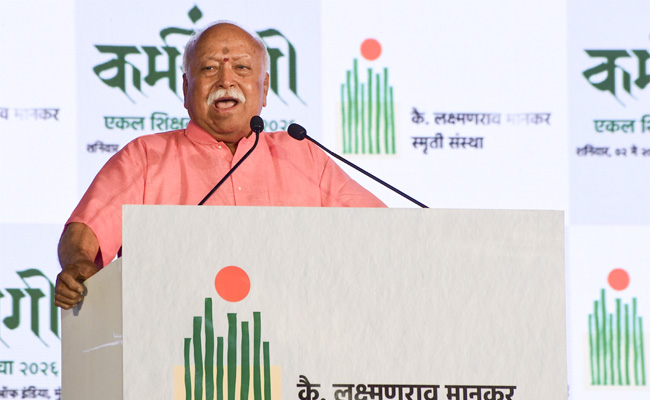
Mumbai (PTI): RSS chief Mohan Bhagwat has said that despite foreign invasions and hardships, tribal communities and Scheduled Castes preserved the country's identity and soul, stressing the need to integrate them into the mainstream development process.
He was speaking on Saturday at the Karmayogi awards ceremony in Mumbai, where Union Road Transport and Highways Minister Nitin Gadkari was also present.
"Human life is defined by giving back to the world, as we are all part of one great family. A person works and spends for the betterment of society, not as a favour, but out of duty. In serving others, we foster our own development. By helping others to thrive, we elevate ourselves and grow as human beings. This principle is the core value of this Indian land, commonly known as a Hindu society," Bhagwat said.
"This is the society's enduring ethos, which has survived for thousands of years. For various reasons, partly because of our indifference and partly because of foreign invasion, those who preserved this ethos paid a heavy price," he said.
The foreign invaders found that this ethos, this value system of the society is its soul and the key to keeping it alive. So they ensured that those who tried to preserve this soul would be uprooted and face extreme hardships, the Rashtriya Swayamsevak Sangh (RSS) chief noted.
But despite foreign invasions and hardships, tribal communities and Scheduled Castes preserved the country's identity and its soul, he said.
"Despite such adversities, the country's core identity remained intact among tribal communities and those belonging to SC and ST groups," he said, emphasising the need to integrate them into the mainstream development process while ensuring they receive equal access to services and facilities.
Referring to global developments, Bhagwat said the present world is "stumbling forward" and struggling to maintain balance, and asserted that India could emerge as a stabilising force.
The country must not only safeguard its own interests but also extend support to the world, he said.
"The world should get to see that the country is not only solving its own misery and sorrow but also helping the world to address similar issues," he said.
The RSS chief stressed that service to society is not a favour but a duty that contributes to one's own development.
Helping others grow also elevates individuals and strengthens the collective fabric of society, he said.
The so-called educated and developed sections have, over time, distanced themselves from these communities, Bhagwat pointed out, and called for the need to bridge this gap.
The identities preserved by these communities represent the true identity of Indian society, he said and underlined that without identity, existence itself is at risk.