Over 400 media figures urge BBC to remove board member over alleged Gaza bias

London: More than 400 media professionals, including 111 current BBC journalists, have signed an open letter calling for the removal of BBC board member Sir Robbie Gibb, citing concerns about his alleged influence on the broadcaster’s coverage of Gaza.
Addressed to BBC Director-General Tim Davie and the BBC Board, the letter accuses Gibb, a former political advisor to ex-Prime Minister Theresa May, of compromising the BBC’s editorial independence due to his prior association with The Jewish Chronicle, a publication often criticised for its anti-Palestinian stance. Gibb served as a director at the paper until August 2024.
The signatories argue that Gibb’s position on the BBC Board and the Editorial Guidelines and Standards Committee is “untenable” given his role in the 2020 acquisition of The Jewish Chronicle. They allege his presence has contributed to a pattern of editorial decisions that marginalise Palestinian perspectives.
Central to the controversy is the BBC’s decision to shelve the documentary Gaza: Medics Under Fire, which Channel 4 later broadcast. The documentary includes accounts of detention, torture, and killings of medical workers in Gaza. The letter states, “We believe the refusal to broadcast the documentary Gaza: Medics Under Fire is just one in a long line of agenda-driven decisions.”
Among the signatories are public figures including actress Miriam Margolyes, filmmaker Mike Leigh, actor Charles Dance, and historian William Dalrymple. The letter alleges that the BBC has repeatedly failed to reflect the realities of the situation in Gaza and the West Bank, citing a “gulf between BBC’s coverage and what our audiences can see is happening via multiple credible sources, including human rights organisations, UN staff, and journalists on the ground.”
A January 2025 analysis by Declassified UK is also referenced in the letter. The analysis criticised the BBC’s limited coverage of UK-Israel military and political ties, including arms transfers using British airspace, visits by Israeli military officials, and lobbying in Westminster.
Former BBC presenter and footballer Gary Lineker also weighed in, saying the BBC “should hold its head in shame” for not airing the Gaza documentary.
In response, a BBC spokesperson defended the organisation’s editorial process, stating, “Robust discussions amongst our editorial teams about our journalism are an essential part of the editorial process.” The BBC pointed to recent programmes including Life and Death in Gaza and Gaza 101 as evidence of its commitment to balanced reporting.
The Centre for Media Monitoring (CfMM) had also criticised the BBC in a 180-page report last month. The study, titled BBC on Gaza-Israel: One Story, Double Standards, analysed over 3,800 articles and 32,000 broadcast segments, concluding that the BBC systematically downplayed Palestinian suffering while giving disproportionate coverage to Israeli perspectives.
Let the Truth be known. If you read VB and like VB, please be a VB Supporter and Help us deliver the Truth to one and all.
Two injuries, one DNF, a DQ as India end messy World Relays campaign
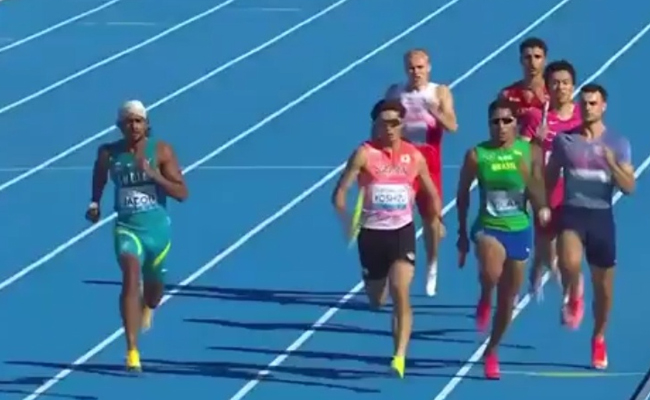
Gaborone (Botswana) (PTI): Amoj Jacob and Ragul Kumar got injured during the men's 4x400m and 4x100 races respectively as India ended their World Athletics Relays campaign in disappointment on the second day of competitions here on Sunday.
The Indian camp had high hopes of making the 2027 World Championships in the men's 4x400m relay but the team did not finish (DNF) the race as Jacob suffered cramps and pulled out of the race after taking the baton from the first leg runner Dharamveer Choudhary. Rajesh Ramesh and Vishal TK were to run in the third and fourth legs.
Those teams which could not qualify for the 2027 Beijing World Championships by reaching the final round of each of the six relay events on Saturday were given another chance in the second qualification round on Sunday.
The top two teams in each of the two heats (in all six relay events) booked the Beijing ticket on Sunday.
India will now have to try and qualify for the World Championships through the Top Lists of the World Athletics, which is a long and tedious process.
In the men's 4x100m race, third leg runner Ragul Kumar fell down the track after failing to hand over the baton inside the exchange zone to fourth leg runner Gurindervir Singh, which clearly showed the lack of coordination among the runners.
Harsh Santosh Raut and Animesh Kujur ran the first two legs.
The Indian quartet was disqualified and Kumar was seen being taken away from the Field of Play with the help of the volunteers.
It was a comedy of errors in the case of the women's 4x100m race, which saw the baton being dropped during an exchange between first leg runner Tamanna and second runner Nithya Gandhe, though the Indians finished the race in 53.09 seconds.
Gandhe started running quite a distance, but after realising that the baton was not in her hand, she turned and ran back to pick it up.
The only silver-lining for the Indian contingent was the national record time in the mixed 4x100m relay race, though the quartet of Ragul Kumar, Nithya Gandhe, Animesh Kujur and Sneha SS finished sixth in heat number two with a time of 41.35 seconds, bettering the previous national mark of 42.30 seconds set in March in Chandigarh.
The mixed 4x400m relay quartet of Theerthesh P Shetty, Kumari Saloni, Nihal William and Rashdeep Kaur ended at fifth in heat number one with a time of 3 minutes and 19.40 seconds.
On Saturday, all the five Indian relay teams had failed to make it to the respective final rounds and thus missed out on the 2027 World Championships berths.