Pacific quake sets off tsunami, threat lifts in New Zealand
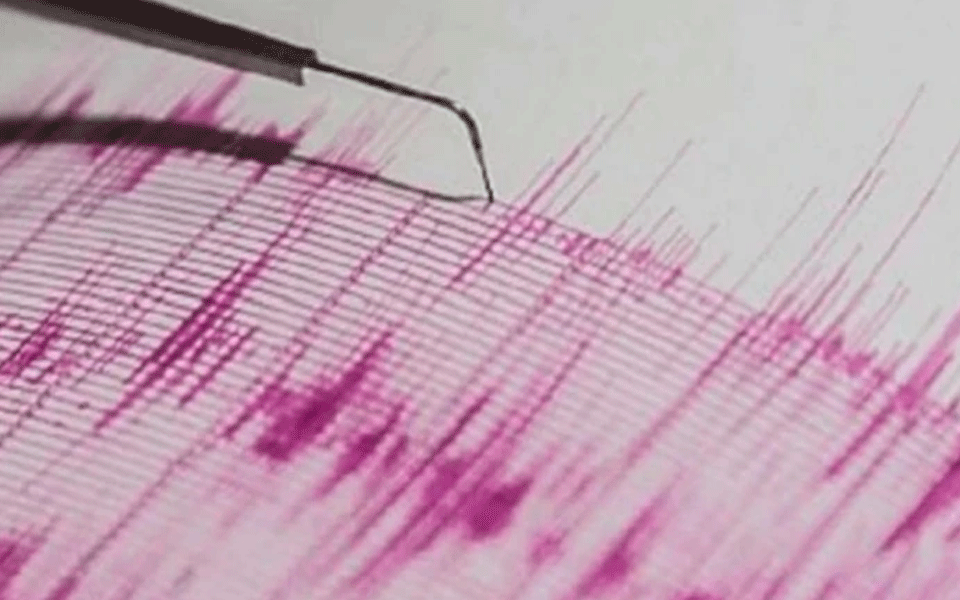
Wellington: One of the strongest earthquakes to hit the South Pacific in modern history triggered tsunami warnings across the ocean and forced thousands of people in New Zealand to evacuate coastal areas Friday. Small tsunami waves were seen, but little damage was apparent hours later.
The magnitude 8.1 quake in the Kermadec Islands region about 1,000 kilometers from New Zealand was the largest in a series of tremors over several hours, including two earlier quakes that registered magnitude 7.4 and magnitude 7.3.
The tsunami threat caused traffic jams and some chaos in New Zealand as people scrambled to get to higher ground.
Residents recorded videos of small wave surges in some places, including at Tokomaru Bay near Gisborne. In the afternoon, the National Emergency Management Agency said the threat had passed and people could return to their homes, although they should continue avoiding beaches.
One of the earlier quakes hit much closer to New Zealand and awoke many people as they felt a long, rumbling shaking. "Hope everyone is ok out there," New Zealand Prime Minister Jacinda Ardern wrote on Facebook during the night.
After the largest quake, civil defense authorities in New Zealand told people in some coastal areas to immediately get to higher ground. They said a damaging tsunami was possible, and waves could reach up to 3 metres.
Emergency Management Minister Kiri Allan told reporters that people had followed the advisory.
"They felt the long or strong earthquakes and they knew to grab their bag and head into the highlands," she said. "I can only thank and acknowledge the tireless efforts of the men and women from up and down the coast who knew how to act, when to act, and what to do."
The Pacific Tsunami Warning Centre cautioned the quake could cause tsunami waves of up to 3 metres in Vanuatu and up to 1 metre in Fiji, French Polynesia and as far away as Mexico and Peru.
Waves of 30 centimeters were measured by ocean gauges in Vanuatu, New Zealand and islands off Australia.
The US Geological Survey said the strongest quake was centred near the remote Kermadec Islands at a depth of 19 kilometers.
The agency said in a report that the quake occurred at the intersection of the Pacific and Australia tectonic plates and eclipsed the largest quake previously recorded in the region, a magnitude 8.0 in 1976.
It said the interaction between the plates creates one of the most seismically active regions in the world, and it has recorded 215 quakes there above magnitude 6.0 over the past century.
Jennifer Eccles, an earthquake expert at the University of Auckland, said the quake was at the top end of the scale for those involving only the Earth's ocean crust.
"This is about as big as it gets," she said.
She said most quakes larger than magnitude 8.0 tend to occur when a section of more robust continental crust is involved.
The US Geological Survey said the magnitude 7.4 quake was likely a "foreshock" that contributed to the larger quake but that the first quake that hit closer to New Zealand was too far away in time and distance to have directly contributed.
The first quake was centred at a depth of 21 kilometers under the ocean about 174 kilometers northeast of the city of Gisborne.
It was widely felt in New Zealand, and residents in the major cities of Auckland, Wellington and Christchurch reported being shaken awake.
In 2011, a magnitude 6.3 quake hit the city of Christchurch, killing 185 people and destroying much of its downtown.
Let the Truth be known. If you read VB and like VB, please be a VB Supporter and Help us deliver the Truth to one and all.
Two held for 'firing' at BJP leader's house in Bengal

Kolkata (PTI): A day before the counting of votes for the West Bengal assembly elections, two persons were arrested on Sunday for allegedly being involved in a firing incident outside the residence of a BJP leader in North 24 Parganas district, police said.
BJP leader Kundan Singh lodged a police complaint, alleging that a few gunmen fired at his house in the Noapara constituency around Saturday midnight.
Based on the CCTV footage, the two accused were apprehended, a senior officer said.
BJP's Noapara candidate Arjun Singh, in a post on social media, claimed that around 12.05 am, two armed miscreants arrived on a motorcycle at the residence of Kundan Singh, a BJP functionary and secretary of the Barrackpore organisational district, with an "intent to kill him".
According to the BJP leader, the accused are residents of Garulia and are known criminals.
Their names as offenders had been submitted to the Election Commission, he said.
The police officer did not specify whether the two arrested persons were the same individuals named by Arjun Singh.
According to the complaint, one round of firing took place outside Kundan Singh's house, triggering panic in the area.
The BJP candidate also questioned the role of the police, claiming that one of the accused had been detained by the police on the polling day but was later released in the evening.
The Noapara assembly seat went to the polls on April 29.
Several BJP leaders alleged that attempts were being made to create an atmosphere of fear ahead of the counting and weaken the organisation of the opposition parties.
The counting of votes will take place on May 4. Polling for the West Bengal assembly elections was held on April 23 and April 29.
The BJP urged the Election Commission to intervene immediately to ensure peaceful counting.
TMC candidate Somnath Shyam rubbished Arjun Singh’s allegation, claiming that the BJP nominee had orchestrated the firing incident to divert attention from imminent defeat.
“Arjun Singh knows all the gangsters in the Barrackpore belt. Everyone knows about his links with the underworld. Let the police investigate the incident,” Shyam said.