Pakistan and India conflict was 'very big', I settled that: Trump
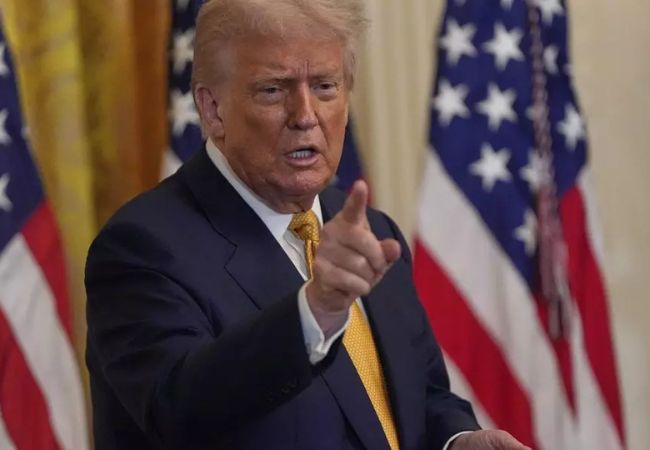
New York/Washington (PTI): US President Donald Trump on Tuesday repeated his claim that he ended the “very big” conflict between nuclear-armed India and Pakistan.
In his remarks to military leaders in Quantico, Trump also said that he was "honoured" when Pakistan Army chief Field Marshal Asim Munir, "who is a very important guy in Pakistan", praised him for saving millions of lives.
"I have settled so many wars" in the nine months of his administration, he said. "I've settled seven. And yesterday we might have settled the biggest of them all, although I don't know, Pakistan and India was very big, both nuclear powers. I settled that.”
Referring to his peace plan to end the Gaza conflict, announced on Monday, Trump said, “We got it, I think, settled. We'll see. Hamas has to agree, and if they don’t, it's going to be very tough on them. But it is what it is. But all of the Arab nations, Muslim nations, have agreed.”
In his remarks, Trump again went back to the conflict between India and Pakistan and praised the Pakistani officials for lauding him for saving millions of lives.
“I had India and Pakistan, (they) were going at it. And I called them both, and in this case, I used trade,” Trump said.
Trump said he told the “two big nuclear nations” that he is “not going to trade" with them. They responded, "'No, no, no, no, you cannot do that'. I said, 'yes, I can. You go into this freaking war that I'm hearing about’,” Trump said, adding that they shot down seven planes. He, however, did not specify which country's jets he was referring to.
“It was starting. There's a lot of bad blood. And I said, ‘You do this, there is not going to be any trade'. And I stopped the war. It was going, it was raging for four days, but that was just the beginning, and we stopped it. It was a great thing,” Trump said.
Last week, Pakistan Prime Minister Shehbaz Sharif and Army Chief Munir met Trump in the White House.
Trump said the Prime Minister of Pakistan “was here along with the Field Marshal, who's a very important guy in Pakistan, and he was here three days ago. And I didn't even realise it, as beautiful as he said it, but he said that to a group of people that were with us, two generals, but a group, he said, ‘This man saved millions of lives because he saved the war from going on, and that war was going to get very bad, very, very bad. President Trump saved millions and millions of lives. That was a bad war’.”
Trump said he “was very honoured. I loved the way he (Munir) said it.”
He added that White House Chief of Staff Susie Wiles was there at the meeting too, and "she said that was the most beautiful thing. But we saved a lot of them. Saved a lot of them.”
Since May 10, when Trump announced on social media that India and Pakistan had agreed to a “full and immediate” ceasefire after a “long night” of talks mediated by Washington, he has repeated his claim nearly 50 times that he “helped settle” the tensions between India and Pakistan.
In his address to world leaders from the UN podium last week, Trump repeated his claim that he stopped the conflict between India and Pakistan.
India has been consistently maintaining that the understanding on cessation of hostilities with Pakistan was reached following direct talks between the Directors General of Military Operations of the two militaries.
Prime Minister Narendra Modi has made it clear in Parliament that no leader of any country asked India to stop Operation Sindoor.
Trump had said he was told that if he could stop the conflict between Russia and Ukraine, he should get the Nobel Prize.
"I said, 'Well, what about the seven others? I should get a Nobel Prize for each one'. So they said, 'but if you stop Russia and Ukraine, sir, you should be able to get the Nobel'. I said I stopped seven wars. That's one war, and that's a big one," he said.
He added that he had thought the Russia-Ukraine conflict would be easy to resolve "because I have a good relationship with President Putin, disappointed in him, but I do. I thought that would be the easiest one, but we'll get it done one way or the other."
Let the Truth be known. If you read VB and like VB, please be a VB Supporter and Help us deliver the Truth to one and all.
Tribals, Scheduled Castes preserved India's identity and soul despite foreign invasions: Bhagwat
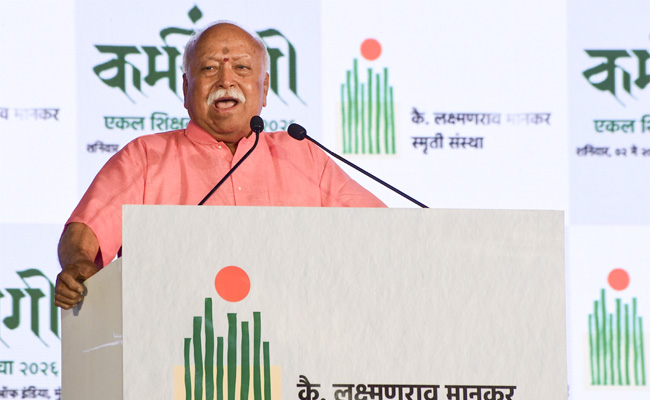
Mumbai (PTI): RSS chief Mohan Bhagwat has said that despite foreign invasions and hardships, tribal communities and Scheduled Castes preserved the country's identity and soul, stressing the need to integrate them into the mainstream development process.
He was speaking on Saturday at the Karmayogi awards ceremony in Mumbai, where Union Road Transport and Highways Minister Nitin Gadkari was also present.
"Human life is defined by giving back to the world, as we are all part of one great family. A person works and spends for the betterment of society, not as a favour, but out of duty. In serving others, we foster our own development. By helping others to thrive, we elevate ourselves and grow as human beings. This principle is the core value of this Indian land, commonly known as a Hindu society," Bhagwat said.
"This is the society's enduring ethos, which has survived for thousands of years. For various reasons, partly because of our indifference and partly because of foreign invasion, those who preserved this ethos paid a heavy price," he said.
The foreign invaders found that this ethos, this value system of the society is its soul and the key to keeping it alive. So they ensured that those who tried to preserve this soul would be uprooted and face extreme hardships, the Rashtriya Swayamsevak Sangh (RSS) chief noted.
But despite foreign invasions and hardships, tribal communities and Scheduled Castes preserved the country's identity and its soul, he said.
"Despite such adversities, the country's core identity remained intact among tribal communities and those belonging to SC and ST groups," he said, emphasising the need to integrate them into the mainstream development process while ensuring they receive equal access to services and facilities.
Referring to global developments, Bhagwat said the present world is "stumbling forward" and struggling to maintain balance, and asserted that India could emerge as a stabilising force.
The country must not only safeguard its own interests but also extend support to the world, he said.
"The world should get to see that the country is not only solving its own misery and sorrow but also helping the world to address similar issues," he said.
The RSS chief stressed that service to society is not a favour but a duty that contributes to one's own development.
Helping others grow also elevates individuals and strengthens the collective fabric of society, he said.
The so-called educated and developed sections have, over time, distanced themselves from these communities, Bhagwat pointed out, and called for the need to bridge this gap.
The identities preserved by these communities represent the true identity of Indian society, he said and underlined that without identity, existence itself is at risk.