Pakistan and India, they were going at it, I ended the war: Trump
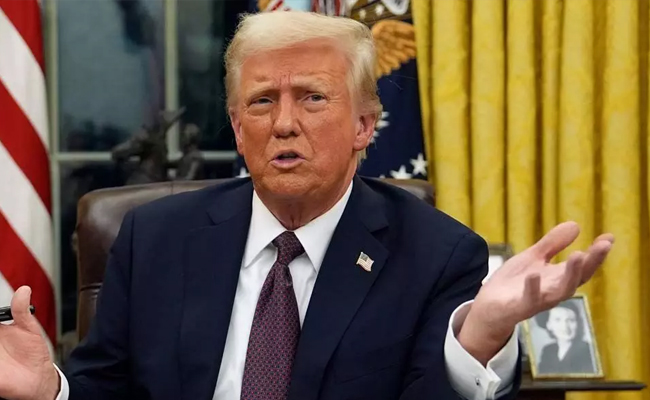
New York/Pennsylvania (PTI): US President Donald Trump said India and Pakistan “were going at it” and he ended the conflict between the two nuclear-armed neighbours, repeating the claim once again.
Trump has so far repeated the claim nearly 70 times that he stopped the conflict in May between India and Pakistan.
“In 10 months, I ended eight wars, including Kosovo (and) Serbia, Pakistan and India, they were going at it. Israel and Iran, Egypt and Ethiopia.… Armenia and Azerbaijan,” Trump said on Tuesday in remarks to his supporters at a rally on the economy in Mount Pocono, Pennsylvania.
India launched Operation Sindoor on May 7, targeting terror infrastructure in Pakistan and Pakistan-occupied Kashmir in retaliation for the April 22 Pahalgam attack that killed 26 civilians.
ALSO READ: Canada's top envoy to US will resign before review of free trade agreement
India and Pakistan reached an understanding on May 10 to end the conflict after four days of intense cross-border drone and missile strikes.
India has consistently denied any third-party intervention in resolving the conflict.
Meanwhile, Trump said Cambodia and Thailand have started fighting again and “tomorrow”, he will make a phone call to those countries.
“Who else could say I'm going to make a phone call and stop a war of two very powerful countries, Thailand and Cambodia. They are going at it. But I’ll do it. So we're making peace through strength. That's what we're doing,” Trump said.
On immigration, Trump said that for the first time in 50 years, “we now have reverse migration, which means more jobs, better wages and higher income for American citizens, not for illegal aliens.”
He said that he has announced a permanent pause on “Third World migration”, including from “hellholes" like Afghanistan, Haiti, Somalia and many other countries.
“…Why can't we have some people from Norway, Sweden, just a few. Let's have a few from Denmark. Do you mind sending us a few people? Send us some nice people. Do you mind? But we always take people from Somalia, places that are a disaster, right? Filthy, dirty, disgusting, ridden with crime. The only thing they're good at is going after ships.”
Last month, Trump had said he would “permanently pause" migration from “all Third World Countries” and deport foreign nationals who are a “security risk” as his administration intensified its crackdown on immigration in the wake of the killing of a National Guard member by Afghan national Rahmanullah Lakanwal.
ALSO READ: Goa nightclub fire: 'I am only a partner,' says co-owner Ajay Gupta
US Citizenship and Immigration Services issued new guidance allowing for “negative, country-specific factors” to be considered when vetting aliens from 19 high-risk countries.
These countries are Afghanistan, Burma, Burundi, Chad, the Republic of the Congo, Cuba, Equatorial Guinea, Eritrea, Haiti, Iran, Laos, Libya, Sierra Leone, Somalia, Sudan, Togo, Turkmenistan, Venezuela and Yemen.
These are the same countries that were subject to a travel ban announced by Trump in a proclamation issued in June this year.
The proclamation ‘Restricting the Entry of Foreign Nationals to Protect the United States from Foreign Terrorists and Other National Security and Public Safety Threats' restricted and limited the entry of nationals of these countries into the US and applied to both immigrants and nonimmigrants.
Let the Truth be known. If you read VB and like VB, please be a VB Supporter and Help us deliver the Truth to one and all.
Four passengers arrested at BLR airport with hydroponic ganja worth over Rs 21.5 crore

Bengaluru (PTI): Four passengers who arrived from Bangkok at Kempegowda International Airport here were arrested with hydroponic ganja valued at over Rs 21.5 crore in two separate cases, officials said on Saturday.
They were intercepted at Terminal 2 of the airport on May 1, they added.
In the first case, Bengaluru Customs said in a post on ‘X’ that three passengers arriving from Bangkok were intercepted, and 52.68 kg of hydroponic ganja, valued at Rs 18.43 crore, was seized from their baggage.
In a separate case on the same day, another passenger arriving from Bangkok was intercepted, and 9 kg of hydroponic ganja, valued at Rs 3.15 crore, was seized from his baggage.
In both cases, the accused, whose identities have not been disclosed, were arrested under the Narcotic Drugs and Psychotropic Substances (NDPS) Act, officials added.