Pakistan denies use of its airspace to PM Modi
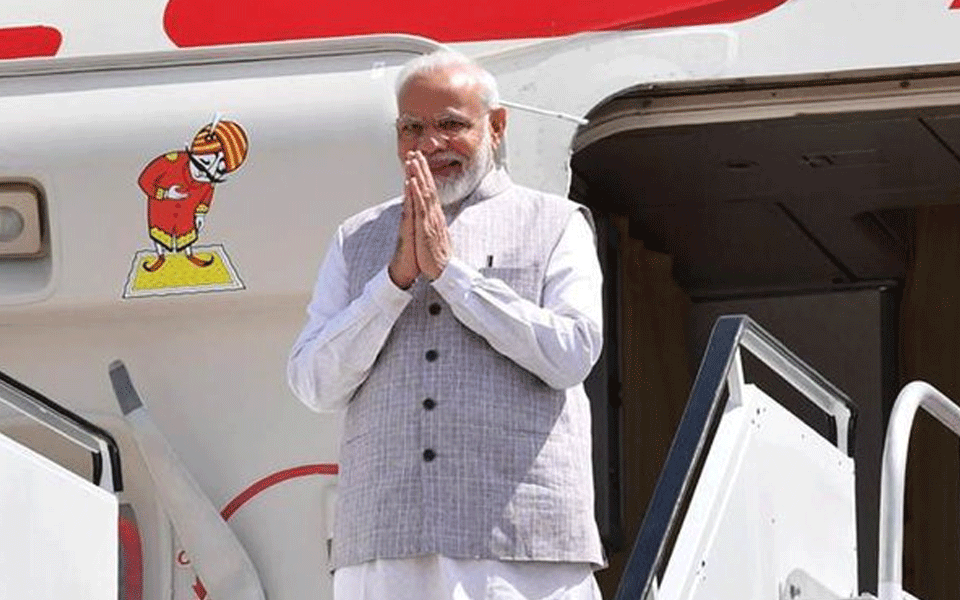
Islamabad: Pakistan on Sunday said it has denied India's request to allow Prime Minister Narendra Modi's VVIP flight to use its airspace for his upcoming visit to Saudi Arabia, citing the alleged human rights violations in Jammu and Kashmir.
In a statement, Foreign Minister Shah Mahmood Qureshi said Pakistan has decided not to allow Prime Minister Modi to use the country's airspace, state-run Radio Pakistan reported. He said the decision has been taken in context of the "black day" and in view of the alleged human rights violations in Jammu and Kashmir, it added.
Pakistan is observing black day on Sunday in support of Kashmiris. Qureshi said the Indian High Commissioner is being informed of this decision in written form.
Modi will travel to Saudi Arabia on Monday where he will attend an international business forum and hold talks with top Saudi leadership.
In September, Pakistan rejected India's request to allow Prime Minister Modi's flight to use its airspace for his visit to the US to attend the UN General Assembly.
Pakistan also refused India's request to allow President Ram Nath Kovind to use its airspace for his flight to Iceland in the same month.
Pakistan fully closed its airspace in February after an Indian Air Force strike on a Jaish-e-Mohammed (JeM) terror camp in Balakot. The country opened its airspace for all flights except for New Delhi, Bangkok and Kuala Lumpur on March 27.
On May 15, Pakistan extended its airspace ban for flights to India till May 30. It fully opened its airspace for all civilian traffic on July 16.
In June, Pakistan "specially" opened its airspace for the flight of Prime Minister Modi to Bishkek to attend the SCO summit. However, India decided not to use the Pakistani airspace for the VVIP aircraft.
Tensions between India and Pakistan spiked after India abrogated provisions of Article 370 of the Constitution to withdraw Jammu and Kashmir's special status and bifurcated it into two union territories, evoking strong reaction from Pakistan.
India has categorically told the international community that the scrapping of Article 370 was an internal matter and also advised Pakistan to accept the reality.
Let the Truth be known. If you read VB and like VB, please be a VB Supporter and Help us deliver the Truth to one and all.
AIITA welcomes Karnataka’s ban on obscene songs in school events
Bhatkal: The Karnataka unit of the All India Ideal Teachers Association (AIITA) has welcomed the Karnataka government’s decision to strictly ban school children from dancing to obscene songs during educational and cultural programmes in government, aided, and private schools across the state.
AIITA Karnataka State President M. R. Manvi congratulated the government for taking what he termed an important step to preserve the sanctity of education.
“Such decisions to safeguard the dignity of school children and uphold the values of education are the need of the hour. This rule should not be limited to government schools alone but must be strictly implemented in all private educational institutions as well,” he said.
He further urged the government to address other concerns within school programmes.
“The government should not only prohibit obscene dances in the name of school anniversaries, but also ensure that plays and dialogues that incite religious hatred are avoided. Schools should be centres of harmony, not platforms for spreading hatred,” he added.
According to a recent circular issued by the Department of School Education and Literacy, obscene dances are adversely affecting the mental health and moral values of students.
In this regard, schools have been advised to use songs that promote nationalism, positive thinking, the greatness of Kannada culture, and value-based traditions instead of inappropriate content during programmes.
The circular also emphasises that students should be dressed in decent attire.
AIITA also backed the department’s warning that disciplinary action would be taken against head teachers if such guidelines are violated. The association has further demanded that district Deputy Directors of Public Instruction strictly monitor the implementation of these rules.