Pakistan opens historic, 1,000-year-old Hindu temple in Punjab for worship after 72 years
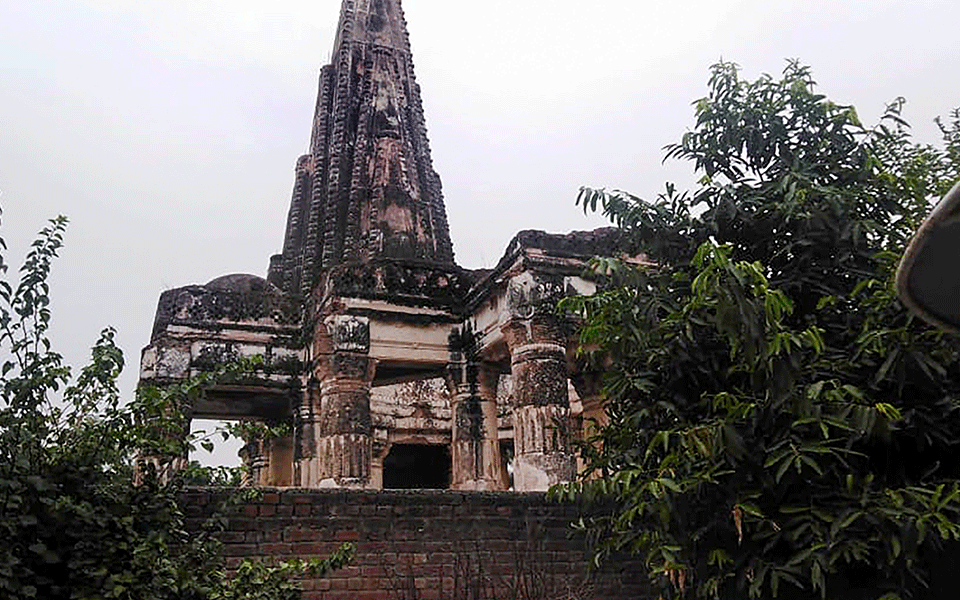
Lahore, Jul 29: Pakistan has opened a 1,000-year-old Hindu temple in eastern city Sialkot for "worship" for the first time since partition on the demand of the local Hindu community, officials said on Monday.
The Shawala Teja Singh temple, located in city's congested Dhaarowal locality, some 100-km from Lahore, is more than 1,000 years old, according to the book 'History of Sialkot' by the late Rashid Niaz.
"The Evacuee Trust Property Board, which looks after the holy places of minorities in Pakistan, has opened Shawala Teja Singh temple after the partition on the demand of the local Hindu community," ETPB spokesperson Amir Hashmi told PTI.
He said since there was no Hindu population earlier residing in the city the temple was closed for worship.
"The temple was partially damaged during attacks on temples here in reaction to Babri Mosque in 1992," he said, adding that the ETPB carried out restoration work of the temple on the direction of Board chairman Dr Amir Ahmed recently.
ETPB Deputy Director Fraz Abbas told PTI that the restoration work of this temple is still underway and the board is expected to complete it shortly.
"The temple has been opened for worship for the first time since partition. Some 2,000 Hindus are residing in this locality and they are so happy to visit their centuries old worship place. Now a good number of local Hindus are visiting it. Hindus from other parts of the country are also expected to visit this temple," he said.
Abbas said the visiting Indian Hindus will also be taken to this temple.
Local Hindu leaders Rattan Laal and Rumaish Kumar have welcomed the government's step to restore the temple and open it for the minority community.
Hindus form the biggest minority community in Pakistan.
According to official estimates, 75 lakh Hindus live in Pakistan. However, according to the community, over 90 lakh Hindus are living in the country.
Majority of Pakistan's Hindu population is settled in Sindh province where they share culture, traditions and language with their Muslim fellows.
Let the Truth be known. If you read VB and like VB, please be a VB Supporter and Help us deliver the Truth to one and all.
Confident we are going to win Kerala: Shashi Tharoor
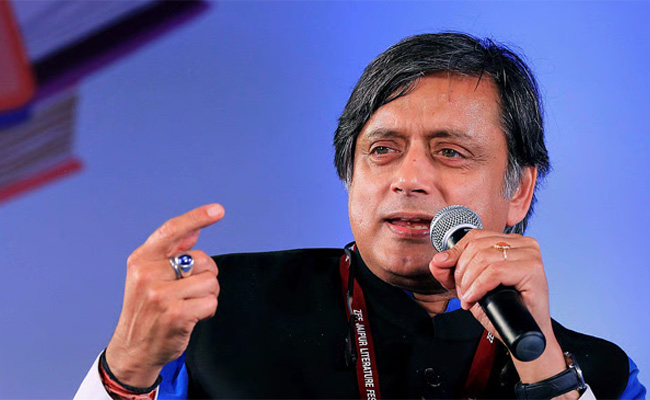
New Delhi (PTI): Congress leader Shashi Tharoor on Thursday expressed confidence in the victory of the United Democratic Front (UDF) in Kerala, saying the Congress-led alliance will win more than 75 seats out of the total 140 in the state.
Tharoor, who hails from Kerala, said he was not surprised to see the results of the exit polls, most of which predicted a victory for the UDF that has been out of power for 10 years in the state.
"We have been on the ground. I have campaigned in 59 constituencies across 12 districts out of 14. I was very confident we are going to win.
"Everything that I have picked up from not just my party colleagues and workers but also from other observers, media and others have always convinced me that we were going to score a comfortable win of above 75 seats. And all the (exit) polls have confirmed the same thing," he told reporters here.
The Thiruvananthapuram MP said he was not surprised to see the results of the exit polls but in general he was not a big fan of exit polls in India.
"Because ours is not purely a homogenous society. We have to take into account gender issue, caste issue, class issue, regional disparities. You never get a convincingly large enough sample to give an accurate poll and now there is the additional complication that we have heard about in West Bengal this year that many people are unwilling to answer the questions of the pollsters," he said.
The Congress leader said normally, it used to be below 10 per cent that people said that they would not answer.
"Even if you are a reputable exit pollster, in Bengal, one polling company has said 60 per cent of people refused to answer. So, what is the worth of a poll where 60 per cent of your respondents have not answered," he said.
Several exit polls on Wednesday predicted a comeback by the Congress-led UDF in Kerala after 10 years, dethroning the CPI(M)-led Left Democratic Front (LDF).
Polling for the 140-member Kerala assembly was held on April 9. Results of assembly elections in West Bengal, Tamil Nadu, Assam, Puducherry, besides Kerala, will be announced on May 4.