Pakistan President Alvi dissolves National Assembly at PM Shehbaz Sharif's advice
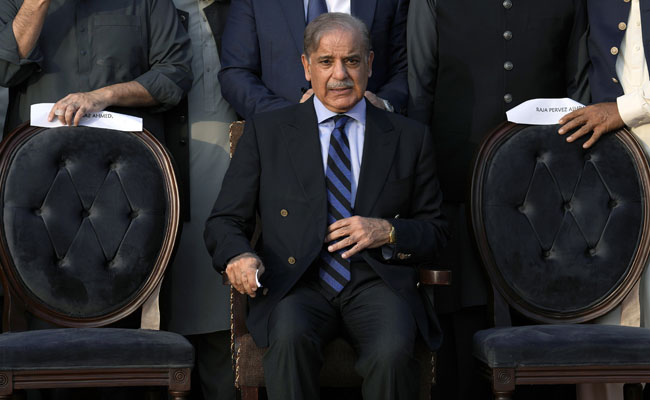
Islamabad (PTI): Pakistan President Arif Alvi dissolved the National Assembly on Wednesday at outgoing Prime Minister Shehbaz Sharif’s advice, marking an end to the current government’s tenure and paving the way for the next general elections.
The notification for the dissolution of the assembly was issued by the Aiwan-i-Sadr, which said the National Assembly was dissolved under Article 58 of the Constitution.
"The Prime Minister's advice at para 6 of the summary is approved," President Alvi said in a statement.
"President Dr. Arif Alvi dissolved the National Assembly. The President dissolved the National Assembly on the advice of the Prime Minister under Article 58-1 of the Constitution," his office posted on social media platform X, formerly known as Twitter.
Pakistan Prime Minister Sharif on Wednesday wrote to President Alvi and sought dissolution of the National Assembly three days before the end of its five-year constitutional term.
With the dissolution of the lower house, the current government’s five-year tenure will also end prematurely.
Later, Parliamentary Affairs Minister Murtaza Javed Abbasi said in a statement that “the elected government has completed its five-year term”, and his ministry had forwarded the summary for the dissolution of the assembly to the prime minister under Article 58 of the Constitution, Dawn newspaper reported.
Earlier on Thursday, the prime minister also chaired the final meeting of the federal cabinet in Islamabad.
In his farewell address at the National Assembly on Wednesday, Sharif said: “Tonight, with the permission of the House, I will send the advice for the dissolution of the National Assembly to the president.” The Pakistan Muslim League-Nawaz (PML-N)-led coalition government would have liked to remain in power for a couple of more days and dissolve Parliament on August 11 but it believes that President Alvi, a former leader of jailed former prime minister Imran Khan's Pakistan Tehreek-e-Insaf (PTI) party, might refuse to issue a notification immediately for the dissolution.
The advice from Prime Minister Sharif for the dissolution was sent to President Alvi three days before the term of the lower house of Parliament expires. President Alvi could have delayed it for 48 hours and after that it would have stood dissolved.
Since the assembly has been dissolved before time, the Election Commission of Pakistan (ECP) would hold elections within 90 days. If the National Assembly had completed its constitutional term, the polls would have been held within 60 days, but in case of dissolution before time, the elections should be held within 90 days.
The polls are expected to be delayed for a couple of months as new census results have been approved, which makes it a constitutional obligation to carry out delimitation before elections.
The ECP is bound to carry out delimitation within 120 days and then announce the election schedule.
Though it is technically possible to expedite the process and determine delimitation of constituencies in minimum time and then go for elections within 90 days, it is not clear if the ECP would follow the deadline as it has a valid reason to overshoot the deadline.
“On the completion of the incumbent government’s term, I would send a summary to the President of Pakistan for dissolution of the National Assembly by Wednesday (and then an interim government will take over," Prime Minister Sharif said on Tuesday while addressing a ceremony.
The outgoing assembly was the 15th National Assembly which began its five-year journey on August 13, 2018, with the election of a speaker and deputy speaker. The assembly was elected after an election held on July 25, 2018.
After the dissolution of the National Assembly, a process to appoint a caretaker prime minister will begin under Article 224-A of the Constitution.
Prime Minister Sharif and Leader of the Opposition in the National Assembly Raja Riaz will hold consultations to finalise the name of the interim prime minister.
If they failed to agree on the name within three days, the matter will go to the parliamentary committee for the appointment of caretaker prime minister.
Under the law, the premier and the opposition leader will send their respective names for the coveted post to the parliamentary committee.
The parliamentary committee will have to finalise the name of the caretaker prime minister within three days or if it too failed to reach a consensus on the name, then the Election Commission of Pakistan (ECP) will pick the caretaker prime minister within two days from the names proposed by the opposition and the government.
In a statement issued on Wednesday, the PTI core committee decided to commemorate the day, as the 16-month tenure of the Pakistan Democratic Movement (PDM) government ends tonight.
The PTI has decided to put forth a detailed analysis of the "devastation" caused by the PDM-led incompetent government before the nation, read the statement.
Let the Truth be known. If you read VB and like VB, please be a VB Supporter and Help us deliver the Truth to one and all.
4 held for sexually assaulting woman, girl on moving bus after social media alert in UP's Agra

Agra (UP) (PTI): Four people were arrested, after a prompt response by police following a social media alert, for allegedly sexually assaulting a woman and a girl inside a moving bus here, officials said on Tuesday.
According to an official police statement, at 12:27 am on April 27, information was received on the social media platform X about an incident of sexual assault on a bus travelling from Kanpur to Ahmedabad, which was approaching Namner crossing in Agra.
Acting under the direction of Police Commissioner Deepak Kumar, the Agra Police social media team immediately alerted the Rakabganj police station within minutes and coordinated with the victims to confirm the incident and obtain the exact location, it stated.
Police teams launched intensive checking at Namner crossing and intercepted the bus as it reached the spot. The four accused involved in the incident were apprehended on the spot, and legal action was initiated against them, the statement said.
The police said the swift response and coordination between the social media team and field units ensured timely action, bringing relief to the victims and other passengers, who expressed gratitude towards the police, it added.