Pakistan's National Assembly Speaker briefly interacts with EAM Jaishankar in Dhaka
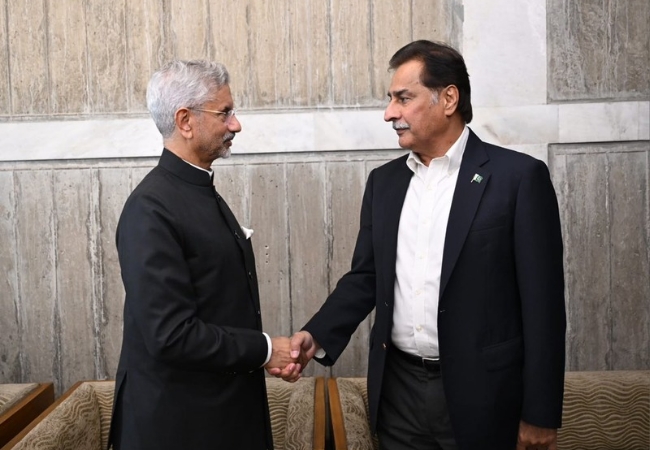
KiIslamabad (PTI): Pakistan on Wednesday said a brief interaction took place between National Assembly Speaker Sardar Ayaz Sadiq and External Affairs Minister S Jaishankar, calling it the "first significant high-level contact" between the two sides since the May conflict.
The two met briefly on the sidelines of the funeral of Bangladesh's former prime minister Khaleda Zia in Dhaka.
During Speaker Sadiq's visit to the Parliament of Bangladesh to inscribe remarks in the condolence book placed for the late Begum Khaleda Zia, in the presence of foreign ministers and delegates of different countries, External Affairs Minister Jaishankar met the Speaker and shook hands, the National Assembly Secretariat said in a statement.
"This interaction marked the first significant high-level contact initiated by the Indian side following the Pakistan-India conflict in May 2025," it said.
The statement went on to say that "Pakistan has consistently emphasised dialogue, restraint, and cooperative measures, including proposals for peace talks and joint investigations" into the Pahalgam attack in which 26 people were killed.
"Sardar Ayaz Sadiq, Speaker of the National Assembly of Pakistan, exchanges greetings with Indian External Affairs Minister S Jaishankar in Dhaka on Wednesday ahead of the funeral programme of former Bangladesh Prime Minister Khaleda Zia," Bangladesh's Chief Adviser Muhammad Yunus's office posted on 'X' along with a photograph.
Sardar Ayaz Sadiq, Speaker of the National Assembly of Pakistan, exchanges greetings with Indian External Affairs Minister S. Jaishankar in Dhaka on Wednesday ahead of the funeral programme of former Bangladesh Prime Minister Khaleda Zia. pic.twitter.com/1eLz0i8nAi
— Chief Adviser of the Government of Bangladesh (@ChiefAdviserGoB) December 31, 2025
Let the Truth be known. If you read VB and like VB, please be a VB Supporter and Help us deliver the Truth to one and all.
Two labourers killed in crane collapse at Link Road project site in Thane district

Thane (PTI): Two labourers were killed on Saturday when a crane collapsed at the under-construction Dahisar-Bhayander Link Road project site in Maharashtra's Thane district, police said.
According to the police, the “gantry crane coastal girders platform”, where labourers were working, suddenly collapsed at 12:30 PM in Bhayander (West), severely injuring Raghunath Das (38) and Kana Singh (45). They were declared dead at a hospital.
"Police have registered a case of accidental death and are investigating," said Bhayander police station senior inspector Jitendra Kamble.
Police said further investigation is underway to ascertain the exact cause of the crane collapse and to determine if any negligence was involved.
The Dahisar-Bhayander Link Road (DBLR) elevated coastal road project connects Dahisar (West) and Bhayander (West).