Philippine military plane crashes, 29 dead, 50 rescued
Manila, Jul 4: A Philippine air force C-130 aircraft carrying troops crashed in a southern province while trying to land Sunday, killing at least 29 military personnel while at least 50 were rescued from the burning wreckage, officials said.
Defence Secretary Delfin Lorenzana said rescue and recovery efforts were ongoing. The aircraft had 92 people on board, including three pilots and five crew and the rest were army personnel, military officials said. The pilots survived but were seriously injured and at least four villagers on the ground were injured, officials said.
The Lockheed C-130 Hercules was one of two ex-U.S. Air Force aircraft handed over to the Philippines as part of military assistance this year. It crashed while landing shortly before noon Sunday in Bangkal village in the mountainous town of Patikul in Sulu province, military chief of staff Gen. Cirilito Sobejana said.
Military officials said at least 50 people on board were brought to a hospital and troops were trying to search for the rest.
Per eyewitnesses, a number of soldiers were seen jumping out of the aircraft before it hit the ground, sparing them from the explosion caused by the crash," a military statement said.
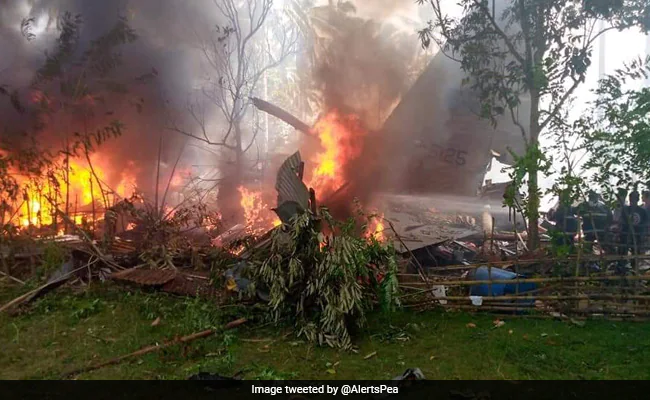
Initial pictures released by the military showed the tail section of the cargo plane. The other parts of the plane were burned or scattered in pieces in a clearing surrounded by coconut trees. Soldiers and other rescuers with stretchers were seen dashing to and from the smoke-shrouded crash site.
The plane was transporting troops, many of them new soldiers who had just undergone basic training, from the southern Cagayan de Oro city for deployment in Sulu, officials said. Government forces have been battling Abu Sayyaf militants in the predominantly Muslim province of Sulu for decades.
It was not immediately clear what caused the crash. Regional military commander Lt Gen Corleto Vinluan said it was unlikely that the aircraft took hostile fire and cited witnesses as saying that it appeared to have overshot the runway then crashed in the periphery of the airport, injuring at least four villagers on the ground.
It's very unfortunate, Sobejana told reporters. The plane missed the runway and it was trying to regain power but failed and crashed.
An air force official told The Associated Press that the Jolo runway is shorter than most others in the country, making it more difficult for pilots to adjust if an aircraft misses the landing spot. The official, who has flown military aircraft to and from Jolo several times, spoke on condition of anonymity because of a lack of authority to speak publicly.
Initial pictures showed that the weather was apparently fine in Sulu although other parts of the Philippines were experiencing rains due to an approaching tropical depression. The airport in Sulu's main town of Jolo is located a few kilometers (miles) from a mountainous area where troops have battled Abu Sayyaf militants. Some militants have aligned themselves with the Islamic State group.
The US and the Philippines have separately blacklisted Abu Sayyaf as a terrorist organization for bombings, ransom kidnappings and beheadings. It has been considerably weakened by years of government offensives but remains a threat.
President Rodrigo Duterte expanded the military presence in Sulu into a full division in late 2018, deploying hundreds of additional troops, air force aircraft and other combat equipment after vowing to wipe out the Abu Sayyaf and allied foreign and local gunmen.
Government forces at the time were running after Muslim armed groups a year after quelling the five-month siege of southern Marawi city by hundreds of militants linked to the Islamic State group. More than 1,000 people, mostly militants and long-elusive Abu Sayyaf commanders, were killed in months of intense air and ground assaults.
Sunday's crash comes as the limited number of military aircraft has been further strained, as the air force helped transport medical supplies, vaccines and protective equipment to far-flung island provinces amid spikes in COVID-19 infections.
The Philippine government has struggled for years to modernize its military, one of Asia's least equipped, as it dealt with decades-long Muslim and communist insurgencies and territorial rifts with China and other claimant countries in the South China Sea.
Let the Truth be known. If you read VB and like VB, please be a VB Supporter and Help us deliver the Truth to one and all.
Two injuries, one DNF, a DQ as India end messy World Relays campaign

Gaborone (Botswana) (PTI): Amoj Jacob and Ragul Kumar got injured during the men's 4x400m and 4x100 races respectively as India ended their World Athletics Relays campaign in disappointment on the second day of competitions here on Sunday.
The Indian camp had high hopes of making the 2027 World Championships in the men's 4x400m relay but the team did not finish (DNF) the race as Jacob suffered cramps and pulled out of the race after taking the baton from the first leg runner Dharamveer Choudhary. Rajesh Ramesh and Vishal TK were to run in the third and fourth legs.
Those teams which could not qualify for the 2027 Beijing World Championships by reaching the final round of each of the six relay events on Saturday were given another chance in the second qualification round on Sunday.
The top two teams in each of the two heats (in all six relay events) booked the Beijing ticket on Sunday.
India will now have to try and qualify for the World Championships through the Top Lists of the World Athletics, which is a long and tedious process.
In the men's 4x100m race, third leg runner Ragul Kumar fell down the track after failing to hand over the baton inside the exchange zone to fourth leg runner Gurindervir Singh, which clearly showed the lack of coordination among the runners.
Harsh Santosh Raut and Animesh Kujur ran the first two legs.
The Indian quartet was disqualified and Kumar was seen being taken away from the Field of Play with the help of the volunteers.
It was a comedy of errors in the case of the women's 4x100m race, which saw the baton being dropped during an exchange between first leg runner Tamanna and second runner Nithya Gandhe, though the Indians finished the race in 53.09 seconds.
Gandhe started running quite a distance, but after realising that the baton was not in her hand, she turned and ran back to pick it up.
The only silver-lining for the Indian contingent was the national record time in the mixed 4x100m relay race, though the quartet of Ragul Kumar, Nithya Gandhe, Animesh Kujur and Sneha SS finished sixth in heat number two with a time of 41.35 seconds, bettering the previous national mark of 42.30 seconds set in March in Chandigarh.
The mixed 4x400m relay quartet of Theerthesh P Shetty, Kumari Saloni, Nihal William and Rashdeep Kaur ended at fifth in heat number one with a time of 3 minutes and 19.40 seconds.
On Saturday, all the five Indian relay teams had failed to make it to the respective final rounds and thus missed out on the 2027 World Championships berths.