PM Modi describes Ukraine conflict issue of human values
says India will do everything possible to find a solution
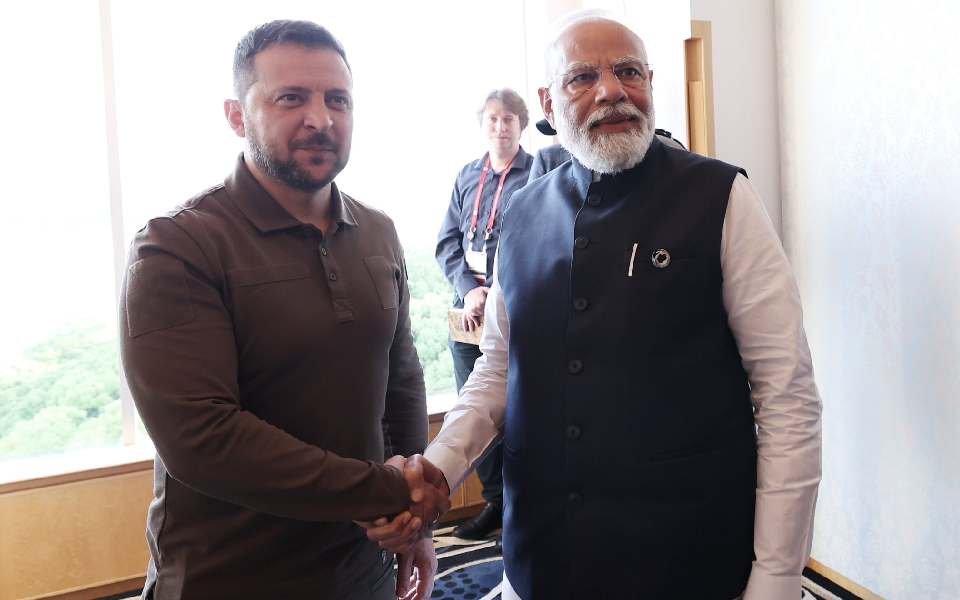
Hiroshima, May 20: Prime Minister Narendra Modi on Saturday conveyed to Ukrainian President Volodymyr Zelenskyy that India will do everything possible to find a solution to the Ukraine conflict as the two leaders held in-person talks for the first time after Russia invaded the eastern European country 15 months back.
In the meeting that took place on the sidelines of the G7 summit in Hiroshima, the prime minister said that the war in Ukraine is a "very big issue" and that it has had many different impacts on the globe.
At the same time Modi told the Ukrainian leader that he does not see the conflict as a political or economic issue and that for him, it is an issue of humanity and human values.
On his part, Zelenskyy briefed the Indian side in detail on his peace formula and urged New Delhi to join in its implementation.
"The war in Ukraine is a very big issue for the whole world. It has had many different impacts on the whole world. But I don't see this as a political or economic issue. For me, this is an issue of humanity, an issue of human values," Modi said in his televised opening remarks.
"You know more than any of us the suffering caused by war, but when our students came back from Ukraine last year. I could understand the pain felt by you and Ukrainian citizens from the description of the circumstances they gave then," he said.
"I wish to assure you that India and I, in my personal capacity, will do whatever is possible to find a solution to this," Modi said.
At a media briefing, Foreign Secretary Vinay Kwatra said there was no discussion during the Modi-Zelenskyy meeting, which lasted for around 30 minutes, on India's procurement of crude oil from Russia.
Asked about Ukraine's participation at G20 meetings under India's presidency, he said the issue did not figure. Zelenskyy has invited Modi to visit Ukraine.
In a tweet, Modi said he conveyed to the Ukranian leader India's "clear support" for dialogue and diplomacy to find a way forward and that New Delhi will continue extending humanitarian assistance to the people of Ukraine.
Since the Ukraine conflict began in February last year, Modi spoke to Russian President Vladimir Putin as well as Zelenskyy a number of times during which he insisted that the conflict should be resolved through dialogue and diplomacy.
Modi also noted that over the past one-and-half years he had spoken to Zelenskyy many times but that they were meeting for the first time after the COP26 conference in Glasgow in 2021.
In his remarks, Zelenskky thanked India for supporting the "territorial integrity and sovereignty of our country" and for providing humanitarian aid.
He also spoke about Ukraine's need for mobile hospitals.
Kwatra said India would continue to provide humanitarian aid to Ukraine. The meeting was sought by the Ukrainian president.
In a statement, the Ministry of External Affairs (MEA) said that Modi appreciated Ukraine's cooperation in the safe evacuation of Indian students and welcomed the decision by Ukrainian institutions to hold examinations in India for them.
"The prime minister conveyed India's clear support for dialogue and diplomacy to find a way forward," it said.
He said that for a resolution of the situation, India and the prime minister personally would do everything within our means," it said.
The prime minister said that India will continue to provide humanitarian assistance to the people of Ukraine, the MEA noted, adding both sides agreed to remain in touch.
The meeting between Modi and Zelenskyy came a day after leaders of the G7 countries resolved to stand against Russia's "illegal, unjustifiable, and unprovoked" invasion of Ukraine and unveiled new sanctions on Moscow.
The Ukrainian president has been trying to drum up support from key countries around the world as Ukranian forces are preparing a major counteroffensive against Russia.
The Indian delegation at the talks included External Affairs Minister S Jaishankar and National Security Adviser Ajit Doval.
The Modi-Zelenskyy meeting took place over a month after Ukrainian First Deputy Foreign Minister Emine Dzhaparova visited India.
During her visit, Dzhaparova handed over a letter to the Minister of State for External Affairs Meenakshi Lekhi. The letter was written to Prime Minister Modi by President Zelenskyy.
In a phone conversation with President Zelenskyy on October 4 last year, Modi said that there can be "no military solution" and that India is ready to contribute to any peace efforts.
At a bilateral meeting with Russian President Putin on September 16 last year in the Uzbek city of Samarkand, Modi said, "Today's era is not of war" and nudged the Russian leader to end the conflict.
India has not yet condemned the Russian invasion of Ukraine and it has been maintaining that the crisis must be resolved through diplomacy and dialogue.
In New Delhi, Dzhaparova said that India is a global leader and can help in addressing key global challenges and promoting peace including in her country.
The prime minister arrived in Hiroshima on Friday to attend the annual summit of the G7 grouping in the first leg of his three-nation tour that will also take him to Papua New Guinea and Australia.
The Ukrainian president is also attending the G7 summit following an invitation by Japan, the current chair of the powerful grouping.
The group of seven, comprising the US, France, the UK, Italy, Germany, Canada and Japan, represent the world's richest democracies. Under its G7 presidency, Japan invited India and seven other countries to the summit as guests.
Let the Truth be known. If you read VB and like VB, please be a VB Supporter and Help us deliver the Truth to one and all.
Advocate found dead in car on Nainital court premises
Nainital (PTI): A 55-year-old advocate allegedly died by suicide after shooting himself inside his car at the Nainital district court parking lot here on Monday, police said.
According to the police, Puran Singh Bhakuni, a resident of Mallital, was found in the rear seat of his vehicle with a gunshot wound to his temple.
Police recovered a licensed pistol from his hand and a suicide note from the car’s dashboard. The note stated that Bhakuni was unwell and suffering from depression.
"We received information through lawyers around noon. The deceased was lying in the back seat with a pistol in his hand and blood near his ear," Circle Officer Anjana Negi said.
Forensic teams and ballistic experts reached the spot to collect evidence, as no witness reported hearing the gunshot.
Government counsel Sushil Sharma stated that Bhakuni left home at 9 am and was found dead at 9.30 am.
Sharma raised concerns over the circumstances, noting that the body was in the rear seat, and demanded a thorough probe to rule out foul play. Bhakuni, who worked as a notary, had married six months ago, he said.
Police took the body into custody and sent it for a postmortem to confirm the cause of death.
The forensic laboratory will examine the suicide note and the ballistics of the weapon, the police said, adding that the investigation is ongoing.