PM Modi holds talks with Singapore's Prime Minister Lee Hsien Loong
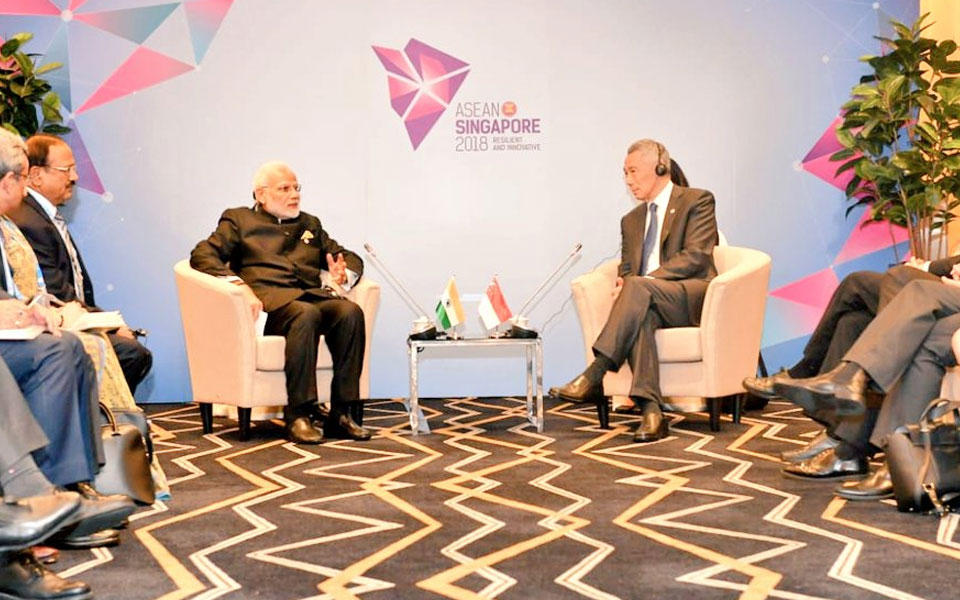
Singapore, Nov 14 : Prime Minister Narendra Modi Wednesday met his Singaporean counterpart Lee Hsien Loong and the two leaders discussed a range of issues, including cooperation in financial technology and regional economic integration.
Modi began his two-day visit to Singapore Wednesday by addressing the Fintech Festival, the world's largest event on financial technology.
Modi became the first world leader to address the festival which was launched in 2016 and is in its third edition. Modi met Lee on the sidelines of East Asia Summit.
"PM Narendra Modi met with Prime Minister of Singapore lee Hsien Loong on the sidelines of East Asia Summit. Good exchange of views on cooperation in financial technology, enhanced connectivity and regional economic integration," External Affairs Ministry Spokesperson Raveesh Kumar said in a tweet.
During his visit, Modi will attend the East Asia Summit, an ASEAN-India informal meet, the Regional Comprehensive Economic Partnership summit and hold meetings with global leaders, including US Vice President Mike Pence.
Before leaving for Singapore, Modi said in New Delhi that his participation in the ASEAN-India and East Asia summits symbolised India's "continued commitment" to strengthen its engagement with ASEAN members and with the wider Indo-Pacific region.
Modi also said he was confident that his visit to Singapore would impart fresh momentum to New Delhi's growing partnership with ASEAN and East Asia Summit nations.
Pence will participate in a bilateral meeting with Prime Minister Modi, the White House said Tuesday releasing the schedule of the Vice President on the eve of the meeting.
India and Singapore are working to connect Indian and ASEAN small and medium enterprises, anchored on an Indian platform, and expand it globally, Modi said in his address on Wednesday.
The Association of Southeast Asian Nations (ASEAN) is a regional intergovernmental organisation comprising ten Southeast Asian countries, which promotes intergovernmental cooperation and facilitates economic, political, security, military, educational, and sociocultural integration among its members and other Asian states.
Let the Truth be known. If you read VB and like VB, please be a VB Supporter and Help us deliver the Truth to one and all.
NIA court to complete framing of charges against 2010 hand-chopping case accused on May 15
Kochi (PTI): A special court here will complete proceedings for framing charges against the prime accused in the 2010 hand-chopping case involving professor T J Joseph, in which PFI activists were accused of attacking him at Muvattupuzha.
Ernakulam Special Court for NIA cases judge P K Mohandas, on April 30, heard the arguments of counsel for accused Savad and Shafeer C and decided to proceed with framing charges against the duo.
A group chopped off Thodupuzha Newman College professor Joseph's right hand in July 2010, accusing him of religious blasphemy in a question paper he had prepared.
The case, later taken over by the National Investigation Agency (NIA), resulted in the conviction of 19 accused.
The first accused, Savad, who allegedly chopped off Joseph’s palm, was arrested in Berram in Mattannur, Kannur, in January 2024, where he had allegedly been hiding under the pseudonym Shajahan.
The NIA also arrested Shafeer, who allegedly arranged shelter and provided logistical support to Savad at Chakkad and Mattannur in Kannur since 2020.
On April 30, the court heard the counsel for the accused and the NIA prosecutor on framing charges against the duo.
"On going through the documents and evidence in the case and on hearing the counsel for the accused and the prosecutor, I am of the opinion that there are grounds for presuming that the first accused has committed offences punishable under provisions of the IPC, the Explosive Substances Act and the Unlawful Activities (Prevention) Act, and that the second accused has committed offences punishable under the IPC and the UAPA, and there are materials for framing charges under these provisions against the accused," the court said.
The court directed that Savad be produced and Shafeer, who is on bail, appear before it on May 15 for recording their pleas as part of the charge-framing process.
After framing the charges, the court will schedule the trial in the case.