PM Modi meets Yunus, flags concerns over safety of minorities in Bangladesh
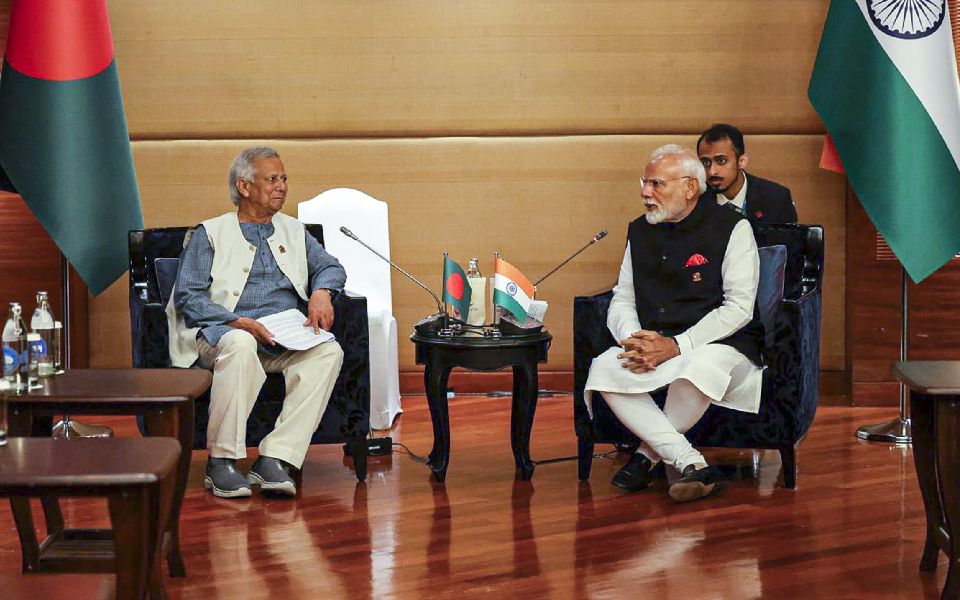
Bangkok, Apr 4 (PTI): In his first meeting with Bangladesh's Chief Adviser Muhammad Yunus Friday, Prime Minister Narendra Modi flagged India's concerns over the safety of minorities, including Hindus, and conveyed that any rhetoric that vitiated the environment was best avoided.
During the 40-minute meeting that took place on the sidelines of the Bay of Bengal Initiative for Multi-Sectoral and Technical Cooperation (BIMSTEC) summit here, Modi also underscored India’s support for a democratic, stable, peaceful, progressive and inclusive Bangladesh.
At the meeting, Yunus also flagged the issues of the extradition of deposed Bangladesh prime minister Sheikh Hasina and border killings.
This was the first meeting between Modi and Yunus since Hasina's ouster in August last year. External Affairs Minister S Jaishankar and National Security Advisor Ajit Doval were also present during the meeting.
The Prime Minister told Yunus that the strict enforcement of the law and prevention of illegal border crossings, especially at night, are necessary for maintaining border security and stability.
“Bangladesh has made a formal request regarding Sheikh Hasina. It will not be proper for me to say anything more on this matter,” Foreign Secretary Vikram Misri told reporters here.
“Met Mr Muhammad Yunus, Chief Adviser of the interim government of Bangladesh. India remains committed to a constructive and people-centric relationship with Bangladesh,” Modi said in a post on X.
“I reiterated India's support for peace, stability, inclusivity and democracy in Bangladesh. Discussed measures to prevent illegal border crossings and expressed our serious concern for the safety and well-being of Hindus and other minorities,” the Prime Minister said.
Modi also enunciated India’s people-centric approach to the relationship, and said that cooperation between the two countries has brought tangible benefits to the people of both the nations.
“In this spirit, he underlined to Professor Yunus India's desire to forge a positive and constructive relationship with Bangladesh based on a spirit of pragmatism,” Misri said on Modi’s conversation with Yunus.
On the issue of attacks on minorities in Bangladesh, Modi said that he expected the Bangladeshi government to ensure their security and thoroughly investigate cases of atrocities against them.
The Prime Minister also congratulated Yunus on Bangladesh assuming the Chair of BIMSTEC and looked forward to the forum further advancing regional cooperation under its leadership.
“The leaders agreed to enhance consultations and cooperation to advance regional integration, including under the BIMSTEC framework,” an official statement said.
Modi also expressed his conviction that all issues of mutual interest between the two countries would continue to be addressed and resolved bilaterally through constructive discussions, in the interest of their long standing and mutually beneficial bilateral relationship.
Soon after the meeting, Yunus' official X handle posted a photo that showed the interim government chief presenting a photo to Prime Minister Modi. “The photo is about Prime Minister Narendra Modi presenting a gold medal to Professor Yunus at the 102nd Indian Science Congress on January 3, 2015,” the post on X said.
A student-led mass protest resulted in the ouster of Hasina's over 15 years of rule on August 5 last year. Three days later, Yunus assumed charge as the Chief Adviser of the Interim government.
Since then, the ties between India and Bangladesh have seen a slump amid Delhi's concerns over the violence targeting Hindus and a rise of hardline Islamist forces there.
During his visit to China last week, Yunus urged Beijing to extend its economic influence to Bangladesh, controversially mentioning that India's northeastern states being landlocked could prove to be an opportunity.
Yunus said the seven northeastern states of India are a landlocked region and have no way to reach out to the ocean. Calling Bangladesh the only guardian of the ocean in the region, he said this could be a huge opportunity and could be an extension of the Chinese economy.
A recent UN fact-finding report covered the period from July 1 to August 15 during the violent agitation by protesting students demanding Hasina’s ouster, followed by days of attacks on Awami League supporters and minorities, including Hindus. It estimated that as many as 1,400 people may have been killed, scores of them minorities, including Hindus, between July 15 and August 5 last year, and thousands injured.
Bangladesh has witnessed a resurgence of unrest since February this year.
Let the Truth be known. If you read VB and like VB, please be a VB Supporter and Help us deliver the Truth to one and all.
Maharashtra sets up state vaccination task force to strengthen immunisation programme

Mumbai (PTI): The Maharashtra government has set up a State Vaccination Task Force to strengthen the regular immunisation programme and review the progress of related campaigns, a health department official said on Monday.
The State Vaccination Task Force will comprise at least 29 members and will be headed by the administrative head of the health department, he informed.
The government has also constituted separate district-level and municipal vaccination task forces to improve implementation and address challenges at the grassroots level, he said.
Municipal task forces, chaired by respective civic commissioners, have been constituted in view of the vast urban population in Maharashtra and the role of civic bodies in implementing different health programmes.
The district-level task forces will function under the chairmanship of collectors.
"Complete immunisation of children at the appropriate age is an extremely simple, cost-effective and highly effective measure to reduce child mortality and the prevalence of diseases among kids. Immunisation is a powerful tool for reducing illness in children," maintained the official.
To ensure full vaccination of all children, the state government implements various campaigns from time to time as per the central government guidelines, he pointed out.
"Active participation and cooperation of other relevant government departments are essential (in making these campaigns successful)," according to the official.
The state-level body will review the regular immunisation programme, associated campaigns and vaccine-preventable diseases in detail. It will also conduct focused assessments of high-risk districts and municipal corporations, including vacancies at district, municipal and sub-district levels, availability of cold chain equipment, resource gaps and training requirements, he noted.
The state task force will review allocation and utilisation of funds for immunisation and ensure timely action by officers concerned based on reports from district and municipal task forces and state-level monitoring mechanisms, the official said.
It will also ensure active coordination and participation of other government departments in immunisation drives, while district and municipal task forces will carry out similar functions at their respective levels, the official added.