PM Modi, President Trump agree to move forward on India-US civil nuclear cooperation
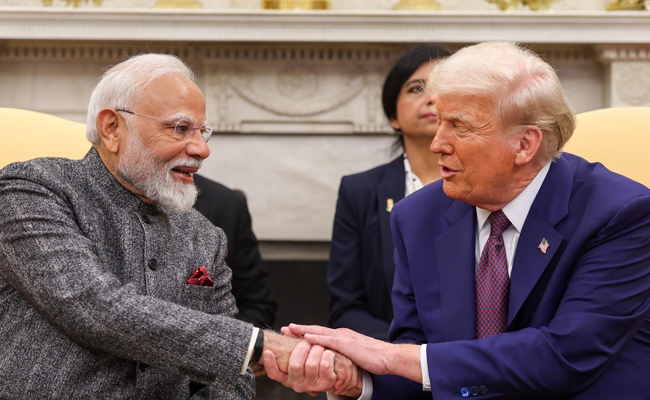
Washington (PTI): Prime Minister Narendra Modi and US President Donald Trump vowed to move forward to facilitate building American-designed nuclear reactors in India under the framework of the epochal civil nuclear deal sealed by the two nations over 16 years back.
In their talks at the White House on Thursday, the two leaders decided to significantly expand energy cooperation.
The civil nuclear deal changed India's overall engagement with the US as it paved the way for building the bonds of a strategic partnership, especially in areas of high technology and defence.
"The leaders announced their commitment to fully realise the US-India 123 Civil Nuclear Agreement by moving forward with plans to work together to build US-designed nuclear reactors in India through large-scale localisation and possible technology transfer," according to a joint statement.
Finance Minister Nirmala Sitharaman, while presenting the Union budget on February 1, announced plans to amend India's nuclear liability law as well as the Atomic Energy Act.
Certain clauses in India's Civil Liability for Nuclear Damage Act, 2010 have emerged as hurdles in moving forward in the implementation of the civil nuclear deal.
Both sides welcomed the recent budget announcement by the government of India to take up amendments to the Atomic Energy Act and the Civil Liability for Nuclear Damage Act (CLNDA) for nuclear reactors, the statement said.
It said the two sides further decided to establish bilateral arrangements in accordance with CLNDA, that would address the issue of civil liability and facilitate the collaboration of Indian and US industry in the production and deployment of nuclear reactors.
The Atomic Energy Act of 1962 prohibits investments by the private sector in nuclear power plants. The proposed amendment is expected to remove this provision.
In January, the US removed restrictions on Bhabha Atomic Research Center (BARC), Indira Gandhi Atomic Research Centre (IGCAR) and the Indian Rare Earths (IRE), a move that was seen as Washington's intent to move forward on civil nuclear cooperation with India.
India and the US unveiled an ambitious plan to cooperate in civil nuclear energy in July 2005 following then Prime Minister Manmohan Singh's meeting with American President George W Bush.
The historic civil nuclear agreement was finally sealed around three years later following a series of negotiations.
It was expected to pave the way for allowing the US to share civilian nuclear technology with India.
However, the planned cooperation did not move forward for a variety of reasons including the strict liability laws in India.
US nuclear reactor makers such as General Electric and Westinghouse had shown keen interest in setting up nuclear reactors in India.
In the last few years, India has been in talks with a number of countries including the US and France on cooperation in small modular reactors (SMRs).
Let the Truth be known. If you read VB and like VB, please be a VB Supporter and Help us deliver the Truth to one and all.
EAM Jaishankar meets Jamaican PM, gifts over 10 BHISHM Cubes
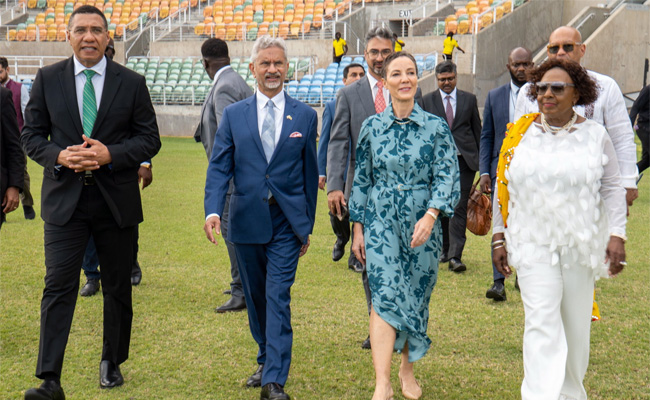
Kingston (PTI): External Affairs Minister S Jaishankar on Monday met Jamaican Prime Minister Andrew Holness and discussed ways to further deepen "political, economic and people-to-people cooperation."
Jaishankar also conveyed greetings from Prime Minister Narendra Modi to Holness.
"Pleased to call on Prime Minister @AndrewHolnessJM in Kingston. Conveyed the greetings of PM @narendramodi," Jaishankar posted on X.
"Discussed deepening our political, economic and people-to-people cooperation. Value his commitment towards further strengthening India-Jamaica relations," the post further read.
Also, the external affairs minister handed over 10 BHISHM (Bharat Health Initiative for Sahyog Hita & Maitri) Cubes as a gift to Jamaica.
"Formally handed over 10 BHISHM Cubes as a gift from India to Jamaica, in the presence of PM @AndrewHolnessJM, Health Minister @christufton and FM @kaminajsmith," Jaishankar posted on X.
"The BHISHM Cube mobile hospital system, designed for rapid deployment, will help Jamaica during disasters and emergencies. The gift of these cubes is a statement of friendship, a commitment to disaster preparedness, and an outcome of innovation," the post said.
Jaishankar arrived in Kingston on Saturday evening, marking the first leg of his nine-day tour of Jamaica, Suriname, and Trinidad and Tobago, aimed at further strengthening India's strategic and cultural ties with the Caribbean nations.
Earlier in the day, he interacted with the Indian diaspora and discussed India's ongoing transformation in infrastructure, human development and technology-driven governance and entrepreneurship with them.
He also highlighted the cricket bond between both countries as India gifted a scoreboard to Jamaica.
A scoreboard was dedicated at Sabina Park in Kingston. It is the home of the Jamaica cricket team and is the only Test cricket ground in the Caribbean island nation.
The minister expressed hope that the new scoreboard would witness many memorable innings, including those symbolising the enduring friendship between the two countries.
Cricket has long been a strong cultural bridge between India and Jamaica, which is part of the West Indies cricket team.
Jamaican players, including Chris Gayle, Courtney Walsh and Michael Holding, have played a major role in shaping the legacy of West Indies cricket in the international arena, contributing to its dominance in earlier decades and its continued global appeal.