Police shoot protester, man set on fire in day of Hong Kong fury
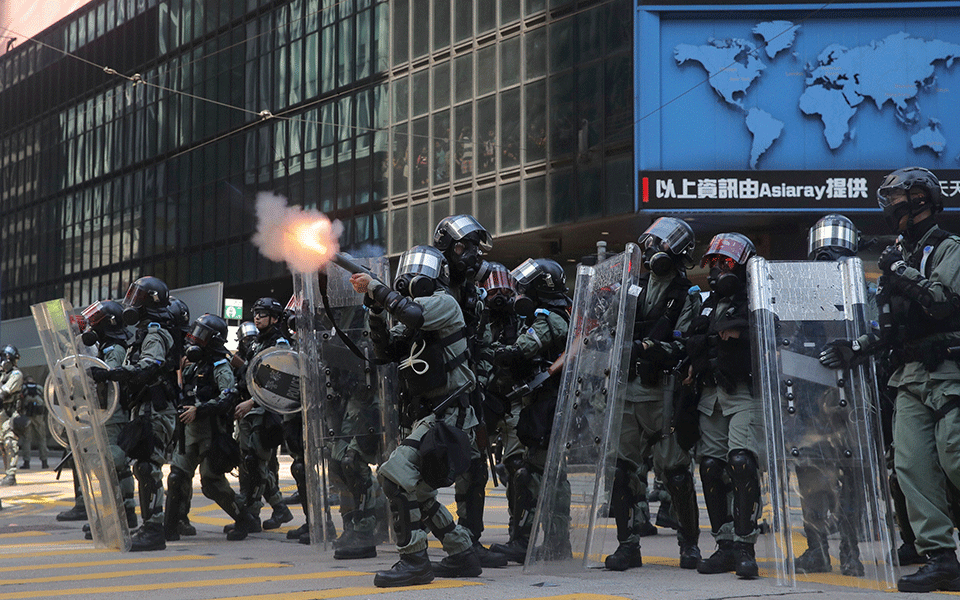
Hong Kong: A police officer shot a masked protester in an incident shown live on Facebook and a man was set on fire Monday during one of the most violent days of clashes in Hong Kong since pro-democracy unrest erupted more than five months ago.
Protesters, who had already begun a city-wide day of action aimed at paralysing the international financial hub, reacted to the morning shooting by rampaging through train stations, barricading streets and vandalising shops throughout the day.
A masked assailant also doused a man with a flammable liquid and set him ablaze during an argument, with the horrifying scene captured on mobile phones and also posted online.
Police said a protester carried out that attack and accused black-clad "rioters" of an array of other violent acts, including throwing a petrol bomb inside a train carriage.
"Continuing this rampage is a lose-lose situation for Hong Kong," police spokesman John Tse said at a press conference in which he showed the video of the man being set alight, as well as a fire inside a train.
At the end of the business day, Hong Kong chief executive Carrie Lam held a press conference to denounce the violence and vow it would not lead to any government concessions.
"I am making this statement clear and loud here, that will not happen," Lam said.
The footage of the shooting -- broadcast live on Facebook by a bystander -- showed a police officer drawing a pistol as he tried to detain a masked person at a junction that had been blocked by protesters.
Another unarmed masked protester then approached the officer and was shot, quickly falling to the ground. Authorities said he was in critical condition in hospital. Police chiefs defended the officer drawing his weapon and firing as a legitimate use of force given his fears for his safety.
But protesters, who for months have accused police of using excessive force and demanded an independent inquiry into their actions, were incensed.
"I don't understand why police have to use that kind of brutality to hurt innocent people... it's just out of control," a 22-year-old IT worker, who gave her surname as Chan, told AFP as she joined angry crowds to protest in the area of the shooting.
Monday's shooting was the third time protesters had been hit by live rounds fired by police. None of the shootings have resulted in deaths.
Lam said the man set on fire was in a critical condition. She described that attack as "totally inhumane". Protesters ignored her pleas for calm with further rallies in multiple locations across the city on Monday night.
Online forums used by the largely anonymous and leaderless movement also carried messages vowing another day of chaos on Tuesday.
Hong Kong has endured 24 straight weeks of increasingly violent rallies aimed at securing greater democratic freedoms from China, which has ruled the city under a "one country, two systems" framework since its handover from the British in 1997.
The British government called the latest incidents "deeply disturbing." "We are seriously concerned by the ongoing violence, and the escalation between protesters and police," said a Foreign Office spokesman, while the office of British Prime Minister Boris Johnson urged "calm and restraint on all sides."
The protesters are desperate to stop what they see as Beijing's tightening control over Hong Kong, and reneging on its handover commitment to allow greater liberties for the city than those on the mainland.
But Beijing has refused to give in, and instead warned it is prepared to impose even greater security measures.
Tensions in Hong Kong were already high following the death on Friday of a 22-year-old student who succumbed to injuries sustained from a fall in the vicinity of a police clearance operation a week earlier.
After a weekend of clashes and huge vigils, Monday's chaos began with small groups of masked protesters disrupting subway stations and roads during the rush hour commute.
But as footage of the shooting went viral, the protests snowballed.
During the lunchtime break in Central, a downtown district that hosts blue-chip international conglomerates and luxury retailers, police fired tear gas to disperse thousands of protesters, many dressed in office attire and chanting "murderers".
Tear gas and rubber bullets were fired in multiple districts throughout the day, including at university campuses.
One video circulated by protesters on messaging channels showed a police officer trying repeatedly to drive his motorbike into protesters who had gathered on a road.
Police said the officer has since been suspended, the first time the force has made an announcement removing someone from active duty in relation to the protests since they began.
Let the Truth be known. If you read VB and like VB, please be a VB Supporter and Help us deliver the Truth to one and all.
AIITA welcomes Karnataka’s ban on obscene songs in school events

Bhatkal: The Karnataka unit of the All India Ideal Teachers Association (AIITA) has welcomed the Karnataka government’s decision to strictly ban school children from dancing to obscene songs during educational and cultural programmes in government, aided, and private schools across the state.
AIITA Karnataka State President M. R. Manvi congratulated the government for taking what he termed an important step to preserve the sanctity of education.
“Such decisions to safeguard the dignity of school children and uphold the values of education are the need of the hour. This rule should not be limited to government schools alone but must be strictly implemented in all private educational institutions as well,” he said.
He further urged the government to address other concerns within school programmes.
“The government should not only prohibit obscene dances in the name of school anniversaries, but also ensure that plays and dialogues that incite religious hatred are avoided. Schools should be centres of harmony, not platforms for spreading hatred,” he added.
According to a recent circular issued by the Department of School Education and Literacy, obscene dances are adversely affecting the mental health and moral values of students.
In this regard, schools have been advised to use songs that promote nationalism, positive thinking, the greatness of Kannada culture, and value-based traditions instead of inappropriate content during programmes.
The circular also emphasises that students should be dressed in decent attire.
AIITA also backed the department’s warning that disciplinary action would be taken against head teachers if such guidelines are violated. The association has further demanded that district Deputy Directors of Public Instruction strictly monitor the implementation of these rules.