When I look at Basel, I see my brother, but we are unequal: Israeli co-director of ‘No Other Land’
Powerful victory speech of No Other Land's makers take centre stage at Oscars
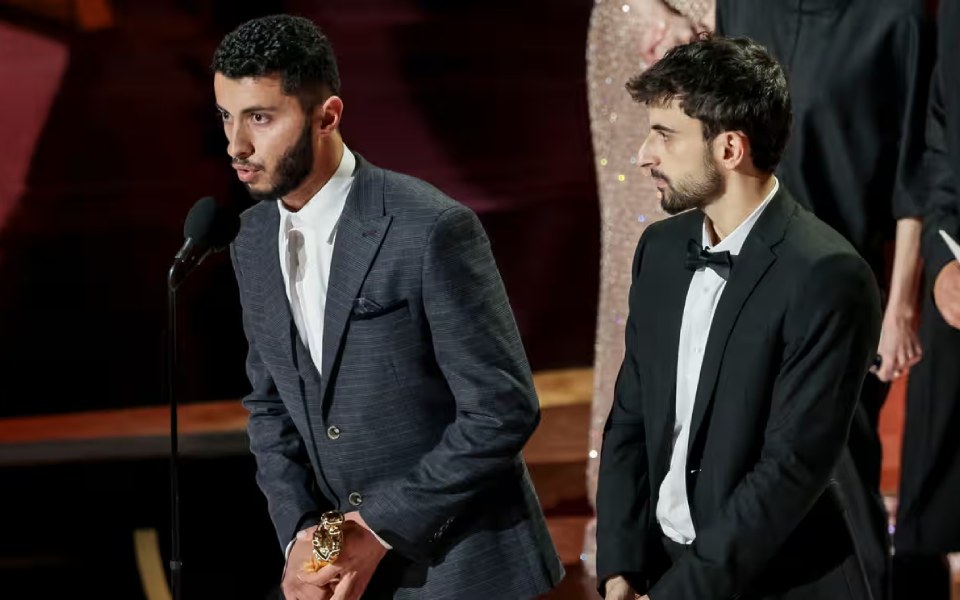
Los Angeles: As directors Yuval Abraham, Basel Adra, Hamdan Ballal, and Rachel Szor took the stage to accept the Academy Award for Best Documentary for No Other Land, they used the global platform to deliver a powerful plea for justice and peace in Gaza.
The acceptance speech by Abraham, an Israeli journalist, and Adra, a Palestinian journalist and activist, became a defining moment of the ceremony, as they called for an end to the ongoing war and the displacement of Palestinians.
Adra, who has been documenting the realities of occupation and displacement, spoke about the suffering of the Palestinian people and urged the world to take action. “We call on the world to take serious actions to stop the injustice and to stop the ethnic cleansing of the Palestinian people,” he declared, his voice filled with emotion. He also spoke about his personal experiences, revealing that he had recently become a father. “About two months ago, I became a father, and my hope for my daughter is that she will not have to live the same life I’m living now. ‘No Other Land’ reflects the harsh reality that we have been enduring for decades and still resist,” he said.
Abraham, who co-directed the documentary alongside Adra, emphasized the collaborative nature of the project between Palestinians and Israelis, underscoring the power of unity in storytelling. “We made this film, Palestinians and Israelis, because together, our voices are stronger,” he said. Addressing the humanitarian crisis in Gaza and the October 7 attack by Hamas, he added, “We see each other—the destruction of Gaza and its people, which must end, the Israeli hostages, brutally taken in the crime of October 7, who must be freed.”
Highlighting the systemic inequality between Israelis and Palestinians, Abraham spoke about the harsh realities faced by his co-director. “When I look at Basel, I see my brother, but we are unequal. We live in a regime where I am free under civilian law, and Basel is under military laws that destroy his life and that he cannot control,” he pointed out, calling for a political resolution that recognizes the rights of both people. “There is a different path, a political solution without ethnic supremacy, with national rights for both of our people,” he stated, making a strong appeal for peace based on equality rather than dominance.
Criticizing U.S. foreign policy and its approach to the Israel-Palestine conflict, Abraham questioned global leaders for failing to recognize the intertwined fate of both communities. “Why can’t you see that we are intertwined, that my people can be truly safe if Basel’s people are truly free and safe?” he asked.
The film ‘No Other Land’ documents the displacement of a Palestinian family from their home in the West Bank, showcasing the human cost of occupation. Made by a collective of four Palestinian and Israeli activists, the documentary serves as both a piece of storytelling and an act of resistance against ongoing injustices.
The film, a co-production between Palestine and Norway, premiered at the 74th Berlin International Film Festival on February 16, 2024, where it won the Panorama Audience Award for Best Documentary Film and the Berlinale Documentary Film Award.
#Oscars2025 🇵🇸 @basel_adra: “We call on the world to take serious actions to stop the injustice and to stop the ethnic cleansing of the Palestinian people.” #NoOtherLand pic.twitter.com/2yVfryoAWC
— State of Palestine (@Palestine_UN) March 3, 2025
Let the Truth be known. If you read VB and like VB, please be a VB Supporter and Help us deliver the Truth to one and all.
Cong takes swipe at PM over India not being part of US-led 'Pax Silica' grouping
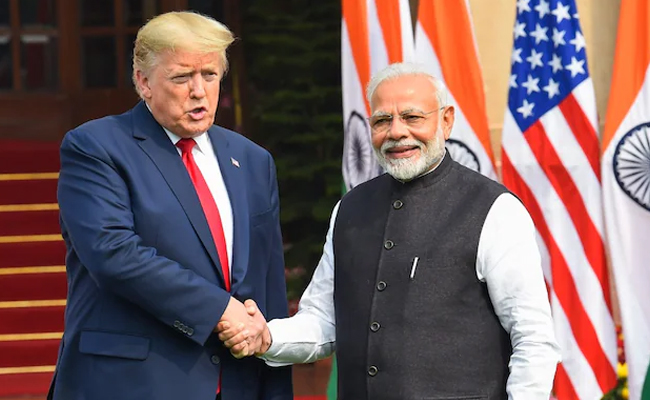
New Delh (PTI) The Congress on Saturday said it is perhaps not very surprising that India is not part of a US-led strategic initiative to build a secure silicon supply chain, given the "sharp downturn" in the Trump-Modi ties, and asserted that it would have been to "our advantage if we had been part of this group".
Congress general secretary in charge of communications Jairam Ramesh took a swipe at Prime Minister Narendra Modi, saying the news of India not being part of the group comes after the PM had enthusiastically posted on social media about a telephone call with his "once-upon-a-time good friend and a recipient of many hugs in Ahmedabad, Houston, and Washington DC".
In a lengthy post on X, Ramesh said, "According to some news reports, the US has excluded India from a nine-nation initiative it has launched to reduce Chinese control on high-tech supply chains. The agreement is called Pax Silica, clearly as a counter to Pax Sinica. The nations included (for the moment at least) are the US, Japan, the Republic of Korea, Singapore, the Netherlands, the United Kingdom, Israel, the United Arab Emirates, and Australia."
"Given the sharp downturn in the Trump-Modi ties since May 10th, 2025, it is perhaps not very surprising that India has not been included. Undoubtedly, it would have been to our advantage if we had been part of this group."
"This news comes a day after the PM had enthusiastically posted on his telephone call with his once-upon-a-time good friend and a recipient of many hugs in Ahmedabad, Houston, and Washington DC," the Congress leader asserted.
The new US-led strategic initiative, rooted in deep cooperation with trusted allies, has been launched to build a secure and innovation-driven silicon supply chain.
According to the US State Department, the initiative called 'Pax Silica' aims to reduce coercive dependencies, protect the materials and capabilities foundational to artificial intelligence (AI), and ensure aligned nations can develop and deploy transformative technologies at scale.
The initiative includes Japan, South Korea, Singapore, the Netherlands, the United Kingdom, Israel, the United Arab Emirates, and Australia. With the exception of India, all other QUAD countries -- Japan, Australia and the US -- are part of the new initiative.
New Delhi will host the India-AI Impact Summit 2026 on February 19-20, focusing on the principles of 'People, Planet, and Progress'. The summit, announced by Prime Minister Narendra Modi at the France AI Action Summit, will be the first-ever global AI summit hosted in the Global South.
Prime Minister Modi and US President Trump on Thursday discussed ways to sustain momentum in the bilateral economic partnership in a phone conversation amid signs of the two sides inching closer to firming up a much-awaited trade deal.
The phone call between the two leaders came on a day Indian and American negotiators concluded two-day talks on the proposed bilateral trade agreement that is expected to provide relief to India from the Trump administration's whopping 50 per cent tariffs on Indian goods.
In a social media post, Modi had described the conversation as "warm and engaging".
"We reviewed the progress in our bilateral relations and discussed regional and international developments. India and the US will continue to work together for global peace, stability and prosperity," Modi had said without making any reference to trade ties.