Powerful quake in Morocco kills more than 800 people and damages historic buildings in Marrakech
Marrakech (Morocco) (AP): A rare, powerful earthquake struck Morocco late Friday night, killing more than 800 people and damaging buildings from villages in the Atlas Mountains to the historic city of Marrakech.
The toll was expected to rise as rescuers struggled to reach the remote areas hit hardest.
People woken by the quake ran into the streets in terror and disbelief. State television showed people clustered in the streets of Marrakech late at night, afraid to go back inside buildings that might still be unstable.
A man said he was visiting a nearby apartment when dishes and wall hangings began raining down, and people were knocked off their feet and chairs. A woman described fleeing her house after an "intense vibration.''
A man holding a child said he was jarred awake in bed by the shaking.
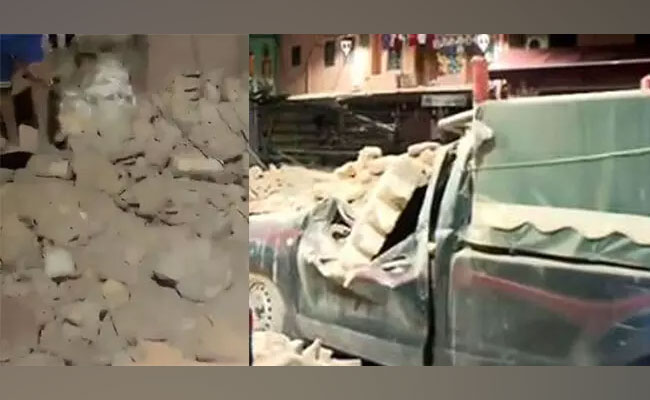
Emergency workers looked for survivors in the rubble of buildings, their reflective yellow vests glowing in the dark. A hole gaped in the side of a home, and a car was nearly buried by the chunks of a collapsed building in other images broadcast by local media.
In Marrakech, the famous Koutoubia Mosque, built in the 12th century, suffered damage, but the extent was not immediately clear. Its 69-meter (226-foot) minaret is known as the "roof of Marrakech."
Moroccans also posted videos showing damage to parts of the famous red walls that surround the old city, a UNESCO World Heritage site.
At least 820 people died, mostly in Marrakech and five provinces near the quake's epicenter, and another 672 people were injured, Morocco's Interior Ministry reported Saturday morning. Of the injured, the ministry wrote, 205 were seriously hurt.
The head of a town near the earthquake's epicenter told Moroccan news site 2M that several homes in nearby towns had partly or totally collapsed, and electricity and roads were cut off in some places.
Abderrahim Ait Daoud, head of the town of Talat N'Yaaqoub, said authorities are working to clear roads in Al Haouz Province to allow passage for ambulances and aid to populations affected, but said large distances between mountain villages mean it will take time to learn the extent of the damage.
Al Haouz is known for scenic villages and valleys tucked in the High Atlas, and Amazigh villages built into mountainsides.
The Moroccan military and emergency services mobilised aid efforts to the areas hit by damages, but roads leading to the mountain region around the epicenter were jammed with vehicles and blocked with collapsed rocks, slowing rescue efforts. Trucks loaded with blankets, camp cots and lighting equipment were trying to region that hard-hit area, the official news agency MAP reported.
On the steep and winding switchbacks from Marrakech to Al Haouz, ambulances with sirens blaring and honking cars veered around piles of Mars-like red rock that had tumbled from the mountainside and blocked the road. Red Cross workers tried to clear a boulder blocking the two-lane highway.
Later Saturday morning in Marrakech, ambulances and motorcycles whirred by the edge of the old city, where business as usual mostly resumed Saturday morning. Tourists and passersby navigated roadblocks and snapped photos of sections of the clay ochre wall that had cracked, spilling fragments and dust onto the sidewalk and street.
World leaders offered to send in aid or rescue crews as condolences poured in from countries around Europe, a Group of 20 summit in India, countries around Europe, the Mideast and beyond.
Turkiye's president, whose country lost tens of thousands of people in a massive earthquake earlier this year, was among those proposing assistance.
France and Germany, with large populations of people with Moroccan origins, also offered to help. And the leaders of both Ukraine and Russia expressed support for Moroccans.
The Moroccan government has not formally asked for help, a step required in order for outside rescue crews to be brought in.
The US Geological Survey said the quake had a preliminary magnitude of 6.8 when it hit at 11:11 p.m. (2211 GMT), with shaking that lasted several seconds. The U.S. agency reported a magnitude-4.9 aftershock hit 19 minutes later.
The epicenter of Friday's tremor was near the town of Ighil in Al Haouz Province, roughly 70 kilometers (43.5 miles) south of Marrakech.
The USGS said the epicenter was 18 kilometers (11 miles) below the Earth's surface, while Morocco's seismic agency put it at 11 kilometers (7 miles) down. Such shallow quakes are more dangerous.
Initial reports suggest damages and deaths were severe throughout the Marrakech-Safi region, which more than 4.5 million people call home, according to state figures.
Earthquakes are relatively rare in North Africa. Lahcen Mhanni, Head of the Seismic Monitoring and Warning Department at the National Institute of Geophysics, told 2M TV that the earthquake was the strongest ever recorded in the mountain region.
In 1960, a magnitude 5.8 tremor struck near the Moroccan city of Agadir and caused thousands of deaths.
The Agadir quake prompted changes in construction rules in Morocco, but many buildings, especially rural homes, are not built to withstand such tremors.
In 2004, a 6.4 magnitude earthquake near the Mediterranean coastal city of Al Hoceima left more than 600 dead.
Friday's quake was felt as far away as Portugal and Algeria, according to the Portuguese Institute for Sea and Atmosphere and Algeria's Civil Defence agency, which oversees emergency response.
Moment of building collapse at #Morocco after massive #earthquake
— Updates (@sirfupdate) September 9, 2023
#Maroc #moroccosismo #earthquake #deprem #earthquakes #Sismo #Morocco pic.twitter.com/zXeLEuNVEA
🚨Breaking: Footage of a building collapsing after the recent earthquake in Morocco🇲🇦
— $K 🇬🇭 (@KobbySmyles) September 9, 2023
Over 200 feared to have lost their Lives. #prayforMorocco
pic.twitter.com/6n6wvC7i4m
Let the Truth be known. If you read VB and like VB, please be a VB Supporter and Help us deliver the Truth to one and all.
Himanta resigns as Assam CM, paving way for formation of new govt
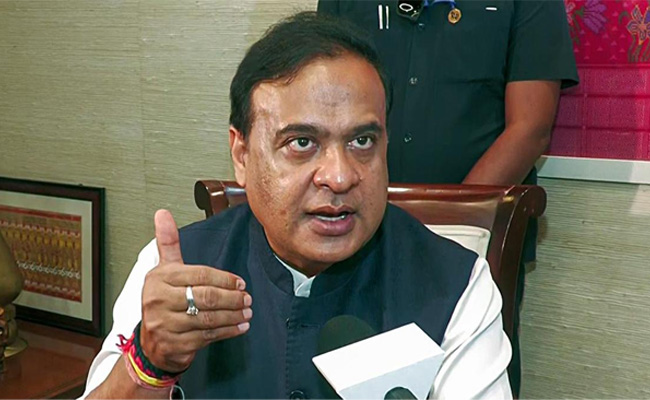
Guwahati (PTI): Assam Chief Minister Himanta Biswa Sarma on Wednesday resigned along with his cabinet colleagues, paving the way for formation of a new government led by the BJP, officials said.
The BJP-led NDA bagged 102 seats in the 126-member assembly. The assembly elections were held in a single phase on April 9, and counting of votes took place on May 4.
"Following the formal notification of the results of #AssamElections2026 and to enable the formation of the new government, Dr @himantabiswa tendered his resignation as Chief Minister along with that of the council of Ministers to Hon'ble Governor Shri @Laxmanacharya54 today at Lok Bhawan," the Chief Minister's Office said in a post on X.
ALSO READ: 11-year-old dies by suicide after sexual assault in Bareilly; accused arrested
The Governor has accepted the resignation, and requested Sarma to continue as the caretaker CM till the new government assumes office, it said.
Later, speaking to reporters outside the Lok Bhawan, Sarma said the oath-taking ceremony is likely to take place after May 11.
“As it was a historic win, we have invited Prime Minister Narendra Modi to grace the occasion," he said.
The new Assam chief minister will be selected at a meeting of the BJP legislature party in presence of central observers, Sarma said.