Powerful explosion in Dhaka kills seven, injures hundreds; police suspect gas leak
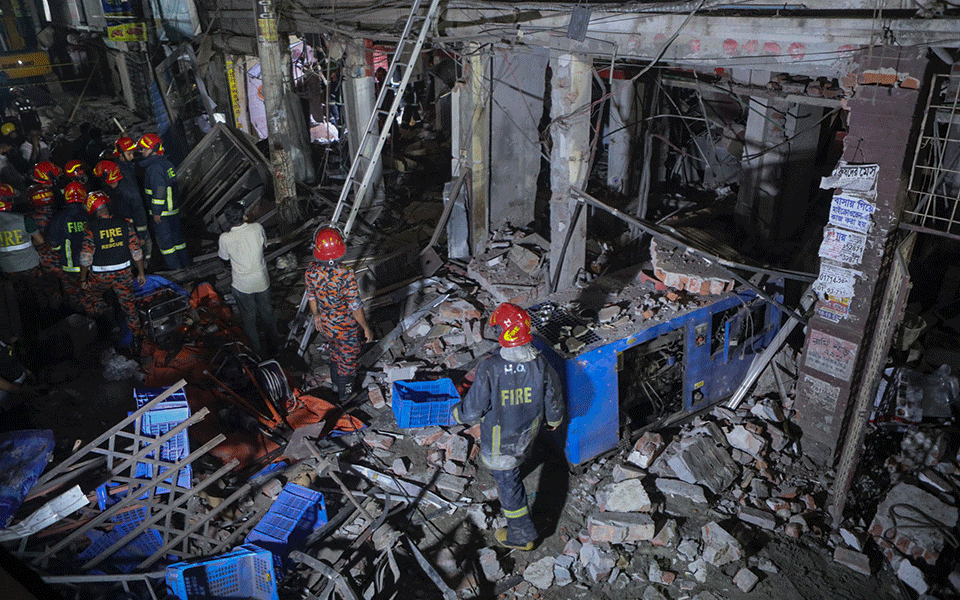
Dhaka: A powerful explosion that destroyed an old three-storey building in a crowded area here in Bangladesh's capital and killed at least seven people and injured around 400 others may have been caused by a faulty gas line or gas cylinders, authorities said on Monday.
Police have ruled out any foul play behind the horrific explosion in Moghbazar area at around 7.30 PM on Sunday and said the initial investigation of the site suggests that the explosion might have been caused by "gas accumulation".
Authorities suspect the building that collapsed was the epicentre of the explosion as it had a restaurant and a faulty gas line or gas cylinders used by it could be the reason behind the blast.
The blast was so powerful that the shock wave smashed the glasses of nearly a dozen buildings around it.
Seven nearby buildings and two passenger buses were badly damaged in the blast that killed seven people and injured 400, some 50 of them critically, Dhaka Metropolitan Police Commissioner Shafiqul Islam said late Sunday.
The severely injured were sent to Dhaka Medical College Hospital and Sheikh Hasina National Institute of Burn and Plastic Surgery.
The Dhaka Community hospital treated almost 300 victims, AZM Rahmatullah Shabuj, outdoor in charge of the hospital, said, adding that they treated victims who mostly had cuts in their bodies or their heads.
Most of them had cuts from the glass shards. Many had wounds in their heads, Sabuj said.
On the possibility of the explosion being deliberate, the Police Commissioner told bdnews, It doesn't look like that to me. If that was the case or had a bomb been exploded, people would've been ravaged by splinters."
I've gathered from the fire service personnel that gas had accumulated here," he said.
Fire Brigade chief Brigadier General Sajjad Hossain said primary evidence suggested that the explosion was triggered by a leak after the accumulation of gas.
There were gas cylinders at a restaurant at the ground floor of the building and air-conditioners at a showroom upstairs. There were gas cylinders also at the road construction site at the scene...investigations have been launched, Hossain said.
According to residents in the neighbourhood, the explosion rocked the part of the city spreading panic while television footage showed broken pillars, concrete and glass shards strewn across the street at the scene in the central part of the country's capital.
I was on a bus when the explosion occurred. I jumped out of it through a narrow window of the vehicle, initially thinking the bus gas cylinder exploded... never experienced such a big explosion in my life, 50-year-old Tajul Islam, who received injuries on his waist and complained of hearing impairment due to the explosion, told PTI.
Another witness said he saw a fireball go over his head and the explosion turned everything dark and smoky in his vicinity while pieces of glass started to shower from above.
The sound was so huge... it scared everyone, he told a TV channel.
According to witnesses, soon after the explosion the buses and cars crashed into one another and panic-gripped passengers struggled to get out of the vehicles.
Several residents of an apartment building in the area came downstairs following the explosion.
One of them, Mufakar Ul Islam, added: We are at a distance here. Still, several glasses of our apartment were shattered."
Let the Truth be known. If you read VB and like VB, please be a VB Supporter and Help us deliver the Truth to one and all.
Two injuries, one DNF, a DQ as India end messy World Relays campaign
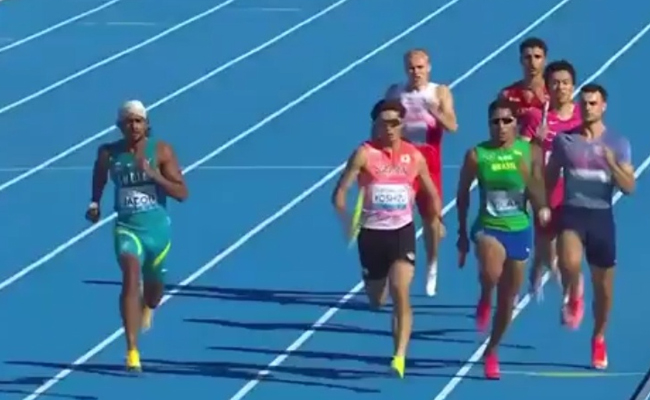
Gaborone (Botswana) (PTI): Amoj Jacob and Ragul Kumar got injured during the men's 4x400m and 4x100 races respectively as India ended their World Athletics Relays campaign in disappointment on the second day of competitions here on Sunday.
The Indian camp had high hopes of making the 2027 World Championships in the men's 4x400m relay but the team did not finish (DNF) the race as Jacob suffered cramps and pulled out of the race after taking the baton from the first leg runner Dharamveer Choudhary. Rajesh Ramesh and Vishal TK were to run in the third and fourth legs.
Those teams which could not qualify for the 2027 Beijing World Championships by reaching the final round of each of the six relay events on Saturday were given another chance in the second qualification round on Sunday.
The top two teams in each of the two heats (in all six relay events) booked the Beijing ticket on Sunday.
India will now have to try and qualify for the World Championships through the Top Lists of the World Athletics, which is a long and tedious process.
In the men's 4x100m race, third leg runner Ragul Kumar fell down the track after failing to hand over the baton inside the exchange zone to fourth leg runner Gurindervir Singh, which clearly showed the lack of coordination among the runners.
Harsh Santosh Raut and Animesh Kujur ran the first two legs.
The Indian quartet was disqualified and Kumar was seen being taken away from the Field of Play with the help of the volunteers.
It was a comedy of errors in the case of the women's 4x100m race, which saw the baton being dropped during an exchange between first leg runner Tamanna and second runner Nithya Gandhe, though the Indians finished the race in 53.09 seconds.
Gandhe started running quite a distance, but after realising that the baton was not in her hand, she turned and ran back to pick it up.
The only silver-lining for the Indian contingent was the national record time in the mixed 4x100m relay race, though the quartet of Ragul Kumar, Nithya Gandhe, Animesh Kujur and Sneha SS finished sixth in heat number two with a time of 41.35 seconds, bettering the previous national mark of 42.30 seconds set in March in Chandigarh.
The mixed 4x400m relay quartet of Theerthesh P Shetty, Kumari Saloni, Nihal William and Rashdeep Kaur ended at fifth in heat number one with a time of 3 minutes and 19.40 seconds.
On Saturday, all the five Indian relay teams had failed to make it to the respective final rounds and thus missed out on the 2027 World Championships berths.