President Gotabaya flees Sri Lanka amid public revolt against his govt for mishandling economy
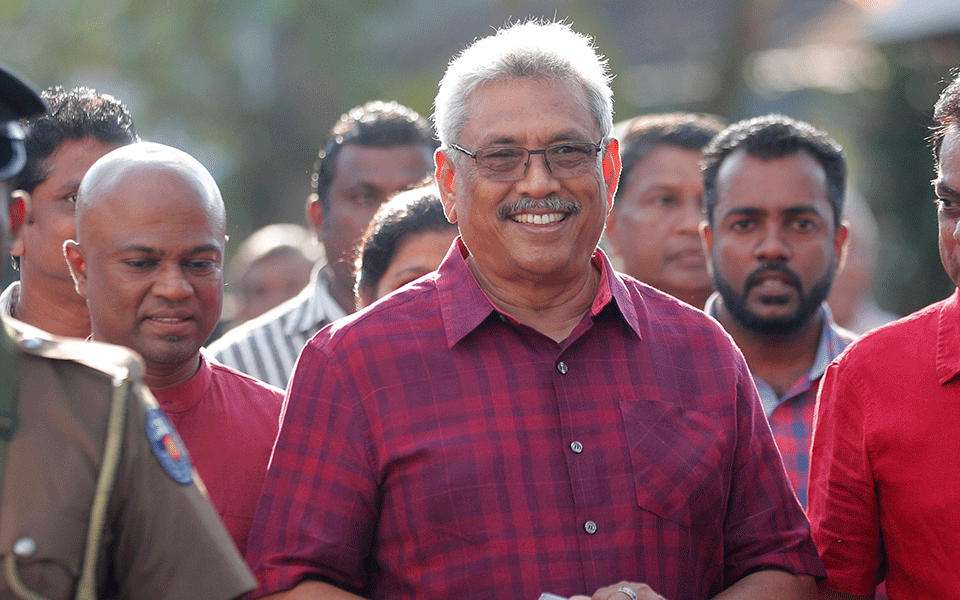
Colombo(PTI): Sri Lanka's embattled President Gotabaya Rajapaksa on Wednesday fled to the Maldives on a military jet, hours before he was supposed to step down in the face of a public revolt against him and his family for mishandling the economy that has bankrupted the country.
The 73-year-old leader fled the country along with his wife and two security officers on a military jet, a brief statement from the Sri Lanka Air Force said.
"On government request and in terms of powers available to a President under the Constitution, with complete approval from the ministry of defence, the President, his wife and two security officials were provided a Sri Lanka Air Force plane to depart from the Katunayake international airport for the Maldives in the early hours of July 13," the statement said.
The Prime Minister's Office also confirmed that the President had left the country.
Rajapaksa, who enjoys immunity from prosecution while he is president, is believed to have wanted to flee abroad before resigning to avoid the possibility of arrest by the new government.
On Saturday, Rajapaksa had announced to step down on Wednesday after thousands of protesters stormed his official residence, blaming him for the unprecedented economic crisis that has brought the country to its knees.
He arrived in the capital of the Maldives, Male, at around 03:00 local time (22:00 GMT), BBC reported.
He was received by a Maldivian government representative at the Velana airport and taken to an undisclosed location under police escort, sources said, quoting Maldivian officials.
Rajapaksa is expected to be in the Maldives on transit before flying to another destination which is yet to be known, the Daily Mirror online reported.
However, the immigration officials confirmed that his younger brother and former finance minister Basil Rajapaksa did not leave the country last night.
Citing sources, BBC earlier reported that Basil has also left the country.
Basil, the 71-year-old leader who is being widely held responsible for the country's worst economic crisis which has heaped misery on the people, is a US passport holder.
On Monday night, both Rajapaksa and his brother Basil were turned back at the Colombo airport as they attempted to leave the country amid mounting anger against the powerful family for mishandling the island's worst economic crisis.
They were prevented from leaving by immigration officials who withdrew from desks saying their personal safety would be under threat by allowing corrupt officials to leave the country in the face of the current popular uprising.
Commenting later, the immigration officials said they have no powers to prevent a President from leaving the country.
Basil resigned as finance minister in early April as street protests intensified against shortages of fuel, food and other necessities and quit his seat in parliament in June.
President Rajapaksa had informed both Speaker of Parliament Mahinda Yapa Abeywardena and Prime Minister Ranil Wickremesinghe that he will resign on July 13.
Abeywardena was expected to publicly announce President Rajapaksa's resignation to the nation on Wednesday.
Prime Minister Wickremesinghe has already said he was willing to resign and make way for an all-party government to take over.
Sri Lanka's political parties have stepped up efforts to form an all-party government and subsequently elect a new President on July 20 to prevent the bankrupt nation sliding further into anarchy.
A meeting was held early this week between the main opposition Samagi Jana Balavegaya (SJB) and former president Maithripala Sirisena's Sri Lanka Freedom Party (SLFP).
Parties have begun campaigning for the support of possible candidates. The SJB said they will campaign for the appointment of Sajith Premadasa as the interim President.
Premadasa said on Monday that his party was ready to lead the country at the presidential and prime ministerial level and develop the economy.
Under the Sri Lankan Constitution, if both the president and prime minister resign, the Speaker of parliament will serve as acting president for a maximum of 30 days.
The Parliament will elect a new president within 30 days from one of its members, who will hold the office for the remaining two years of the current term.
The political uncertainty prevails in Sri Lanka where the distribution of cooking gas has resumed alongside the delivery of fuel to retailers by the Indian Oil Company after a stoppage on Sunday. Long queues are still seen at fuel pumps.
The protesters continue to occupy the three main buildings in the capital, the President's House, the presidential secretariat and the prime minister's official residence, Temple Trees, calling for their resignations.
Sri Lanka, a country of 22 million people, is under the grip of an unprecedented economic turmoil, the worst in seven decades, leaving millions struggling to buy food, medicine, fuel and other essentials. Prime Minister Wickremesinghe last week said Sri Lanka is now a bankrupt country.
Let the Truth be known. If you read VB and like VB, please be a VB Supporter and Help us deliver the Truth to one and all.
3 women die after giant tree falls on them in Odisha’s Koraput
Koraput (PTI): Three women died and another was injured after a giant tree fell on them following thunderstorms in Odisha’s Koraput district, police said on Tuesday.
The incident took place on Monday evening when they were in a market at Pedabayalu in Nandapur block near the Andhra-Odisha border.
The tree was uprooted due to strong winds amid rain and thunderstorms, a police officer said.
Two women died on the spot and another in hospital, he said.
Nandapur BDO Durga Prasad Dora and MLA Rama Chandra Kadam visited the spot, and assured the victims’ families of government support.