President unveils Mahatma Gandhi's bronze statue in Australia
Melbourne, Nov 22 : President Ram Nath Kovind on Thursday unveiled a bronze statue of Mahatma Gandhi in the Australian city of Sydney and said his powerful message of non-violence and peaceful coexistence is relevant in these times of strife.
Marking the ongoing celebrations of the 150th anniversary year of the Mahatma along with Australian Prime Minister Scott Morrison, Kovind said it was an honour for him to unveil the statue as the legend belonged to the entire world.
Kovind, the first-ever Indian head of state to visit Australia, arrived in Sydney on Wednesday on the second leg of his two-nation trip. During the first leg, he visited Vietnam.
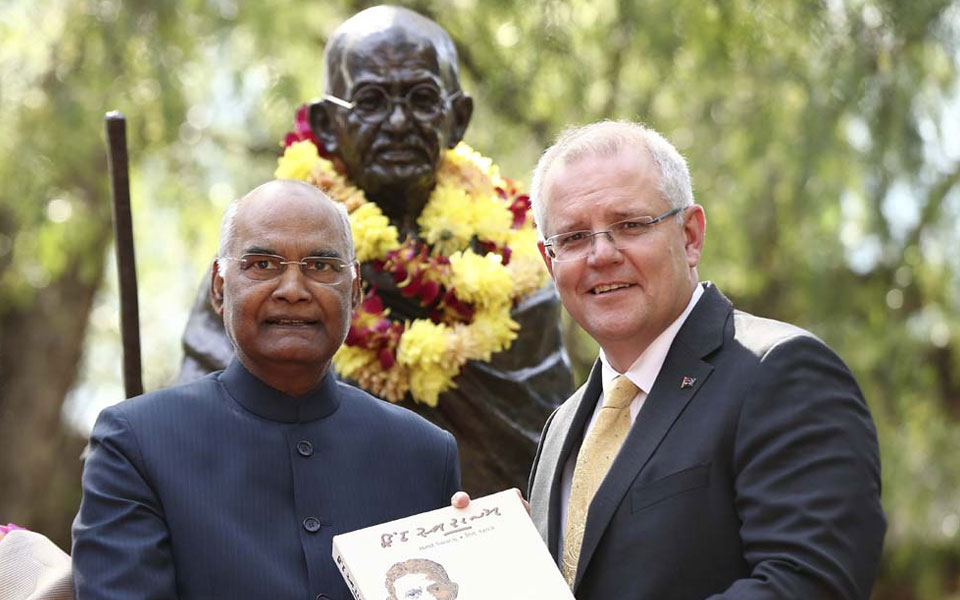
Two photographs posted by the official Twitter handle of the President of India showed the striking bronze statue garlanded with flowers.
In one of the photographs, President Kovind, First Lady Savita Kovind, Australian Prime Minister Scott Morrison and Mayor of Paramatta Andrew Wilson were seen in front of the statue.
Members of Indian community were also present at the event and raised slogans of "Bharat Mata Ki Jai" and "Vande Matram".
Acknowledging the presence of Premier Morrison, Kovind said, "This initiative has a very special meaning to help spread Mahatma Gandhi's legacy and timeless message across the world."
"His universal teachings have a special resonance in all corners," he said.
Kovind said Gandhi and the Australian society struck a common cord as he too was a strong supporter of multi-cultural ethos, like Australia. He said Gandhi's message of non-violence and peaceful coexistence stands all the more relevant in these times of strife.
"As a country which is home to people from every part of the world, Mahatma Gandhi's legacy cannot be more relevant to its values and ethos," Kovind said before unveiling the statue.
Let the Truth be known. If you read VB and like VB, please be a VB Supporter and Help us deliver the Truth to one and all.
Brothers awaiting board exam results drown in canal
Erode (Tamil Nadu) (PTI): Minor brothers who were awaiting their board exam results have drowned in a canal in this district while spending their Summer holidays at their aunt's place, police said.
According to Arachalure Police, Santhosh, aged 17, and his younger brother Sanjai, aged 15, natives of Musiri village in Tiruchirapalli district, came to Gopaliparai hamlet near Arachalure to their Aunt's house a couple of days ago after writing their annual 12th and 10th examinations, respectively.
The police said on Friday that both boys went to the nearby Lower Bhavani Project canal to take a bath. It was alleged that while taking a bath, both boys went to a deeper area of the canal and went missing.
As they didn't return home, even two hours after they left, their aunt grew suspicious and informed the Fire and Rescue Services, Chennimalai. A rescue team from the department rushed to the spot. After a few minutes of searching, they located the dead bodies of the brothers and sent them to the hospital. Arachalure police registered a case of death due to drowning and are investigating.