President Wickremesinghe invites Sri Lankan parties to form national government
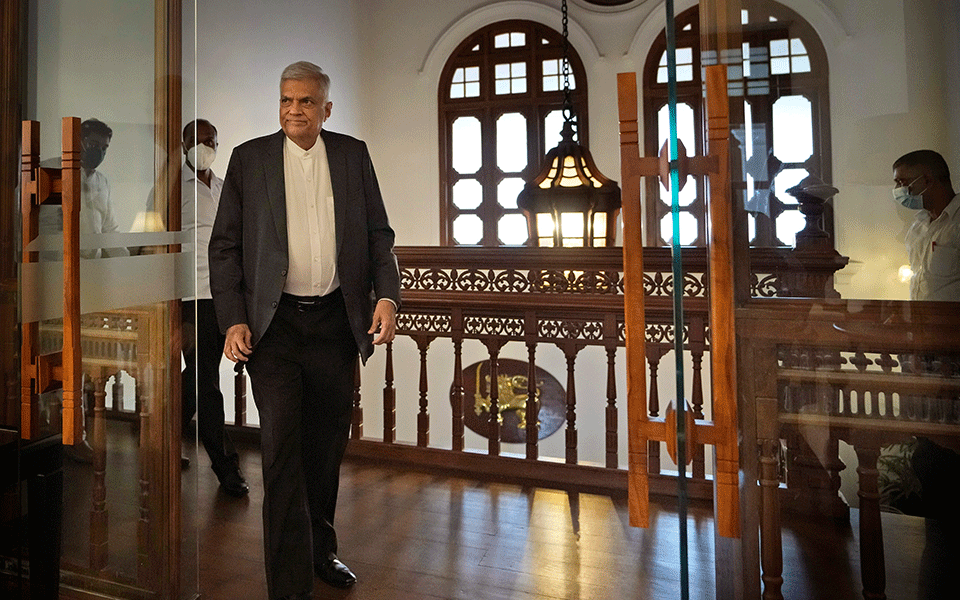
Colombo(PTI): Sri Lankan President Ranil Wickremesinghe has written to members of Parliament, inviting them to form an all-party national government to help the bankrupt country to recover from the worst economic crisis.
The government is currently engaged in great efforts to gradually restore normalcy to the political and social unrest created by the economic crisis that the country is facing today," Wickremesinghe said in the letter on Friday.
"Accordingly, initial plans required to implement a systematic economic programme are being formulated while preliminary measures are also being undertaken for the creation of economic stability, he added.
Wickremesinghe said a programme could only be implemented with the participation of all political parties represented in Parliament, expert groups and civil society.
He also proposed to start a dialogue with parties on the reintroduction of the 19th Amendment to the Constitution.
The 19A adopted in 2015 pruned presidential powers by empowering Parliament above the executive president. Wickremesinghe was the main sponsor of the 19th Amendment in 2015.
However, the 19A was scrapped after Gotabaya Rajapaksa won the November 2019 presidential election.
Sri Lankan MPs on July 20 elected Wickremesinghe as the country's new president, with the majority of the vote coming from lawmakers representing ousted President Rajapaksa's Sri Lanka Podujana Peramuna (SLPP) party.
There were only two non-SLPP lawmakers in the Cabinet appointed on Friday. Constitutionally, the Cabinet can be extended up to 30 members.
The 73-year-old President was appointed for the rest of the term of Rajapaksa who initially fled to the Maldives and then to Singapore.
Rajapaksa is accused of mishandling the economic crisis, the worst since 1948. Wickremesinghe was appointed prime minister by Rajapaksa in mid-May.
He was tasked with reviving the economy by giving early solutions to fuel, cooking gas and power shortage problems, which triggered mass agitations against Rajapaksa.
The government declared bankruptcy in mid-April by refusing to honour its international debt.
Wickremesinghe on Wednesday said his government's main priorities are to fix the country's ailing economy and end the severe fuel shortage that has exacerbated after the last shipment under the Indian credit line arrived in the country in June.
Let the Truth be known. If you read VB and like VB, please be a VB Supporter and Help us deliver the Truth to one and all.
Delhi: Teenager slashes boy for refusing money for drugs; held

New Delhi (PTI): A 16-year-old boy has been apprehended for allegedly attacking a teenager with a paper cutter near the Red Fort area last month after the victim refused to give him money for drugs, an official said on Tuesday.
The juvenile, who had been absconding after the incident, was also found to be involved in another attempt to murder case registered at Jama Masjid police station, they said.
The case came to light on April 5 when police received information from LNJP Hospital about a 17-year-old boy, a resident of Nangloi, who had been admitted with serious injuries.
The victim had sustained sharp wounds on his neck and abdomen and was unfit to give a statement, the police said.
Preliminary inquiry revealed that the victim quarrelled with an unidentified boy at Parade Ground near the Red Fort, following which he was attacked. A case under relevant sections of the BNS was registered.
A team was constituted to trace the accused, which analysed CCTV footage from the area and identified a suspect seen fleeing the spot. The boy was later identified with the help of local intelligence as a vagabond frequenting the Chandni Chowk area, police said.
Despite multiple raids in Delhi and adjoining areas, the accused remained untraceable. Subsequently, his mobile number was tracked, and technical surveillance led police to Haridwar in Uttarakhand.
On April 29, the police team conducted a raid in a village in Haridwar and apprehended the juvenile after sustained efforts, an officer said.
During questioning, the accused disclosed that he had been living in the Chandni Chowk area for the past two years and was addicted to drugs. On the night of April 4, he allegedly got into an argument with the victim after the latter refused to give him money and slapped him. Enraged, he attacked the boy with a paper cutter, inflicting multiple injuries.
The police said the accused later attacked another person near the Jama Masjid Metro Station on the same night before fleeing to Haridwar.
He also disposed of the weapon and clothes by throwing them from a moving train to evade arrest, they said.
Further investigation is underway, they added.